
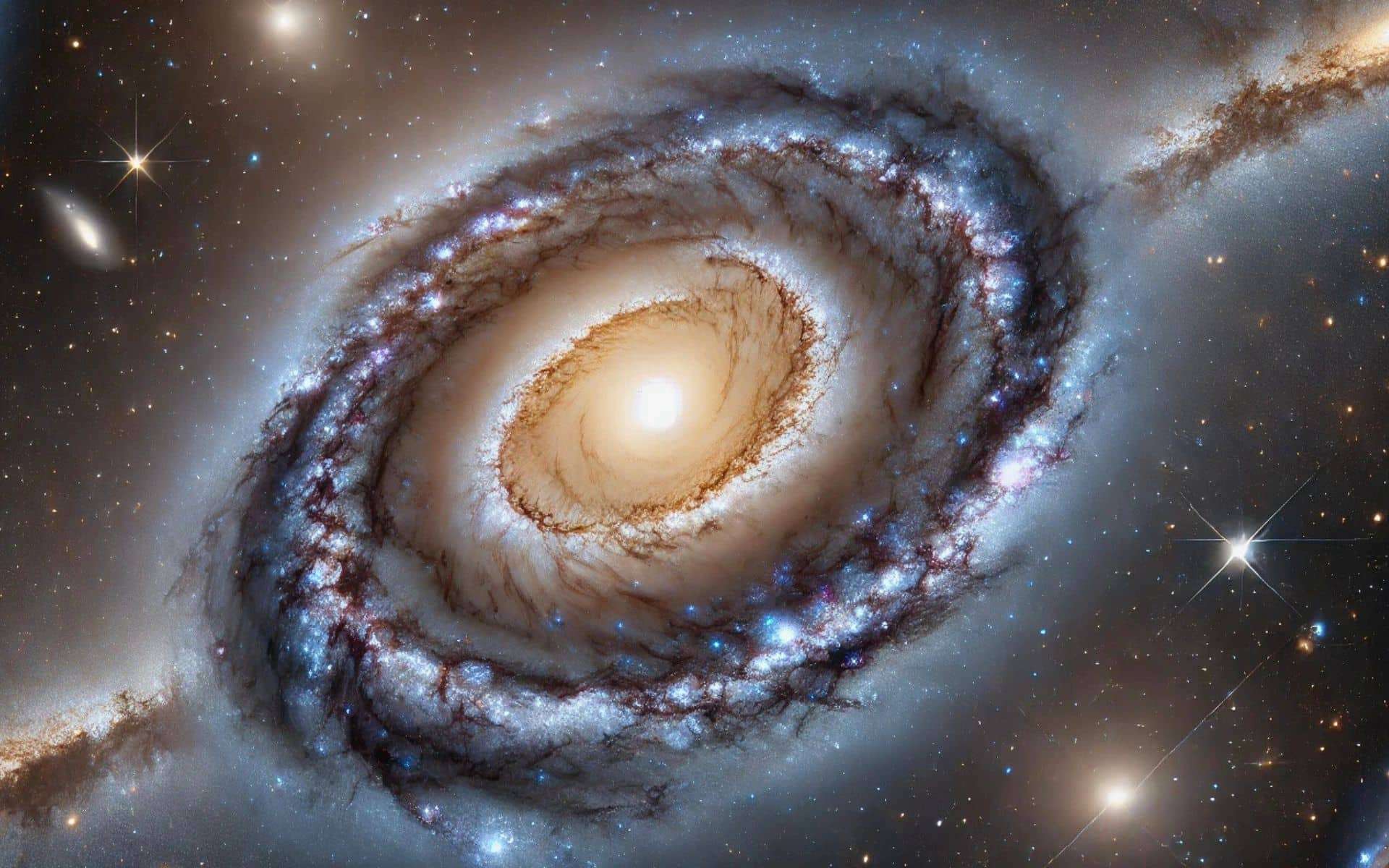
Dark matter, constituting about 85% of all matter in the cosmos, has remained undetected for decades. A new study proposes that neutron stars could serve as ideal cosmic laboratories to help reveal this long-standing mystery.
Axions: Mysterious Candidates for Dark Matter
In the ongoing hunt for dark matter, scientists have turned their attention to a curious particle called the axion. Initially theorized in the 1970s to address issues within the Standard Model of particle physics, axions are incredibly light and weakly interacting particles.
These traits make them extremely difficult to detect directly, yet they remain promising contenders for explaining dark matter. The particle’s name, inspired by a popular cleaning detergent, alludes to its potential role in resolving perplexing inconsistencies in physics.

Recent renewed interest in axions arises from their properties, which nearly match the required characteristics for dark matter: invisibility and minimal interaction with ordinary matter. Should they exist, axions could explain the gravitational phenomena attributed to dark matter, from galaxy formation to the cosmic web’s structure.
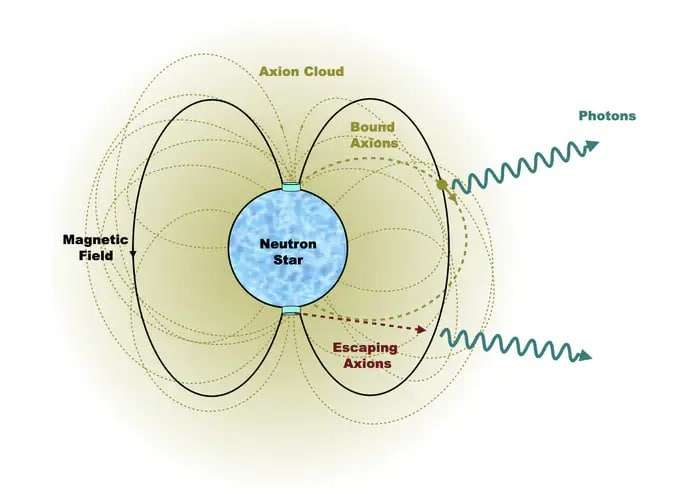
Neutron Stars: Nature’s Most Intense Particle Enclosures
Neutron stars are dense stellar remnants formed from massive stars following supernova explosions. Packing around 1.4 times the Sun’s mass into a sphere roughly 12–25 miles wide, these objects are among the universe’s most compact.
Their magnetic fields rank among the most powerful known, billions of times stronger than Earth’s magnetic field.
What makes neutron stars particularly relevant for dark matter detection? Researchers from Amsterdam, Princeton, and Oxford Universities suggest these stars create unique conditions to detect axions.
Their recent publication in Physical Review X dated October 17, 2024, outlines how neutron stars might trap axions and convert them into detectable light emissions.
Gravitational Capture of Axions
Earlier work from the team in October 2023 prioritized locating axions that escaped neutron stars. The new analysis turns its attention to those axions bound by the star’s gravitational field.
Neutron stars’ extreme density and gravity could cause them to accumulate axion clouds over millions of years. Unlike black holes, which swallow axions completely due to intense gravity, neutron stars maintain a gravitational force that allows axions to cluster without being absorbed.
This phenomenon could result in dense axion clouds surrounding neutron stars, offering a rare observational gateway.
Converting Axions into Detectable Light
Axions are theorized to transform into photons—or light particles—when subjected to intense magnetic fields. Neutron stars’ extreme magnetism could enable this conversion. While individual axions emit negligible light, a sufficiently large cloud could produce signals visible to current telescope technology.
Scientists propose two detection possibilities: a continuous glow from the neutron star’s surface during its lifetime, or a sudden, intense burst of light associated with the star’s collapse at life’s end.
Advancing the Quest to Understand Dark Matter
Though axion clouds have not yet been observed, researchers now possess refined strategies to search for them. Confirming axions would not only prove their existence but also dramatically progress our grasp of cosmic mysteries.
This innovative approach brings hope for finally shedding light on one of the universe’s most profound secrets. A successful detection could revolutionize astrophysics by filling a critical gap in our cosmic knowledge.








0 comments
Sign in to Comment