

Scientists have obtained striking images showcasing a spiral-shaped jet streaming from a distant neutron star, shedding light on the extreme forces shaping these cosmic phenomena.
Unveiling the Spiral Jet Formation
Researchers have, for the first time, detected a spiral-like jet originating from the neutron star in the binary system Circinus X-1, located more than 30,000 light-years away. This neutron star emerged from the collapsed core of a massive supergiant star that met its fate around the period Stonehenge was constructed.


The captured image, obtained via South Africa’s MeerKAT radio telescope, reveals how the jet’s distinctive shape results from the wobbling motion—known as precession—of the neutron star’s orbiting hot gas disk. While this behavior has been observed in jets from black holes, it marks the first confirmed case involving a neutron star. These jets propel matter swiftly and tightly, stretching beyond five light-years, though they appear minuscule, like a coin seen from 100 meters away.
Distinctive Traits of Circinus X-1
Neutron stars arise as the ultra-dense remnants left behind after massive stars undergo supernovae. Just a teaspoon of their matter would weigh as much as Mount Everest. Circinus X-1’s neutron star is gravitationally paired with a companion star in a binary system.
Its intense gravity siphons gas from the companion star, creating a swirling disk of hot plasma that spirals inward. This accretion process unleashes vast energy—surpassing a million times the Sun’s output—and fuels the observed jets.
Recent enhancements to the MeerKAT array have dramatically improved its sensitivity and image resolution, enabling scientists to clearly document the S-shaped jet structure in Circinus X-1. These findings were shared at the National Astronomy Meeting held at the University of Hull.
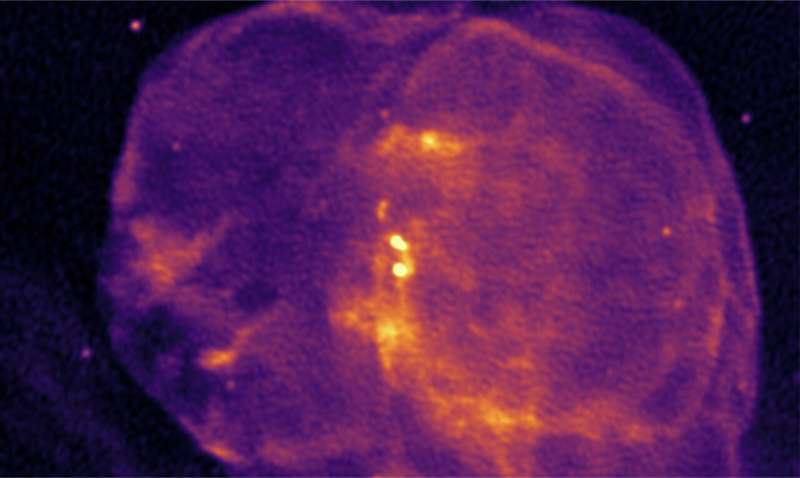
Fraser Cowie, leading the research from the University of Oxford, remarked, “This image offers the first compelling proof of a precessing jet in a confirmed neutron star, apparent through the jet’s symmetric S shape and the rapid, broad shockwave that only a changing jet direction can generate.”
Importance of the Spiral Jet Observation
Spotting the S-shaped jet is a breakthrough because it confirms the presence of jet precession in neutron stars—a phenomenon until now only associated with black holes. The precessing jet seen in Circinus X-1 opens a window into the intense physics at play when jets are launched.
MeerKAT’s high-resolution imaging also tracked dynamic termination shocks—areas where the jet clashes with surrounding material, creating energetic shockwaves. These shocks serve as natural particle accelerators, producing cosmic rays with substantial energy. Measuring speeds of these shocks, nearly 10% of light’s pace, grants deeper insights into the jet’s composition and dynamics.
Highlighting the significance, Fraser Cowie said, “Circinus X-1 is among the brightest X-ray sources studied for over fifty years, yet it continues to puzzle scientists. Uncovering fresh details about its behavior, especially with decades of prior research, is incredibly gratifying.”
Impact on Neutron Star Research
The tremendous density of the neutron star generates powerful gravity that draws gas from its partner, forming a hot gas disk funneling toward its surface. This accretion unleashes tremendous energy, some of which powers jets travelling close to light speed.
The jet’s precession informs scientists about the dynamic interplay within the neutron star system, revealing how interactions between the star and its accretion disk produce such extraordinary phenomena.
“The broad angle covered by the shockwaves aligns well with our models,” Cowie explained. “This gives us two robust indicators that the neutron star’s jet is indeed precessing.” This confirmation plays a key role in refining models of jet development and activity in neutron star environments, allowing deeper understanding of the extreme conditions defining these cosmic accelerators.
Continued Monitoring and Future Prospects
The research team is committed to ongoing observation of Circinus X-1’s jets to detect any changes matching their predictions. This continued study promises to yield more accurate data on jet traits and deepen comprehension of the driving mechanisms behind these exceptional cosmic structures.
As investigations continue, the knowledge gained will expand understanding of neutron stars and the processes forming jets in harsh astrophysical contexts. “Our next phase focuses on tracking jet evolution over time to better measure their characteristics and unravel more about this intriguing system,” Cowie concluded.
The Circinus X-1 project is integrated within larger initiatives such as X-KAT and ThunderKAT on the MeerKAT telescope, run by the South African Radio Astronomy Observatory. These programs focus on exploring diverse astrophysical phenomena using cutting-edge radio astronomy.
Through these sustained observations and analyses, astronomers aim to assemble a clearer picture of neutron star dynamics and jet physics, furthering our grasp on some of the universe’s most powerful and mysterious objects.
- Categories:
- Astronomy ,
- News ,
- Space












0 comments
Sign in to Comment