
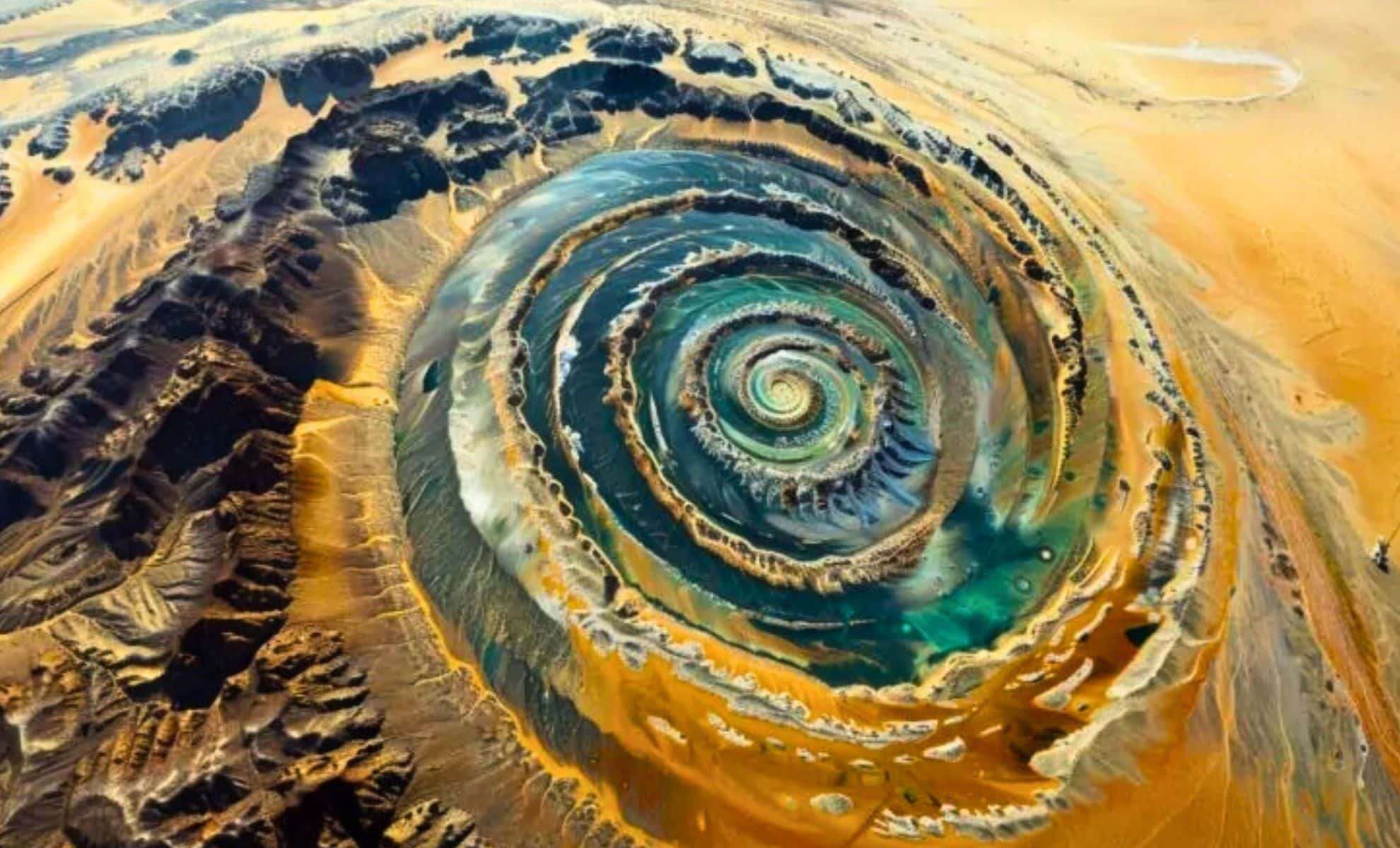
Situated in the heart of the Sahara Desert, the massive circular formation known as the Richat Structure or Eye of Africa stretches across nearly 50 kilometers, captivating observers with its striking concentric rings.
This remarkable geological phenomenon has attracted scientific curiosity for decades and serves as a critical landmark for astronauts pinpointing their position in orbit. Its near-perfect circular shape has sparked numerous hypotheses about its formation.
Across years of investigation, proposed explanations ranged from a meteorite collision to eruptive volcanic activity. Yet, none sufficiently explained its unique characteristics until a collaborative study by researchers from France and Mauritania provided new insights dating back hundreds of millions of years.

An Iconic Formation Visible from Orbit
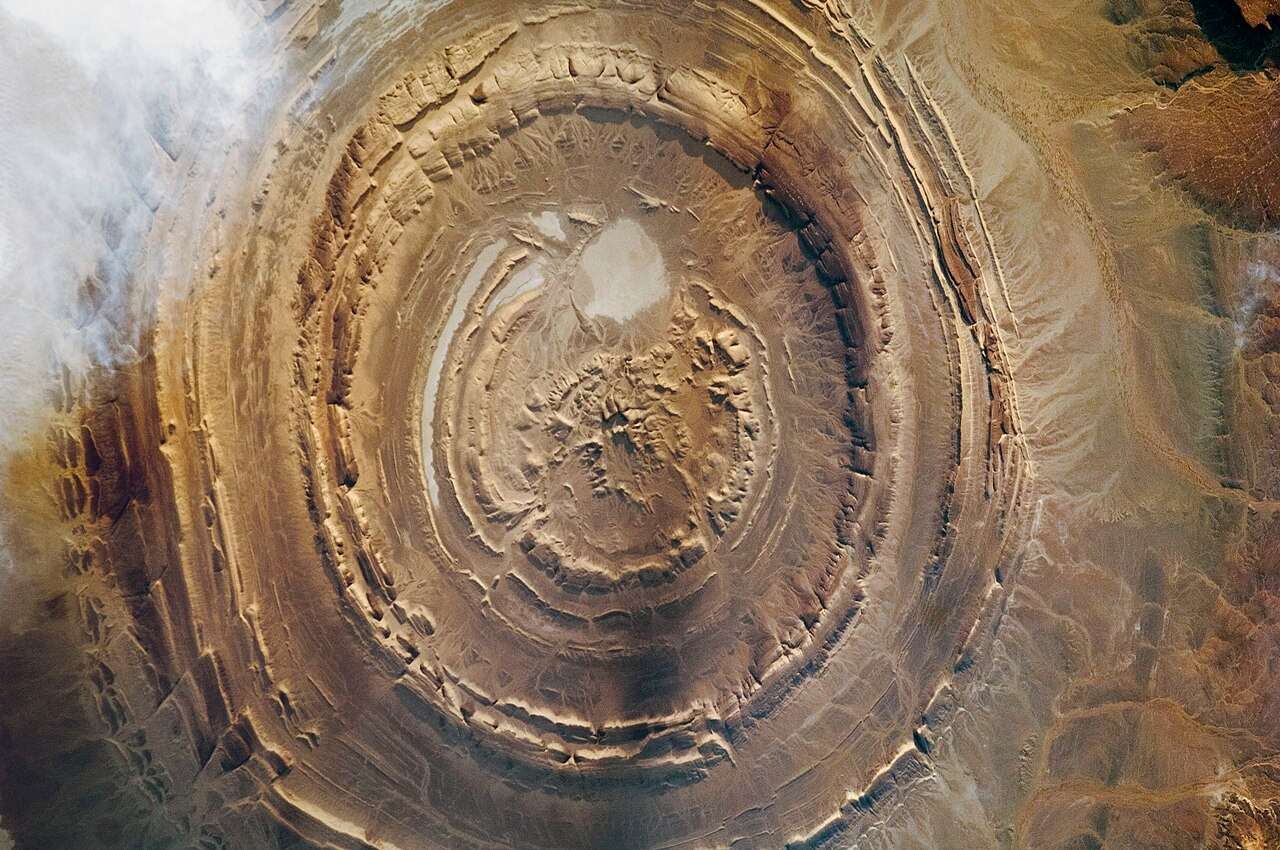
The Eye of Africa ranks among Earth's most prominent natural structures, located within Mauritania. Its symmetrical rings stand out vividly against the undulating Sahara dunes, making it a familiar sight even from the International Space Station (ISS), where astronauts use it for orientation.
This distinct pattern inspired numerous theories, from catastrophic natural disasters to connections with the mythical city of Atlantis. However, the actual origin, though less fanciful, highlights the power of geological forces shaping the landscape over immense time spans.
Unraveling the Geological Mystery
Initial hypotheses attributed the Richat Structure to a meteorite impact because of its circular design. However, no impact-specific minerals such as shocked quartz or evidence of melted rock were identified. Another suggestion was that it was a collapsed volcanic caldera, but the absence of volcanic rocks contradicted this idea.
More recent research published on Sciencedirect reveals a more gradual and complex origin involving magma intrusion, tectonic uplift, and persistent erosion rather than a sudden catastrophic event.
The Gradual Formation of a Geological Marvel
The genesis of the Richat Structure traces back about 100 million years to the epoch marking the fragmentation of the supercontinent Pangaea. Tectonic dynamics remodeled Earth's crust, forcing magma upwards that lifted the sedimentary layers into a massive dome.
Unlike volcanic eruptions, this magma did not breach the surface. Instead, wind and water erosion gradually stripped away layers of varying hardness, sculpting the striking concentric rings we observe today.
The alternating erosion resistance of rock strata explains the well-defined circular ridge pattern that defines the Eye of Africa.
A Glimpse into Earth’s Ancient Geological History
More than a stunning natural formation, the Richat Structure is a geological archive chronicling Earth's distant past. Some rock formations within it date back approximately 2.5 billion years, offering critical information about the ancient continental crust. Its composition includes a blend of quartzite, sandstone, and remnants of volcanic activity, each stratum revealing clues about historical environmental conditions.
Research indicates that millions of years ago, this currently arid zone was once dotted with lakes and rivers, possibly facilitating early life forms. While it is now a vast desert, traces of ancient water-related geological features hint at a once more hospitable environment.
Dispelling the Atlantis Connection
Due to its distinctive concentric rings and location in North Africa, the Richat Structure has sometimes been romantically linked to Plato’s myth of Atlantis. Some proponents argue the geological layout matches descriptions from the legend.

Nonetheless, scientific consensus refutes these claims. The structure is entirely natural, lacking any indication of human construction or artificial manipulation. While the formation fuels imaginative theories, the Eye of Africa remains a marvel of natural geological evolution, not a relic of ancient civilizations.
A Geological Treasure to Protect
Despite its remote setting, the Eye of Africa continues to attract geologists, explorers, and nature enthusiasts eager to experience its grandeur. Its scientific importance paired with visual uniqueness ranks it among Earth’s most extraordinary natural landmarks.
With climate change and growing human pressures threatening natural environments, conserving geological gems like the Richat Structure is crucial. It stands as a powerful reminder of Earth's dynamic history and the formidable natural forces that sculpt our planet.











0 comments
Sign in to Comment