
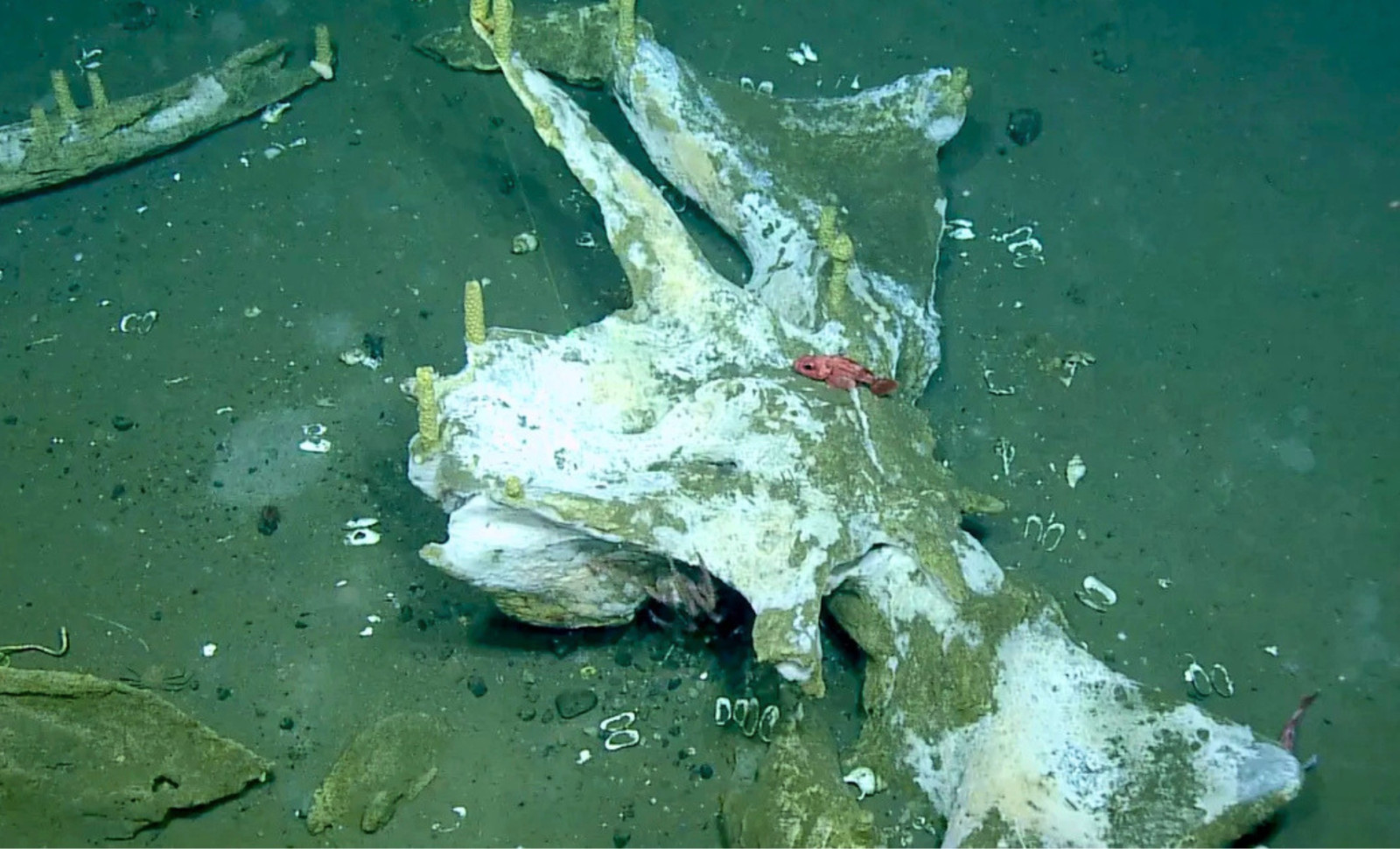
Back in 2009, a team of researchers exploring the Clayoquot Slope near Vancouver Island discovered a massive whale skeleton lying on the ocean floor. Most of its soft tissues had long decomposed. Positioned at an imposing depth of 1,288 meters, this find offered scientists a unique opportunity to observe the ecological succession over time. Returning repeatedly over 15 years, they documented the remarkable persistence of this deep-sea habitat, as detailed in a study published by Frontiers in Marine Science.
The whale, most likely a blue or fin species, had already passed through the initial decomposition phases when found. This investigation centers on the prolonged third phase known as the sulphophilic stage. Intriguingly, this stage has endured for over 21 years and is expected to continue for another decade, defying earlier assumptions about its duration.
“A major breakthrough,” explained Fabio De Leo from the University of Victoria, “was employing high-precision photogrammetry to revisit the exact skeleton location and document its condition with centimeter-level accuracy.”

Minimal Bone Degradation Detected Over Eleven Years
The collaborative team from Ocean Networks Canada and the University of Hawaii at Manoa used remotely operated vehicles to revisit the site on four occasions between 2012 and 2024. They created detailed 3D models from video surveys, enabling precise measurement of bone erosion.
The whale’s skull and 23 tail vertebrae largely remained intact. From 2012 to 2023, vertebrae length decreased by just 1.4 percent on average. The jawbones displayed slightly more wear, with one fragment shrinking by 7.8 percent. According to the authors in Frontiers in Marine Science, these bones are projected to endure for at least another ten years.
While bone decay was minimal, the species composition on the skeleton shifted over time. Initially in 2009, Osedax worms, known as zombie worms, colonized the bones. By the last survey, however, none were observed. Scientists suggest these worms either exhausted their food sources or were displaced by expanding microbial mats. Subsequently, a diverse sulphophilic assemblage developed, including 33 vestimentiferan tube worms (Lamellibrachia cf. barhami), living vesicomyid clams, provannid gastropods, and over 100 empty clam shells.
Bacterial Mats Intensify With Time
The sulphophilic phase depends on bacteria that metabolize lipids within the bones, producing sulfur compounds that support other specialized creatures. Between 2012 and 2023, the extent of bacterial mat coverage grew notably. On the vertebrae, coverage increased from 39.9% to 48.6%, while on the skull, it rose from 27.0% to 30.7%. This significant growth indicates that the sulphophilic stage is still progressing.
De Leo stated in a report on Discover Wildlife, “This suggests whale-fall specialist species will continuously find habitats as larvae settle on successive carcasses that persist at the sulphophilic stage on the seafloor.”
By 2023, researchers documented 31 megafaunal species within one meter of the skeleton. The most abundant was the gastropod Neptunea cf. amianta, with 74 individuals present. Thirty-six tower-shaped Neptunea egg masses covered the skull, indicating the skeleton serves as a nursery. Nearly a year later, egg masses remained, though fewer in number and no adult snails were found atop them.
Concerns About Expanding Low-Oxygen Zones
The whale fall site lies within a persistent low-oxygen zone known as an Oxygen Minimum Zone, where dissolved oxygen averages 0.46 milliliters per liter. Climate change is causing these zones to expand and shift shallower in the Northeast Pacific, deepening by up to three meters yearly in some cases.
If oxygen falls below 0.33 milliliters per liter—the survival threshold documented for Osedax at other locations—the bone-eating worms may fail to colonize new whale remains. Researchers warn that losing Osedax would disrupt bone decomposition and decrease species diversity. Currently, the Clayoquot Slope remains just above this critical oxygen level, so the absence of Osedax is not attributed to oxygen shortages.
This sulphophilic stage has lasted over two decades, paralleling observations from southern California. The lipid-rich skull and vertebrae continue to erode slowly, bacterial mats are expanding, and chemosynthetic fauna persist. Published in Frontiers in Marine Science, the study projects that these organisms will keep feeding on the whale bones for years into the future.
- Categories:
- Science



0 comments
Sign in to Comment