
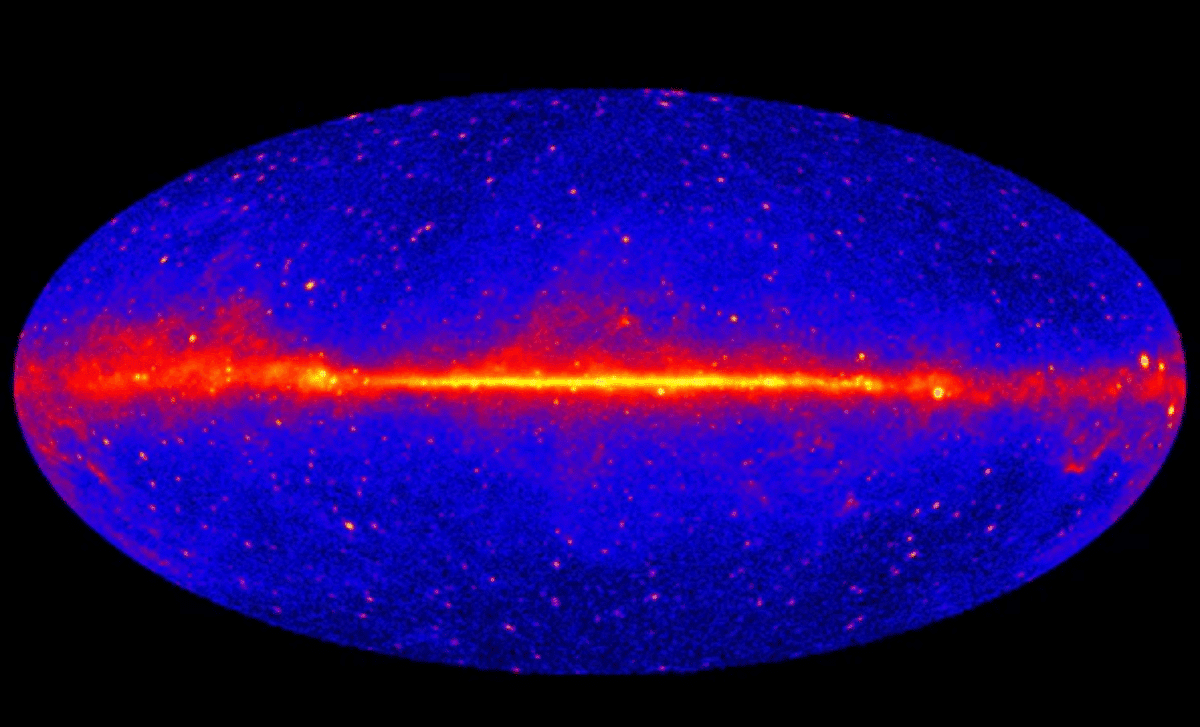
For decades, scientists have been trying to pinpoint dark matter, the invisible substance thought to comprise the bulk of the universe's mass. A recent observation of a peculiar gamma-ray glow emanating from the Milky Way’s core may finally provide a significant lead. Scientists have proposed two main explanations: one suggests collisions between dark matter particles create this glow, while the other attributes it to known gamma-ray sources like pulsars or black holes. Recent advanced modeling favors the dark matter explanation, reigniting excitement about unraveling this cosmic mystery.
Exploring the Source of the Galactic Gamma Rays
A striking surplus of high-energy gamma rays has been detected at the center of our galaxy, baffling astronomers for years. This emissions peak in the Galactic Center, an area crowded with stars, gas clouds, and the supermassive black hole known as Sagittarius A*. Yet, the exact cause of this gamma-ray surplus remains up for debate.
Two competing ideas aim to explain this signal. One posits that unseen dark matter particles collide and annihilate in that dense space, releasing gamma rays. The other hypothesizes that familiar cosmic sources, such as pulsars or black holes, could be responsible for this radiation.

The question has lingered without consensus for many years.
“Understanding the nature of the dark matter which pervades our galaxy and the entire universe is one of the greatest problems in physics,” said Joseph Silk, a cosmologist at Johns Hopkins University and co-author of a recent study that aims to shed new light on this question.
The latest findings, featured in Physical Review Letters, bring us closer to determining if dark matter is behind this unexplained galactic illumination.
New Simulations Support Dark Matter as a Source
Dark matter has evaded direct detection so far, but cutting-edge computational models now strengthen the case for its role in causing the gamma-ray surplus. Researchers used powerful supercomputer simulations to predict the dark matter distribution in the Milky Way's crowded core. Their results show that the gamma-ray signature recorded by the Fermi Gamma-ray Space Telescope aligns closely with patterns expected if dark matter particles are annihilating and releasing energy.
“Our main breakthrough is demonstrating that dark matter explains the gamma-ray data as well as the competing pulsar model,” Silk explained. “This significantly boosts the likelihood that we’ve indirectly observed dark matter.” Although not definitive proof, this advances dark matter as a prime candidate for the unusual gamma-ray emission from the Galactic Center.
Why Dark Matter Still Puzzles Physicists
Despite being key to the structure and evolution of the universe, dark matter remains elusive because it neither emits nor absorbs light, making direct observation impossible. Scientists infer its existence through gravitational effects on visible objects like galaxies and clusters. Yet, decades of experimental efforts have yet to capture dark matter particles themselves.
This difficulty arises primarily because dark matter doesn’t interact with electromagnetic radiation in any detectable way.
“Because dark matter doesn’t emit or block light, we can only detect it through its gravitational effects on visible matter,” explained Moorits Mihkel Muru, the lead author of the study.
The newly developed simulations provide optimism that indirect detection methods, like gamma-ray observations, could finally reveal dark matter's true nature.
Dark Matter Annihilation: The Key to the Gamma-ray Signal?
A particularly compelling element of the dark matter theory is the idea that these particles might annihilate when they encounter each other. This process would generate high-energy gamma rays, similar to those produced when protons collide with their antiparticles. The concept is that dark matter particles could be their own antiparticles, so their collisions result in total annihilation and gamma-ray emission.
“Unique to the simplest dark matter hypothesis is the fact that dark matter particles are thought to be their own antiparticles and annihilate completely when they collide,” said Silk. “Only protons and antiprotons do something similar to produce energetic gamma rays, and antiprotons are exceedingly rare.”
This annihilation scenario could uniquely explain the intensity and pattern of the gamma-ray glow where no other known sources suffice.
Competing Explanation: Pulsars and Black Holes
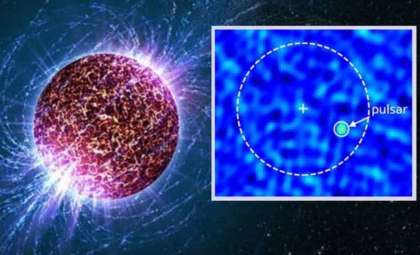
Opposing the dark matter idea, some scientists attribute the gamma rays to known energetic sources like pulsars and supermassive black holes. Pulsars, highly magnetized and rapidly spinning neutron stars, emit concentrated radiation beams including gamma rays that telescopes can detect. The Galactic Center’s dense stellar environment makes it a prime location for pulsar activity.
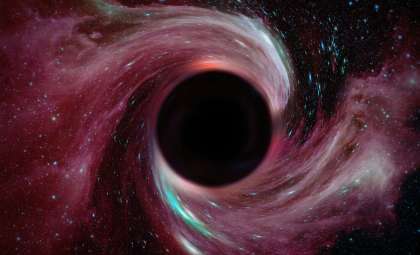
Similarly, supermassive black holes such as Sagittarius A* produce gamma rays linked to gas and material falling into them. However, the observed gamma-ray excess vastly exceeds what is expected from these known pulsar and black hole sources, raising doubts about their ability to explain the entire phenomenon and leaving room for dark matter as a viable explanation.
- Categories:
- News




0 comments
Sign in to Comment