
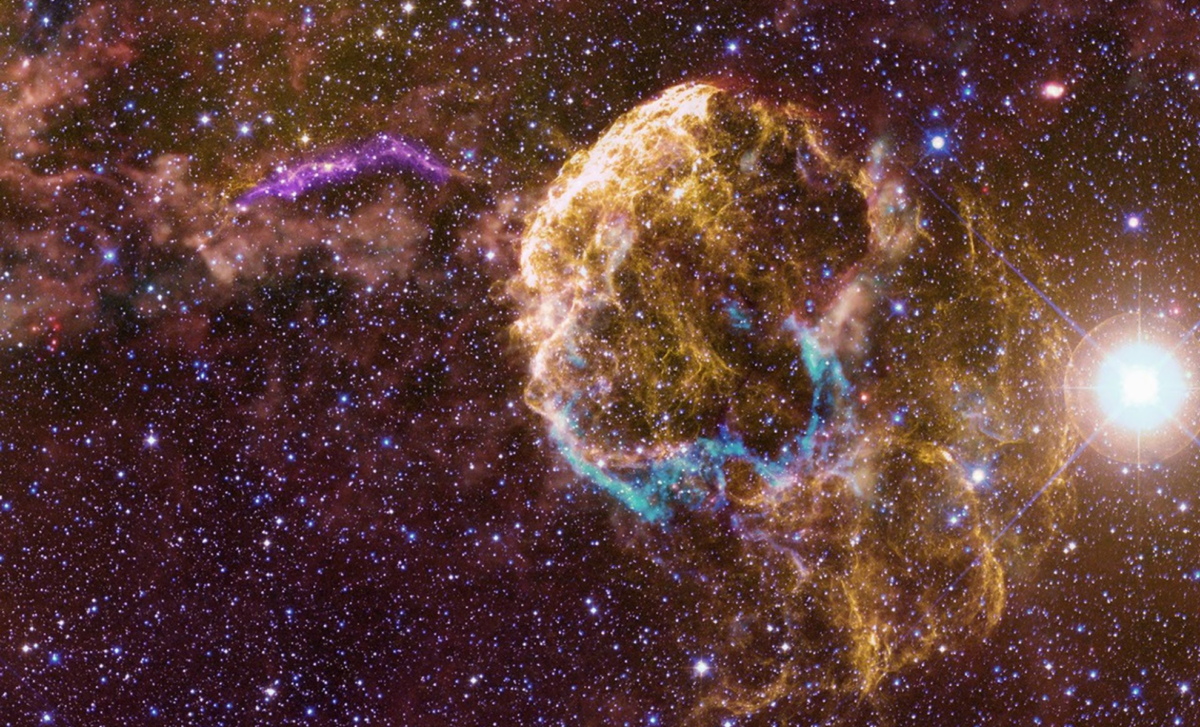
Hidden within the Gemini constellation lie two massive stellar explosions that share a remarkable connection. The striking Jellyfish Nebula is well-known for its intense gamma-ray emissions, but its faint companion, G189.6+3.3, remained largely unseen until NASA’s Fermi Gamma-ray Space Telescope detected it. This powerful observation suggests a unique binary star system where both stars ended their lives as supernovae, offering new insights into the explosive fates of massive binary stars.
Revealing Concealed Cosmic Neighbors
Astronomers have long studied the Jellyfish Nebula (IC 443), a luminous supernova remnant emitting gamma rays in Gemini. The nearby G189.6+3.3, however, was too dim to spot clearly, its signals overshadowed by the Jellyfish Nebula’s brightness.
“Using 16 years of data from NASA’s Fermi Gamma-ray Space Telescope, our analysis uncovered gamma rays associated with a supernova remnant that was hidden in the glare of its neighbor, the Jellyfish Nebula, one of the brightest gamma-ray-emitting supernova remnants known,” said Miltiadis Michailidis, a postdoctoral fellow at Stanford University. “There are so many striking connections between the two remnants that we conclude they’re likely related, giving us the first known example of a binary system where both stars have undergone supernova explosions.”
Add Cosmo Herald as a Preferred Source

This breakthrough underscores the advantage of extended gamma-ray surveillance, enabling scientists to detect faint features in cluttered cosmic regions that appear complex in visible or X-ray observations. The overlapping locations of these remnants suggest they originated from a shared environment, presenting a rare setting to study star interactions in binary systems.
Gamma-Ray Emissions and Particle Acceleration
Supernova remnants serve as natural cosmic accelerators, propelling particles such as protons to near-light speeds. The Fermi Large Area Telescope (LAT) plays a vital role in charting these energetic phenomena.
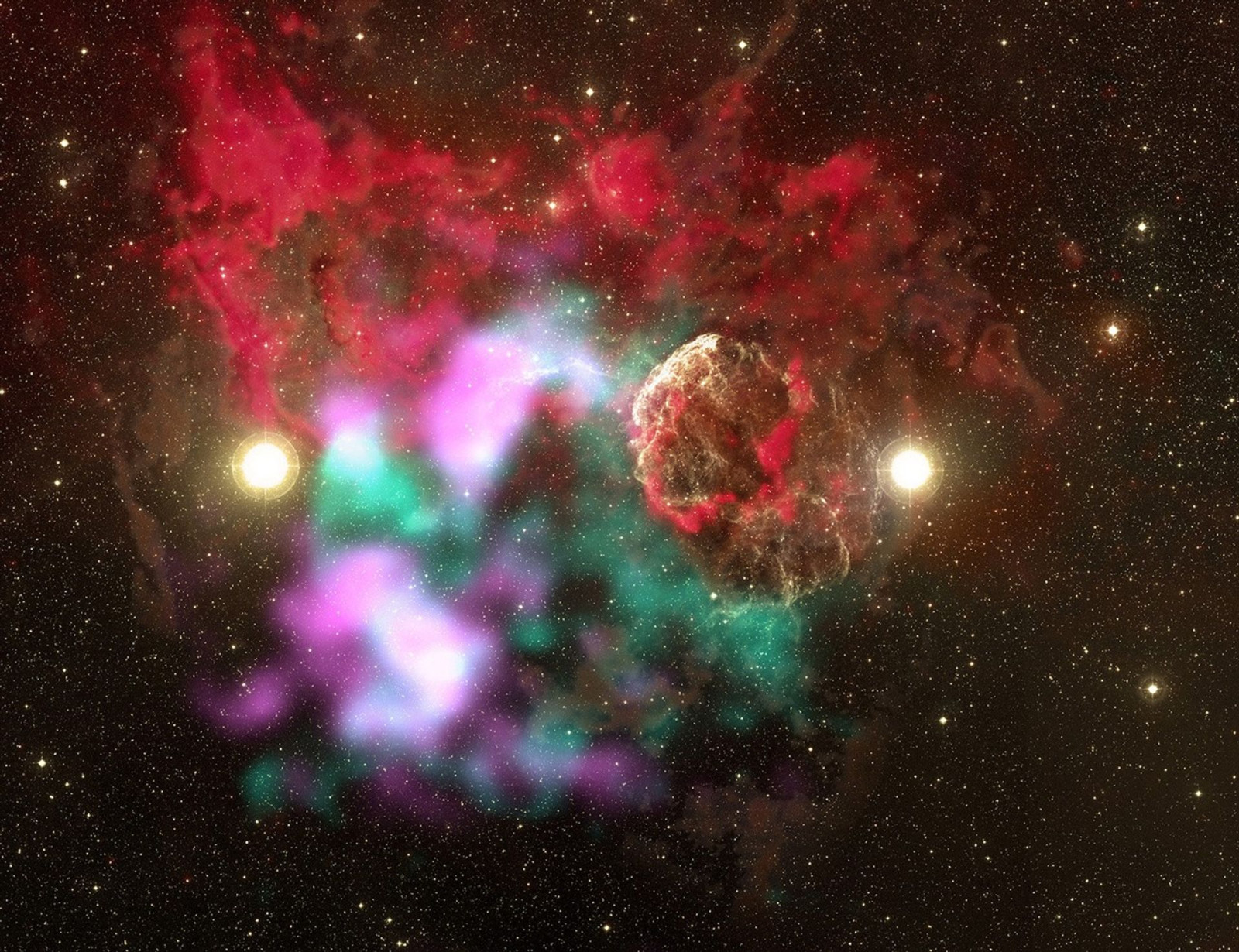
“The overlapping remnants, a connecting gas filament, and the availability of data from Fermi and other facilities motivated us to delve into this complex but little-studied region,” said Marianne Lemoine-Goumard, an astrophysicist at CNRS, University of Bordeaux. “With Fermi’s LAT instrument, we found gamma-ray emission associated with accelerated protons in the northern part of the fainter remnant. If both remnants are interacting with the same structure, then they must share a common distance from us.”
This interaction confirms that cosmic rays—the energetic particles permeating our galaxy—originate from shock waves generated in supernova blasts. When these cosmic rays collide with clouds of interstellar gas, gamma rays are emitted, unveiling their trajectories and energies. The proximity of these two remnants offers a unique chance to study twin particle accelerators side-by-side, advancing astrophysics research.
Evolution and Demise of Binary Massive Stars
Massive stars commonly form in pairs or groups, sharing complex evolutionary paths. Combining Fermi observations with X-ray data and simulations of millions of binary stars suggests that the progenitors of the Jellyfish Nebula and G189.6+3.3 orbited each other closely, exchanged material, and exploded at different moments. Scientists estimate the Jellyfish Nebula’s explosion occurred around 8,000 to 9,000 years ago, while the neighbor’s detonation might date back 20,000 to 110,000 years, indicating a time gap of up to 100,000 years between events.
“The evidence we’ve compiled — including observations across the spectrum, the chemical and physical properties of the remnants, simulations, and more — paints a compelling picture of a dual supernova event,” said Michailidis.
This finding affirms that massive binary stars can leave behind multiple, interacting remnants, shedding light on stellar lifecycles, explosion physics, and the behavior of interstellar matter.
Expanding Our View of Stellar Explosions
Beyond individual stars, this breakthrough opens new prospects for studying how supernovae influence their celestial neighborhoods. By examining gamma-ray emissions and particle acceleration in these remnants, researchers can better understand how exploding stars promote star formation and contribute to cosmic rays in our galaxy. “Fermi’s gamma-ray observations of supernova remnants continue to reveal the dynamic lives of stars,” commented Elizabeth Hays, Fermi project scientist at NASA’s Goddard Space Flight Center. “We can now connect the glowing remains of two massive stars to a powerful pair that evolved together over thousands of years.”
Continued observation by NASA promises to uncover more concealed cosmic treasures, helping to unravel the intricate interactions shaping stellar evolution in the Milky Way.
- Categories:
- News



0 comments
Sign in to Comment