
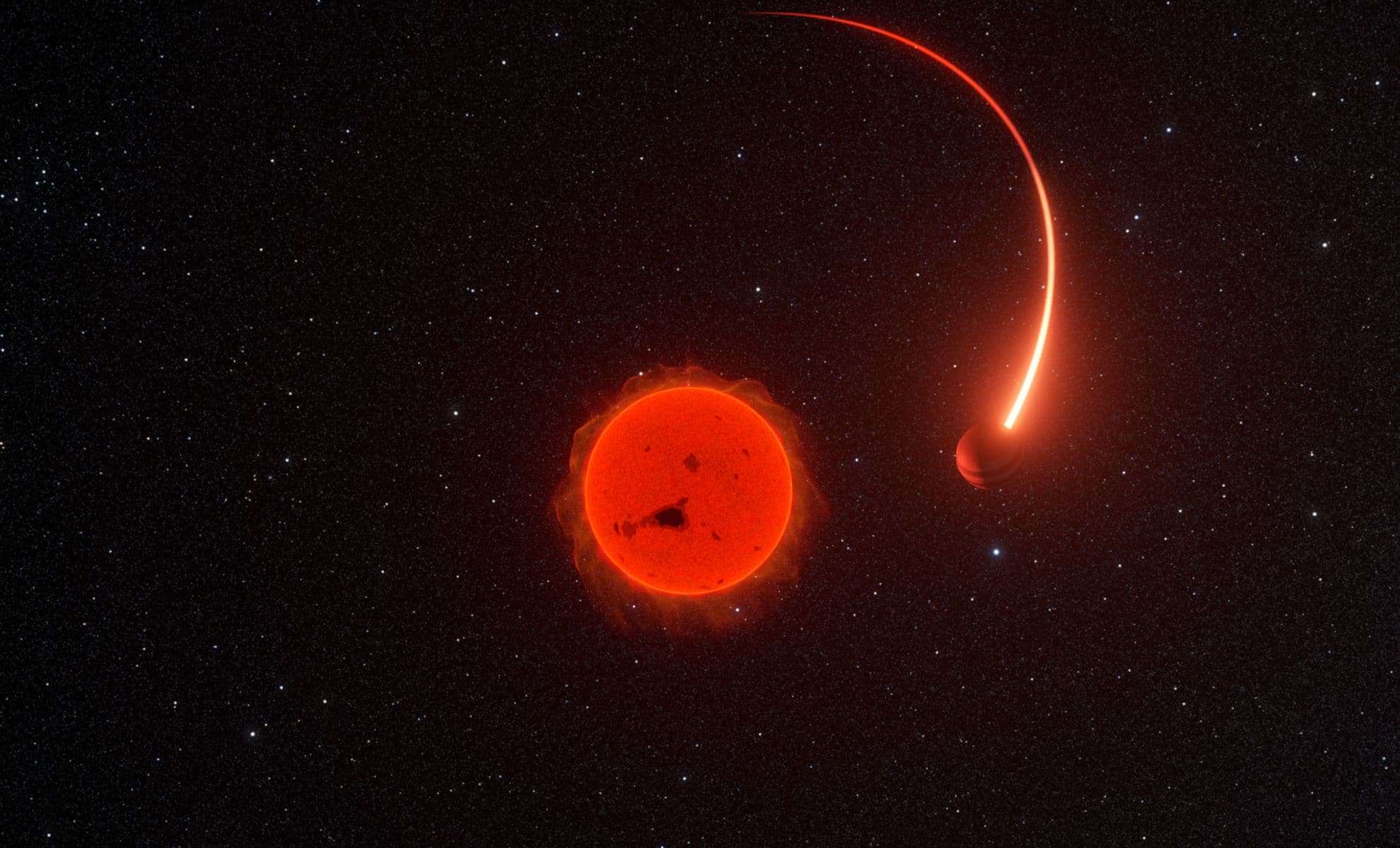
Traditionally, astronomers have detected exoplanets mainly through the transit technique, which observes drops in a star’s brightness when a planet crosses its face, and the radial velocity method, which measures minute changes in a star’s light caused by the gravitational pull of orbiting planets. However, for the first time, a new method focusing solely on stellar wobbling has successfully identified planetary companions.
Leveraging data collected by the European Space Agency’s Gaia mission, researchers uncovered two intriguing celestial bodies that challenge existing planetary formation models: Gaia-4b, an enormous Super-Jupiter, and Gaia-5b, a brown dwarf. These objects closely orbit low-mass stars, a setup previously considered quite uncommon.
Gaia-4b boasts a mass approximately twelve times that of Jupiter and follows a long, cool orbit spanning about 570 days. On the other hand, Gaia-5b, with a mass 21 times that of Jupiter, falls into the category of brown dwarfs—objects too heavy to be planets but not quite massive enough to ignite nuclear fusion and become stars. These discoveries demonstrate Gaia’s extraordinary ability to uncover hidden worlds by carefully tracking how stars subtly shift position in space.

The Astrometric Breakthrough Behind Gaia’s Planetary Discoveries
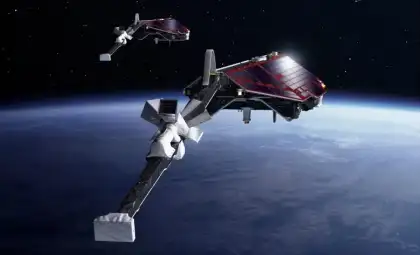
Gaia, launched in 2013, has been charting precise locations and movements for over two billion stars, producing the most detailed three-dimensional galactic map to date. Different from other planet-finding instruments that depend on light variations, Gaia applies astrometry, tracking minute shifts in a star’s position over time.
Orbiting planets tug on their stars gravitationally, causing minute stellar disturbances known as wobbles. Detecting these tiny perturbations demands exceptional sensitivity, a challenge Gaia is uniquely equipped to meet.
“Gaia's continuous observations built up detailed stellar motion data,” explained Guðmundur Stefánsson, a University of Amsterdam astronomer leading the research. “The 2022 Gaia Data Release 3 presented a catalog of stars exhibiting motions consistent with orbiting companions. By combining this with radial velocity data from ground telescopes, we were able to confirm both our inaugural planet and brown dwarf discoveries.”
This marks Gaia’s first direct astrometric identification of new worlds beyond suggesting their potential existence.
Transforming Exoplanet Detection and Our Understanding of Stellar Systems
Most exoplanetary finds have used the transit approach, which favors planets tightly orbiting close to their host stars. Yet astrometry allows Gaia to excel at discovering planets in wider orbits that often elude other methods.
Given that about 75% of stars in the Milky Way are low-mass stars like those hosting Gaia-4b and Gaia-5b, these findings imply that large planets around such stars may be more common than once thought.
“Although massive planets orbiting low-mass stars are rare, when present, they produce significant stellar wobbles, simplifying astrometric detection,” noted Stefánsson.
With Gaia continuing to scan the heavens, researchers anticipate uncovering possibly hundreds or thousands more exoplanets and brown dwarfs, significantly advancing theories about planetary system formation and development.
The Future Landscape of Planet Hunting with Gaia
This breakthrough is merely the beginning. The upcoming Gaia data release in 2026 will encompass 5.5 years of mission data and is predicted to disclose a wealth of new planetary systems. Combining Gaia’s precise motion tracking with other detection strategies will enable astronomers to refine models illustrating how planets evolve and interact with their stars.
ESA Research Fellow Matthew Standing, an exoplanet specialist, remarked, “This discovery heralds a promising surge of exoplanet finds from Gaia in the years ahead.”
Adding to this, ESA’s Gaia Project Scientist Johannes Sahlmann stated:
“Gaia-4b’s identification highlights how Gaia’s detailed measurements complement existing planet detection methods, opening fresh avenues for exoplanet research. The forthcoming Gaia data releases will be invaluable resources for planetary scientists.”
Gaia is paving the way for a new era in exoplanetary studies, enhancing search techniques and supporting upcoming missions like ESA’s Cheops and Plato, which aim to further scrutinize distant planetary characteristics.
ushering in a New Chapter for Exoplanetary Science
By detecting hidden companions through the subtle dance of stars, Gaia has redefined how we uncover planets beyond our solar neighborhood. The detection of Gaia-4b and Gaia-5b suggests that countless planetary systems might remain concealed, awaiting discovery.
As next-generation instruments such as NASA’s James Webb Space Telescope and ESA’s Plato mission gear up to hunt for Earth analogs, Gaia’s dataset will be an indispensable roadmap, guiding attention to the most promising candidates.
For now, these two substantial hidden worlds provide a powerful reminder: the cosmos still holds many secrets, and even the slightest stellar wobble can reveal remarkable new worlds waiting to be explored.
- Categories:
- News




0 comments
Sign in to Comment