
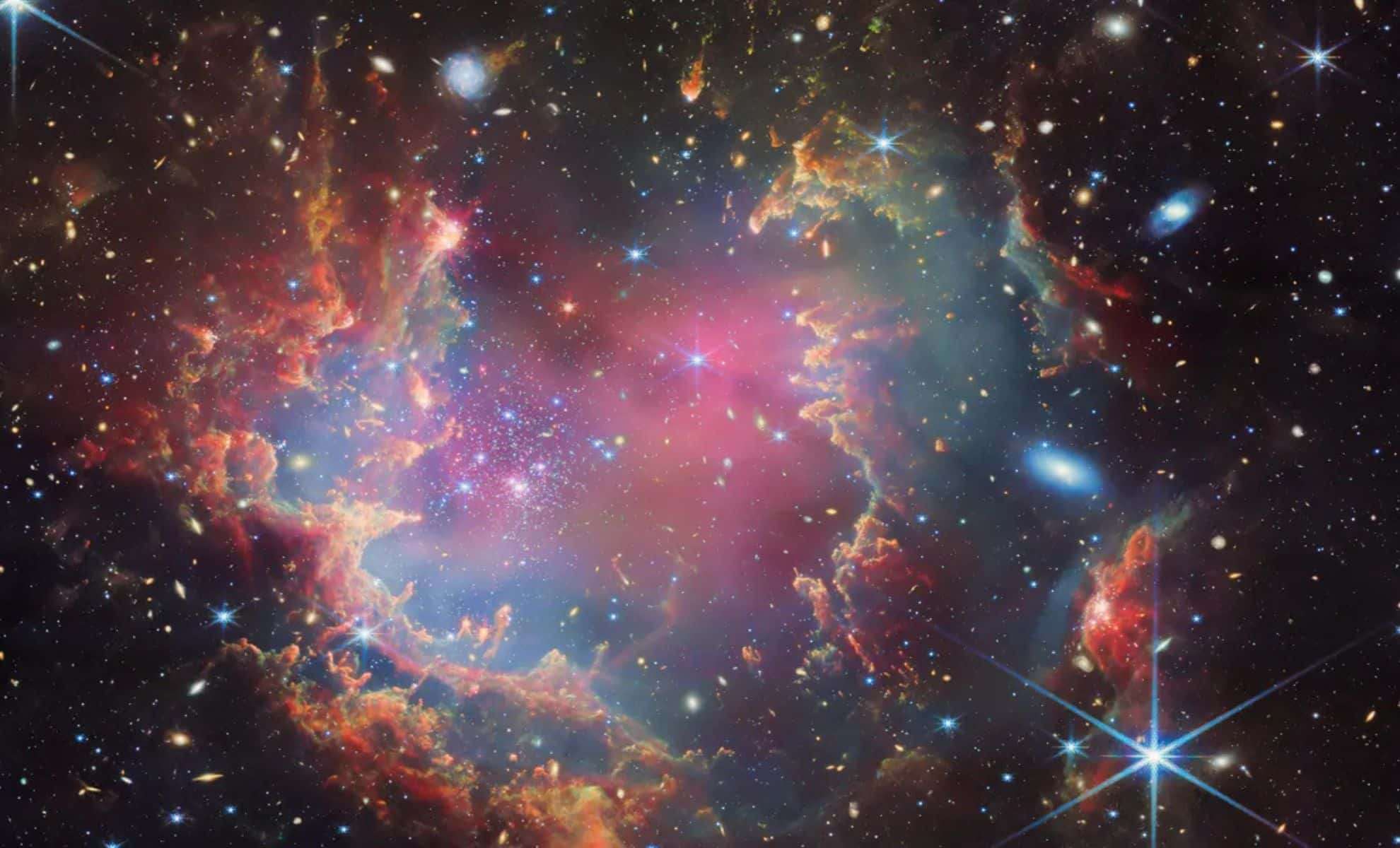
Using its powerful infrared vision, the James Webb Space Telescope (JWST) has potentially spotted the first brown dwarfs beyond our galaxy.
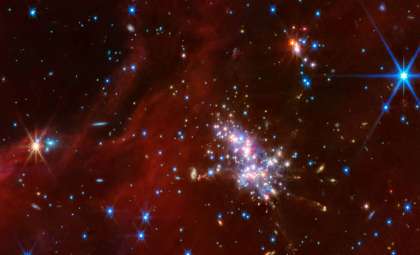
These intriguing substellar bodies reside in the Small Magellanic Cloud (SMC), roughly 200,000 light-years away, nestled within the youthful star cluster NGC 602. Thanks to JWST’s cutting-edge infrared instruments, scientists now have a unique peek into star formation processes in environments akin to those of the early cosmos, marking a major advance in our knowledge of stellar development.
Brown dwarfs detected outside the Milky Way
Brown dwarfs are celestial objects that occupy the mass range between the smallest stars and largest giant planets—too light to fuse hydrogen but heavier than typical gas giants. While approximately 3,000 brown dwarfs have been discovered within our galaxy, identifying them in other galaxies is extremely difficult due to their dim glow. JWST’s Near-Infrared Camera (NIRCam) and Mid-Infrared Instrument (MIRI) successfully penetrated thick dust clouds in NGC 602 to detect faint candidates matching brown dwarf signatures. Peter Zeidler from the European Space Agency commented, “Only with the incredible sensitivity and spatial resolution in the correct wavelength regime is it possible to detect these objects at such great distances.” This kind of observation is beyond the reach of Earth-based telescopes, underscoring JWST's critical role in exploring these faint cosmic bodies.

The discovery builds on earlier observations from the Hubble Space Telescope, which had identified NGC 602 as a region teeming with newly formed, low-mass stars. JWST’s enhanced sensitivity enabled scientists to analyze these substellar candidates in greater detail. Antonella Nota of the International Space Science Institute remarked, “Hubble showed that NGC 602 harbors very young low-mass stars, but only with the JWST, can we finally see the extent and the significance of the substellar mass formation in this cluster.”
Significance of brown dwarf formation in metal-poor galaxies
The SMC offers a remarkable laboratory for studying star formation in metal-deficient environments, resembling early galactic conditions. Heavy elements, or "metals," are pivotal in typical star formation processes. Elena Sabbi from the University of Arizona explains, “By studying the young metal-poor brown dwarfs newly discovered in NGC 602, we are getting closer to unlocking the secrets of how stars and planets formed in the harsh conditions of the early universe.” Brown dwarfs in this setting may share characteristics with the first generations of stars, providing insight into how stellar and planetary systems originated in primordial times.
JWST’s observations bolster the idea that brown dwarfs emerge from gas clouds collapsing under gravity, but they lack the mass needed to spark fusion. This expands our comprehension of star formation and suggests brown dwarfs are common in diverse galactic conditions. Confirming their presence in metal-poor regions raises new questions regarding their distribution and birth mechanisms across different cosmic environments.
JWST’s future prospects in stellar research
This landmark finding highlights JWST’s unmatched capability to investigate remote and dust-obscured regions with exceptional clarity. Its ability to study star clusters like NGC 602 within the SMC—and potentially other nearby dwarf galaxies—opens fresh avenues for exploring how stars and substellar objects form beyond the Milky Way, enriching our grasp of galactic evolution and cosmic history.
By exploiting JWST’s sensitivity, astronomers will be able to characterize early-stage stars, brown dwarfs, and exoplanets with unprecedented precision. As Zeidler points out, “This has never been possible before and also will remain impossible from the ground for the foreseeable future.” This discovery signals the beginning of many revolutionary revelations expected from JWST about star formation in the broader universe.
- Categories:
- Astronomy ,
- News ,
- Nasa





0 comments
Sign in to Comment