

Astronomers have uncovered the oldest known stellar disk within the Milky Way, offering fresh perspectives on how our galaxy came into existence. This primordial disk, called PanGu, dates back more than 13 billion years and represents the foundational structure from which our galaxy expanded. This breakthrough challenges existing ideas about the timing and process of the Milky Way’s formation and deepens our understanding of early spiral galaxy evolution.
Tracing the Galaxy’s Origins
Scientists from the Chinese Academy of Sciences and the University of Toronto concentrated their efforts on identifying the oldest stellar populations in the Milky Way to reconstruct its initial framework. They employed sophisticated methods to analyze the kinematics of high-α stars—stars rich in alpha elements that are generally among the first to form in a galaxy’s timeline. Their research revealed a disk-shaped assembly of stars older than 13 billion years, which they named PanGu, inspired by the ancient Chinese creator deity.
This stellar disk originates from a phase soon after the Big Bang, approximately 13.4 billion years ago, marking one of the earliest stages of star formation. Before this revelation, astronomers estimated the Milky Way’s structured formation began around 12.5 billion years ago, but the PanGu disk shows a much earlier onset of galactic structure. The combined mass of stars in this ancient disk is estimated at about 3.7 billion solar masses, contributing substantially to the young Milky Way’s mass.


Gradual and Stable Galactic Growth
A standout aspect of this discovery is the PanGu disk’s steady expansion. Unlike other galaxies of similar size that often grew through turbulent mergers and disruptive events, the early Milky Way seems to have experienced a comparatively calm evolution. Initially, the PanGu disk was almost as tall as it was wide, evolving into the flattened spiral shape observed today, which points to a gentler formation history.
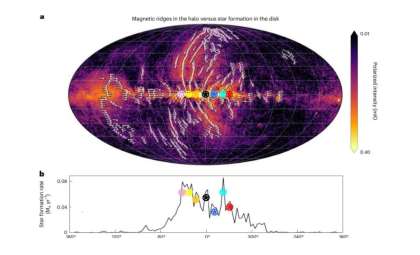
At the zenith of its star formation activity roughly 11 billion years ago, the Milky Way was generating stars at a pace near 11 solar masses annually. This smooth growth pattern differentiates the Milky Way from many spiral galaxies prone to frequent upheavals during their birth. Now, the ancient PanGu disk constitutes only about 0.2% of the Milky Way’s total mass, as much of the galaxy’s assembly came from subsequent mergers with smaller stellar systems.
Reevaluating Conventional Galaxy Evolution Theories
Finding the PanGu disk compels scientists to rethink established models of how galaxies form. Prior theories posited that large galaxies like the Milky Way formed through numerous chaotic mergers leading to patchy, irregular development. The presence of the PanGu disk implies instead that our galaxy underwent a more consistent and orderly formation process.
This new insight adds nuance to astrophysical models of galaxy growth. Simulations have long suggested that galaxies similar to the Milky Way suffered significant early collisions, but the PanGu discovery highlights a less tumultuous history for our home galaxy.
Looking Ahead: Probing the Galaxy’s Early Era
The identification of the Milky Way’s ancient disk opens promising paths for exploring the galaxy’s formative years. Continued research into the stars within the PanGu disk aims to uncover the unique conditions enabling such stable growth compared to other galaxies. These studies will refine our understanding of galactic development and enhance models describing the universe’s evolution following the Big Bang.
Given that the Milky Way reached its star formation peak approximately 11 billion years ago, investigating how this primordial disk transformed thereafter may illuminate the growth patterns of other spiral galaxies across the cosmos.
- Categories:
- Astronomy ,
- News ,
- Science








0 comments
Sign in to Comment