
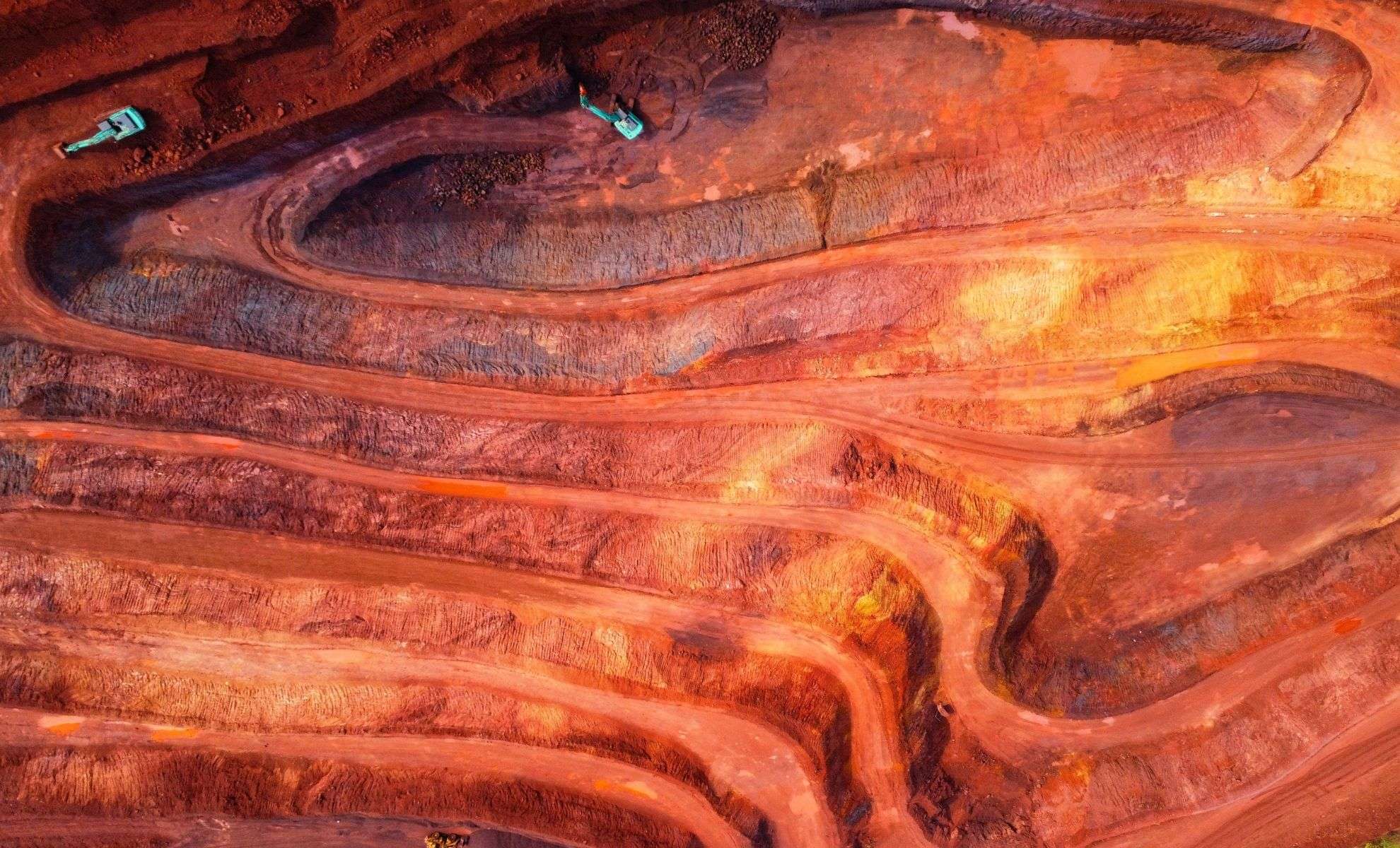
A breakthrough gold find in southeastern Suriname has captured significant attention within the mining sector. Canadian exploration company Founders Metals Inc. announced a remarkable 22.5-metre intercept averaging 11.88 grams per tonne (g/t) at its Maria Geralda prospect, an achievement field geologists describe as a once-in-a-lifetime opportunity.
Revealed in June, this impressive intercept was obtained from drill hole MG003 in an area that modern exploration had never previously surveyed. The site lies roughly 5 km southeast of Founders’ Lower Antino base camp within its expansive 200 km² Antino gold project. Earlier auger sampling results had hinted at potential — with more than half of the samples exceeding 0.1 g/t Au — yet the newly discovered mineralization far surpassed expectations.
“Our initial drilling success at Maria Geralda confirms the effectiveness of our exploration strategy,” stated Colin Padget, CEO of Founders Metals, in the company announcement. “These findings underscore the immense discovery possibilities that extend beyond the project’s currently defined zones.”

Gold Formation in Unique Geological Settings
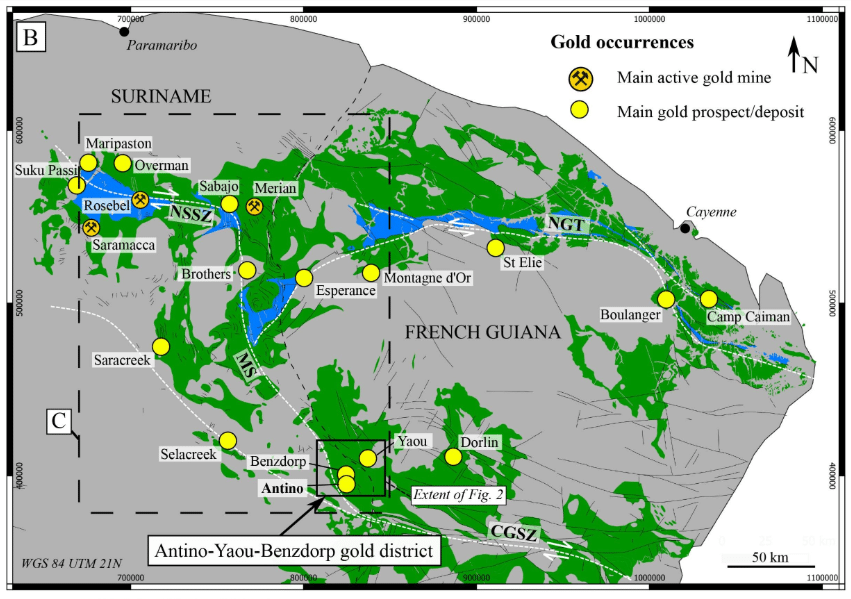
This intercept’s importance extends well beyond its grade. Structural studies conducted by Vincent Combes, Founders’ geologist and co-author of a 2025 peer-reviewed article, reveal that Maria Geralda is positioned at a rare geological juncture where both intrusion-related and shear zone-hosted gold deposits coincide, situated within the ancient Marowijne Greenstone Belt—one of the Guiana Shield’s oldest rock formations.
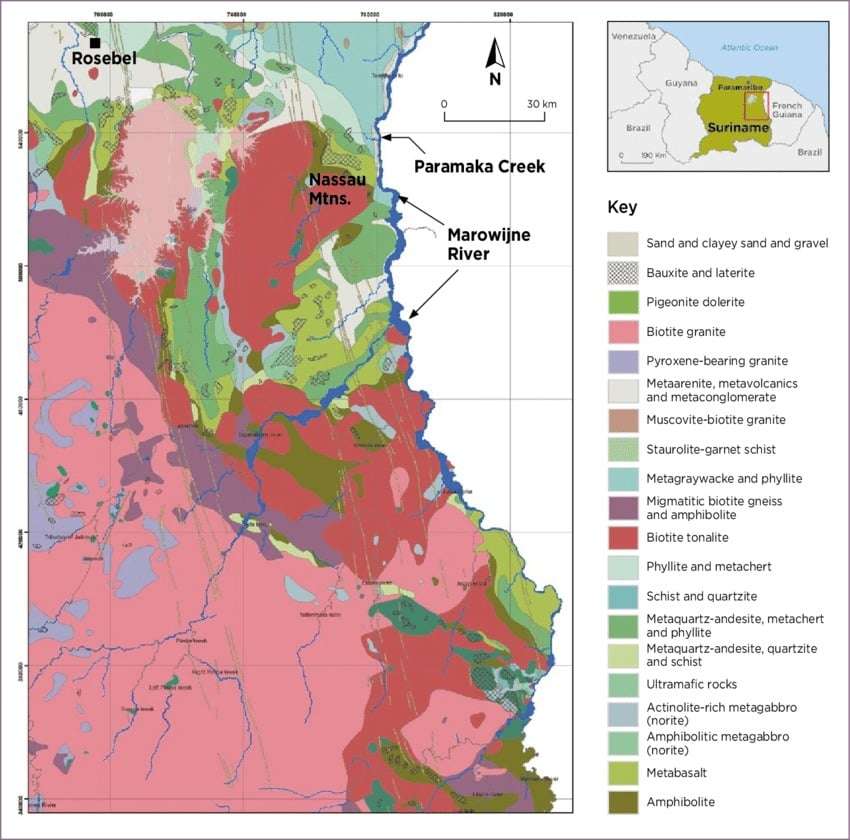
Formed more than 2 billion years ago, this belt comprises tonalite dykes, metavolcanic rocks, and volcano-sedimentary layers that underwent intense folding, shearing, and intrusion during substantial tectonic upheavals. This distinctive tectonic environment induced fractures which facilitated the infiltration and crystallization of quartz veins and gold-bearing fluids. As depicted on this geological map, lithological boundaries and zones of stress rotation form excellent traps for concentrated gold deposits.
On a microscopic level, X-ray fluorescence analyses demonstrate how early-stage D2b veins created preliminary pathways for gold accumulation, with features such as boudin necks and folded mylonites serving as key sites for high-grade gold deposition following subsequent brittle deformation phases.
A Discovery with Significant National Importance
Suriname, a country with fewer than one million inhabitants, relies heavily on extraction industries for its economy. Mining and petroleum activities represent about 60% of the nation’s GDP and nearly 90% of its export earnings. New finds like Maria Geralda have considerable implications beyond resource income, including job creation, infrastructure development, and attracting foreign capital.
The remote setting of the Antino region poses logistical challenges, located deep within tropical rainforest where annual precipitation surpasses 4,000 mm. Access often depends on helicopters, river transport, or temporary pathways shaped by weather conditions. Additionally, environmental regulations are rigorous. Suriname’s 2022 Responsible Mining Framework mandates strict adherence to water quality monitoring, Indigenous community engagement, and transparent royalty management for any mining development.
Communities in the Tapanahony and Lawa districts have already urged meaningful consultations before any extraction begins. The Surinamese government, mindful of past issues stemming from informal placer mining along the Marowijne belt, prioritizes biodiversity conservation alongside economic progress, a balance detailed in Earth.com’s report on the finding.
Measured Optimism: One Drill Hole Doesn’t Make a Mine
Despite the enthusiasm, experts caution that a singular drill intercept doesn’t guarantee a commercially viable deposit. Other nearby holes such as MG001 and MG002 yielded less impressive grades—6.0 m at 1.04 g/t and 7.5 m at 0.51 g/t, respectively—according to Founders’ published drilling results. The current focus is on confirming continuity of mineralization laterally and at depth via step-out drilling presently underway north and south of the initial site.
Additional plans include employing metallic screen assays to reduce sampling variability, conducting downhole electromagnetic surveys, and carrying out an airborne LiDAR survey to enhance the understanding of regional geology before the year's end. Founders has allocated a drilling budget of 60,000 metres for 2025, signaling a commitment to long-term exploration.
As elaborated in the Ore Geology Reviews mineral-scale study, these gold systems are shaped by successive deformation events and exhibit highly localized high-grade zones. Transforming visually striking core samples into an economically viable resource demands dense drilling spacing, thorough metallurgical analysis, and rigorous financial evaluation combined with securing environmental permits and community approval.
- Categories:
- News







0 comments
Sign in to Comment