

The United Nations has released a dire forecast indicating a 70 percent probability that the Earth's average temperature between 2025 and 2029 will surpass the pivotal 1.5 degrees Celsius warming limit. This conclusion, documented in a recent World Meteorological Organization (WMO) report, underscores that the planet is on track to experience unprecedented heat waves beyond the extremes recorded in 2023 and 2024.
The Elusive 1.5°C Goal
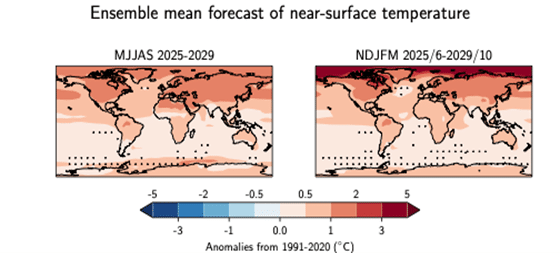
The WMO projects that global surface temperatures will likely range between 1.2°C and 1.9°C above pre-industrial averages during the next five years. The reference period of 1850–1900 serves as a benchmark for evaluating industrial-era greenhouse gas impacts. This forecast, prepared in coordination with the UK Met Office and other leading meteorological bodies, reinforces concerns that the 1.5°C limit, established by the 2015 Paris Agreement, may soon be unachievable.
Peter Thorne, head of the Irish Climate Analysis and Research Units at the University of Maynooth, commented, “It aligns perfectly with the projection that we will cross the 1.5°C threshold on a long-term scale by the late 2020s or early 2030s.” He further predicted that within “two to three years, the likelihood of this will reach 100 percent.”

Setting New Records for Global Heat
The assessment also indicates an 80 percent chance that a year within 2025–2029 will eclipse 2024 as the hottest on record. Broader climate analyses highlight that warming is approaching hazardous intensities.
Using a mix of observed data from 2015–2024 and forecasts extending to 2034, the WMO calculates present warming at approximately 1.44°C. Comparatively, the Copernicus Climate Change Service estimates it slightly lower at 1.39°C, yet anticipates that the 1.5°C mark could be reached by mid-2029 or earlier.
Notably, there is a 1 percent possibility that one year between 2025 and 2029 could exceed 2°C warming, a scenario once deemed unlikely. Adam Scaife of the Met Office described this as “staggering,” adding that the probability will likely increase. He noted that similar warnings about surpassing 1.5°C a decade ago were initially dismissed until observed in 2024.
Visible Impacts of Rapid Temperature Rise
The tangible consequences of escalating heatwaves are becoming increasingly apparent worldwide. Recently, China has seen temperatures exceed 40°C, the United Arab Emirates has recorded temperatures nearing 52°C, and Pakistan suffered deadly winds after an intense spell of heat. At the same time, severe floods have struck regions in Australia, France, Algeria, India, China, and Ghana, while wildfires continue to impact Canada.
Friederike Otto, a climatologist at Imperial College London, remarked, “We’ve reached perilous levels of warming already.” She criticized continued reliance on fossil fuels, calling it “utter madness” in 2025. Echoing her sentiment, Davide Faranda from France’s CNRS stressed that the scientific consensus is “unmistakable” in demanding swift reductions in carbon emissions and rapid adoption of renewable energy.
Shifts in Polar Ice and Rainfall Patterns
The report also details accelerated warming in the Arctic, where temperatures are rising faster than the global average. For the period 2025–2029, ongoing sea ice decline is forecast in the Barents Sea, Bering Sea, and Sea of Okhotsk. In precipitation trends, regions like the Sahel, northern Europe, Alaska, and northern Siberia are expected to experience heightened rainfall, while the Amazon basin is projected to become drier.
These trends indicate growing climate instability, where even marginal temperature increases heighten the risk of heatwaves, severe storms, drought events, and accelerated ice melt. Ko Barrett, WMO’s deputy secretary-general, summarized: “The impacts will increasingly harm economies, disrupt our daily lives, damage ecosystems, and threaten the health of our planet.”
- Categories:
- News











0 comments
Sign in to Comment