

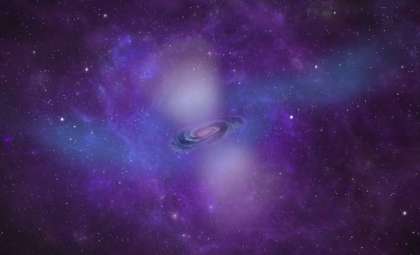
Astronomers have identified REBELS-25, the earliest known rotating disk galaxy, which existed when the universe was merely 700 million years old. This surprising discovery contradicts established ideas about galaxy evolution, revealing a well-ordered galaxy with a disk structure similar to the Milky Way far earlier than previously anticipated. This breakthrough challenges existing timelines for galaxy formation, suggesting that mature disk galaxies may have developed much faster than scientists once assumed.
Unveiling a Faraway Galaxy Reminiscent of the Milky Way
The detection of REBELS-25 was achieved using the remarkable capabilities of ALMA, a cutting-edge radio telescope array located in Chile’s Atacama Desert. This powerful instrument allowed astronomers to examine the ancient galaxy with unparalleled detail, probing deep into the cosmos’ history. While earlier studies hinted at rotation within REBELS-25, it was only with improved resolution that rotation—and striking features akin to those in the Milky Way—were confirmed. These include possible spiral arms and a pronounced central bar. Published in the Monthly Notices of the Royal Astronomical Society, these results are prompting researchers to reconsider conventional theories of how galaxies take shape and evolve.
Traditionally, astronomers have thought that galactic disks like the Milky Way’s required billions of years to mature from initially chaotic, clumpy systems. Early galaxies were believed to grow through violent mergers and collisions before settling into smooth, stable disks. However, REBELS-25’s existence just 700 million years post-Big Bang challenges this framework, evidencing a well-organized rotating disk galaxy far earlier than models predicted. “We expect most early galaxies to be small and messy looking,” commented Jacqueline Hodge, highlighting how unexpected this finding is.

Rethinking How Galaxies Form and Mature
This discovery carries significant implications for understanding galaxy build-up. The smooth, rotation-focused form of REBELS-25 confronts the prevailing notion that complex galactic structures demand extensive cosmic time to develop. Its early emergence suggests that galaxies could achieve organized disk systems much sooner than thought. “Finding further evidence of more evolved structures would be an exciting discovery, as it would be the most distant galaxy with such structures observed to date,” said Lucie Rowland, pointing to the potential impact of continued research.
The research team intends to explore REBELS-25 and other similar galaxies for deeper insight into the mechanisms behind such rapid galaxy development. Upcoming observations, notably from the James Webb Space Telescope, promise to shed more light on the formation and dynamics of early-universe galaxies. By studying their movements and internal structures, astronomers aim to revise the galaxy evolution timeline, revealing that stable, rotating disks might arise in a fraction of the time previously believed. As Renske Smit, a co-author affiliated with Liverpool John Moores University, remarks, “ALMA is the only telescope in existence with the sensitivity and resolution to achieve this,” emphasizing the essential role of advanced observational tools.
Prospects for Uncovering More Ancient Galaxies
The revelation of REBELS-25 marks only the initial step toward a deeper understanding of galaxy formation during the universe’s infancy. Ongoing studies of this galaxy and others like it will provide crucial data on how the earliest galaxies organized themselves just hundreds of millions of years after the Big Bang. The REBELS project, dedicated to surveying the early cosmos, seeks additional orderly galaxies that formed surprisingly quickly. As astronomers probe further back in time, they may find that mature galaxies developed much earlier than previously acknowledged, prompting a significant revision of early cosmic evolution theories.
Should more examples akin to REBELS-25 be discovered, it would imply that galaxy formation processes operate with far greater speed and efficiency than existing models predict. This could reshape our comprehension of how matter coalesced into stable, rotating systems soon after the Big Bang. “This discovery, and others like it, could transform our understanding of the early universe and the formation of galaxies,” emphasized Lucie Rowland, underscoring the transformative potential of ongoing and future observations.
With observatories like ALMA and the James Webb Space Telescope advancing our view of the early universe, astronomers stand at the threshold of groundbreaking insights into the birth and evolution of the universe’s first galaxies and the development of cosmic structure.
- Categories:
- Astronomy ,
- News ,
- Science ,
- Space






0 comments
Sign in to Comment