
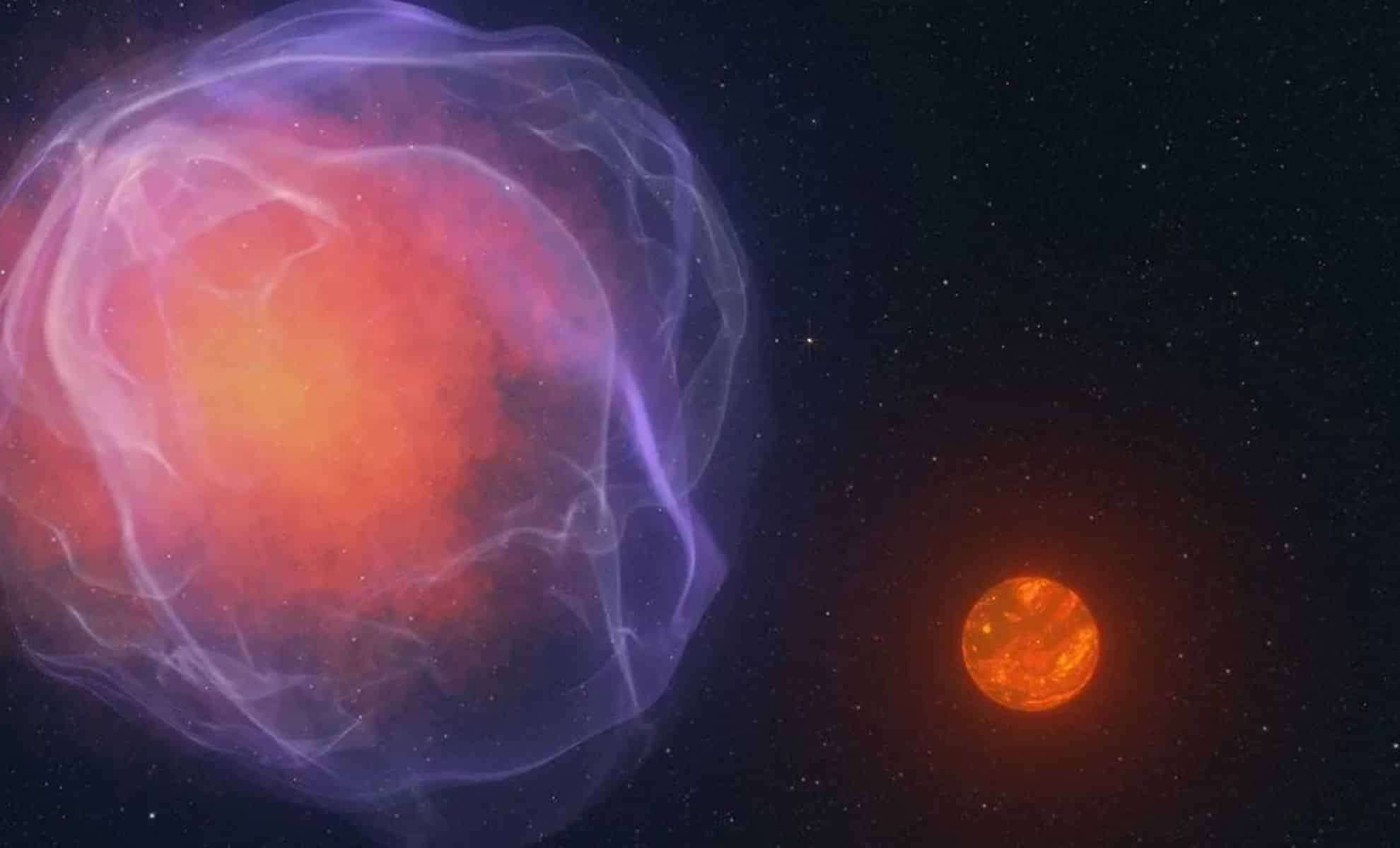
NASA’s citizen science initiative has led to the identification of a staggering hypervelocity object traveling at roughly 1 million miles per hour.
This celestial body, with a mass comparable to or smaller than a low-mass star, is moving so rapidly that it is expected to break free from the Milky Way’s gravitational pull and journey into intergalactic space. This finding, achieved through the NASA Backyard Worlds: Planet 9 program, highlights the valuable contributions of citizen scientists in expanding our cosmic knowledge.
Unveiling CWISE J1249 through NASA’s Backyard Worlds Endeavor
The Backyard Worlds: Planet 9 initiative engages volunteers in analyzing data collected by NASA’s WISE spacecraft, which initially surveyed the sky in infrared wavelengths between 2009 and 2011. Its successor, NEOWISE, continued this effort from 2013 until retiring in August 2024, delivering essential astronomical data.

Volunteer researchers Martin Kabatnik, Thomas P. Bickle, and Dan Caselden detected a faint and swiftly moving object—CWISE J124909.08+362116.0 (nicknamed "J1249")—within the WISE archives. Subsequent observations by terrestrial telescopes confirmed the object’s presence, revealing an unusual entity that challenges traditional classification as either a star or a brown dwarf due to its distinct mass and velocity.
An Uncommon Hypervelocity Phenomenon
While hypervelocity stars are a rarity, J1249’s notably low mass and chemical makeup—which includes a scarcity of iron and metals—sets it apart. This atypical elemental composition suggests it could be a remnant from one of the Milky Way’s earliest stellar generations, marking it as an ancient cosmic artifact.
Researchers speculate that J1249 may have originated in a binary system alongside a white dwarf that underwent a supernova explosion, propelling J1249 to extreme speeds. Alternatively, gravitational encounters within a globular cluster involving a pair of black holes might have accelerated it to such incredible velocities.
Observing Hypervelocity Stars with Help from the Public
Another hypervelocity star discovered through the Backyard Worlds project is zipping through space at around 1.3 million miles per hour, equivalent to nearly 0.1% of light speed. Situated approximately 400 light-years from Earth, this star—also known as CWISE J1249+36—holds the record as the closest known hypervelocity star to our solar system. Its path suggests it too may eventually leave the Milky Way.
Under the guidance of Professor Adam Burgasser at the University of California, San Diego, scientists examined this star’s characteristics using data gathered from the W. M. Keck Observatory and other ground instruments. Their analysis classifies J1249+36 as an L subdwarf, a class of low-mass, cooler stars. The star’s speed and orbit raise questions about whether it was expelled from a binary system by a supernova blast or propelled from a globular cluster via interactions with a black hole binary.
Citizen Science: Transforming Our View of the Cosmos
These remarkable findings demonstrate the growing influence of citizen scientists in the field of astronomy. Programs like Backyard Worlds harness human pattern recognition skills, often outperforming automated algorithms in identifying subtle signals within vast datasets.
The partnership between volunteers, academic researchers, and students is reshaping astronomical research, driving new discoveries and providing fresh perspectives on the universe’s mysteries.
Locating hypervelocity objects like CWISE J1249 and J1249+36 opens new avenues for studying their origins and the gravitational processes within the Milky Way. Continued examination of their elemental compositions could unveil details about their parent systems, enriching our understanding of galactic history and cosmic dynamics.
- Categories:
- Astronomy ,
- News ,
- Space ,
- Nasa







0 comments
Sign in to Comment