

Astronomers have obtained the clearest images yet of newborn planets in the process of forming around a faraway star, uncovering surprising bursts of growth and turbulent surroundings. Leveraging the state-of-the-art Magellan Adaptive Optics Xtreme (MagAO-X) technology, scientists examined two emerging planets orbiting the youthful star PDS 70, situated 370 light-years away in the constellation Centaurus.
Unveiling the Early Stages of Planet Formation
The PDS 70 planetary system offers a rare glimpse into the conditions that likely shaped our solar system billions of years ago. Unlike older stars, PDS 70 remains encircled by a protoplanetary disk — an extensive cloud of dust and gas where planets are born.
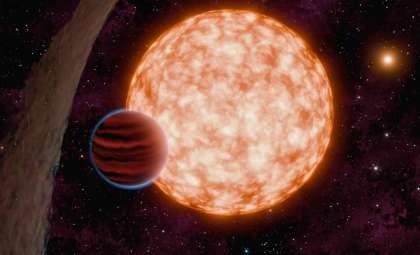
Through observations with the MagAO-X instrument, researchers detected dense dust rings enveloping the two forming planets, PDS 70 b and PDS 70 c. These rings are expected to eventually collapse, potentially leading to the formation of moons in a process similar to what occurred around Jupiter and Saturn during our solar system’s infancy.

Laird Close, a professor at the University of Arizona’s Steward Observatory, explains that massive planets behave like cosmic vacuum cleaners, creating clearings within the surrounding disk of dust and gas as they grow. The observed compact dust formations affirm that these planets influence their environment, shaping how moons and planetary traits evolve.
Advanced Optics Unveil Fine Planetary Features
Capturing images of planets in their initial formation stages poses significant challenges. Atmospheric turbulence distorts light, making clarity difficult for ground-based telescopes.
The MagAO-X system addresses this by employing a deformable mirror that adjusts its shape up to 2,000 times per second, neutralizing the atmospheric disturbances.
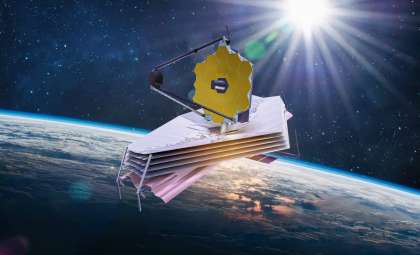
This innovation enables ground observatories to surpass the resolution capabilities of space telescopes like the Hubble Space Telescope and the James Webb Space Telescope (JWST).
Close likens this technology to noise-canceling headphones that block unwanted sounds—in this case, canceling out atmospheric blurs. The precision achieved is extraordinary.
From a distance of 370 light-years, MagAO-X can resolve details akin to distinguishing whether someone is holding one or two quarters from 125 miles away.
Unexpected Brightness Variations in Young Planets
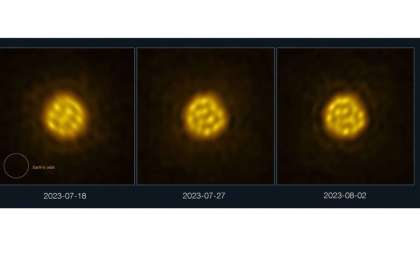
Researchers were surprised to find significant shifts in the brightness of the observed planets over time. Between 2019 and 2022, PDS 70 b faded to roughly one-fifth its initial light output, while PDS 70 c brightened to nearly double its former glow.
These changes are thought to be caused by hydrogen streams flowing onto the planets, emitting H-alpha radiation as the gas heats. The varying hydrogen inflow suggests planet formation may occur in uneven bursts rather than consistent, steady growth.
Close humorously summarized: "It’s like one planet suddenly stopped feeding while the other kept gobbling hydrogen."
The Future of Exoplanet Discovery
These observations highlight the remarkable capabilities of ground-based telescopes equipped with top-tier adaptive optics. While space telescopes like JWST provide stunning images, Earth-based facilities can leverage larger mirrors to capture even finer details of distant worlds.
Jared Males, lead scientist of the MagAO-X project, anticipates that such technological strides will simplify the detection of more infant planets and expose previously hidden aspects of planetary formation.
Enhancing observational methods will help astronomers reconstruct the history of our own solar system's origins, uncovering clues lost across billions of years.
- Categories:
- Space







0 comments
Sign in to Comment