
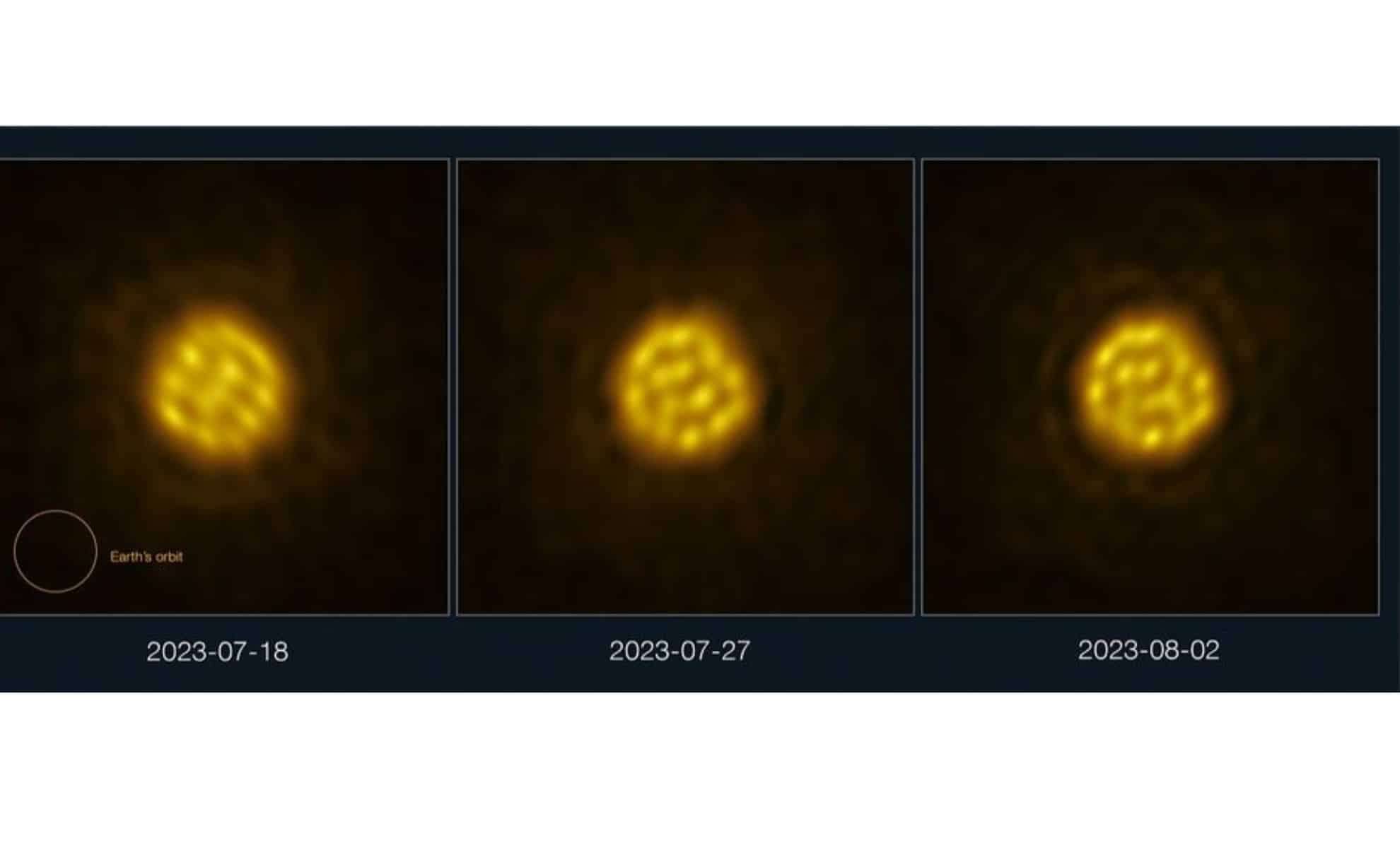
Astronomers have, for the first time, obtained high-resolution images of huge convection bubbles moving across the surface of a star beyond our Sun.
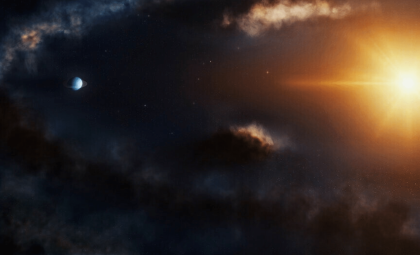
Utilizing the Atacama Large Millimeter/submillimeter Array (ALMA) in Chile, researchers concentrated on R Doradus, a red giant star located roughly 180 light-years away. Observations made during mid-2023 have unveiled fresh perspectives on the behavior of stars as they transform from stars like our Sun into red giants.
Exploring the Dynamic Surface of R Doradus
R Doradus, situated in the southern constellation Dorado, boasts a size nearly 350 times greater than the Sun, which makes it an excellent subject for detailed surface imaging. The team employed ALMA to record a time-lapse of the star’s outer layer, displaying enormous gas bubbles roughly 75 times the Sun's diameter rising and descending across the surface. These features arise from convection, the process by which hot material ascends from the inner star, cools near the surface, and sinks back down. This movement is essential for distributing heavy elements like carbon and nitrogen within the star and into the cosmos, eventually aiding the birth of new stars and planets.

Lead scientist Wouter Vlemmings from Chalmers University of Technology in Sweden expressed the significance: “This marks the first occasion to visualize the bubbling activity on an actual stellar surface in such detail.” He noted that the detailed convection patterns were unexpectedly vivid in the data. The results, published in the journal Nature, offer important clues for understanding the dynamics of aging stars.
Rapid Convection Cycles on Red Giants
Unlike our Sun, where convection cells evolve over minutes, the movements on R Doradus happen much faster, cycling in about a month. This pace surpasses prior predictions and suggests that convection alters dramatically as stars expand into their red giant stage. Vlemmings remarked that the cause of this accelerated convection is still unknown, emphasizing the need for ongoing research into the changing physics of older stars.
Though R Doradus is immense in size, its mass remains similar to the Sun’s, making it an invaluable model for forecasting the future of our solar star as it enters its red giant phase billions of years from now. During this stage, stars swell considerably and lose substantial mass, dispersing outer layers into space. Studying R Doradus provides a rare glimpse into these transformative processes expected for the Sun.
ALMA’s Breakthrough in Stellar Surface Imaging
The detailed images captured by ALMA mark an enormous step forward in observing distant stellar surfaces. Previously, such detailed convection observations were restricted to the Sun due to its closeness. With ALMA’s advanced resolution, astronomers can now directly observe the physical mechanisms governing stellar evolution on stars far beyond our solar system. Co-author and Chalmers PhD candidate Behzad Bojnodi Arbab reflected, "It's extraordinary to directly capture surface details on stars so remote from Earth."
This study also clarifies an earlier mystery regarding the rotation of R Doradus. Previous data hinted at unusually rapid rotation for a red giant, but the new observations confirm the star rotates more slowly than initially thought. This contrasts with the previously suggested illusions caused by surface bubbling seen in similar stars like Betelgeuse, offering fresh insights into red giant rotation dynamics.
Looking Ahead: Implications for Stellar Evolution Research
The ability to monitor convection and surface activity on stars like R Doradus represents a major advancement in astrophysics. Since red giants are crucial to enriching the universe with heavier elements, understanding their behavior informs models of star life cycles and planetary system formation. These insights will enhance scientific predictions about the late evolutionary stages of stars akin to our Sun.
As the Sun ages and expands into a red giant, it will lose a significant portion of its mass, affecting the orbits of nearby planets such as Mercury and Venus. Observing stars like R Doradus enables researchers to better anticipate these transformations in our solar neighborhood and beyond.
The team intends to continue monitoring R Doradus with ALMA to explore further details of its convective activity and surface behavior, advancing our comprehension of stellar physics and the destiny of our Sun.
- Categories:
- Astronomy ,
- News ,
- Space ,
- Physics





0 comments
Sign in to Comment