
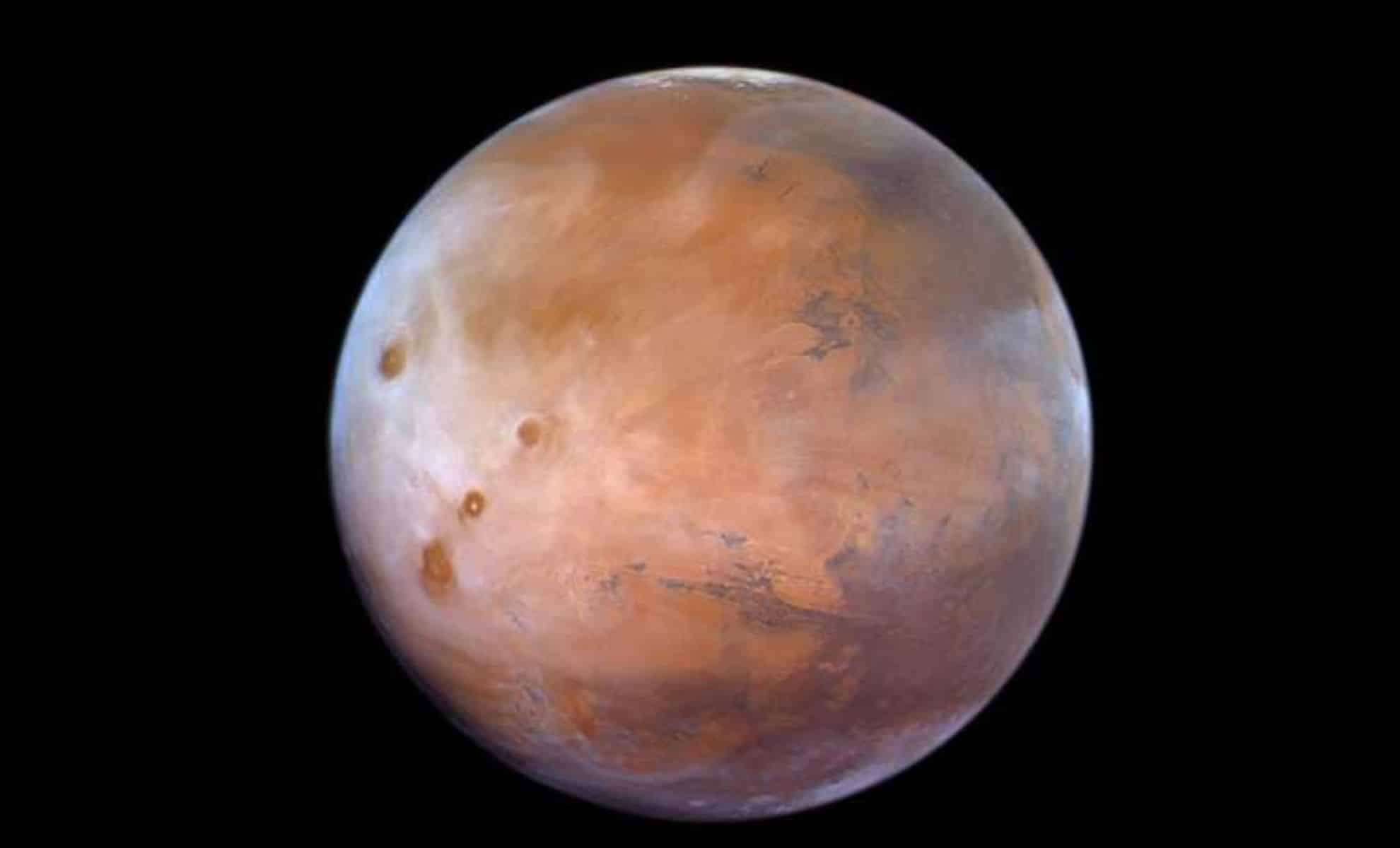
In an important breakthrough published by the Journal of Geophysical Research: Planets, scientists have, for the first time, mapped out the complete behavior of Martian clouds at night using data collected by the Hope probe from the Emirates Mars Mission. This research, titled The Full Diurnal Cycle of Mars Water‐Ice Cloud Optical Depth in EMIRS Observations, fills a crucial gap in our knowledge about Martian atmospheric phenomena. Previous observations mainly focused on daylight hours, leaving cloud processes during nighttime poorly understood. Thanks to the Hope mission, this new study now offers an unprecedented view of how Mars’s clouds evolve around the clock, deepening our insight into the Red Planet’s climate dynamics.
This discovery plays a vital role in improving the precision of climate simulations for Mars and expands our comprehension of cloud formation mechanisms that are relevant for planetary science at large. These findings not only illuminate key aspects of Mars’s atmosphere but also set the stage for enhanced planning of upcoming space expeditions.
Understanding Nighttime Martian Clouds and Their Climate Influence
Mars’s atmosphere, though much thinner and drier than Earth’s, hosts clouds made of fine water ice particles. These clouds significantly affect the planet’s climate, much like clouds on our own planet. A long-standing challenge for researchers has been to grasp how these clouds form and shift during a full Martian day. Orbiting since 2021, the Hope probe has captured comprehensive, round-the-clock data, especially focusing on nighttime phenomena.

Analyzing nearly two full Martian years of observations from the Emirates Mars Infrared Spectrometer (EMIRS), scientists discovered that clouds at night are generally denser than those recorded during the day. This revelation is crucial for fine-tuning our understanding of Martian weather and helps scientists improve climate models. By studying these daily cycles in detail, researchers can better anticipate how weather patterns on Mars will develop, which is key for assessing factors like habitability and resource potential for future human missions.
Hope Probe’s Strategy for Capturing Mars’s Daily Cloud Cycle
The Emirates Mars Mission was carefully engineered so that the Hope probe’s orbit would allow it to monitor Mars continuously through day and night, covering nearly the entire planet. Its elliptical, low-inclination orbit facilitates data collection across a wide range of latitudes and longitudes. The mission’s signature instrument, the Emirates Mars Infrared Spectrometer (EMIRS), is specialized to detect water ice clouds by measuring how they scatter and absorb infrared radiation.
This capability enables scientists to gauge the optical depth—or thickness—of the clouds throughout the whole Martian day. EMIRS’s unique proficiency in picking up water ice presence at all times has made it instrumental in mapping nighttime atmosphere conditions, previously uncharted. Such methodology has led to the first comprehensive depiction of Mars’s cloud behavior during night hours.
New Insights into Martian Cloud Formation Patterns
Mars exhibits intricate cloud formation cycles, and this study unveiled some novel patterns. Results indicate cloudiness peaks during the pre-dawn and early evening periods, with a notable decline around midday. This implies a significant day-night influence on cloud dynamics, akin to Earth’s diurnal weather influence, where temperature shifts dictate atmospheric changes. The research further found that thick cloud layers tend to emerge during the cold season near the equator, especially just after sunrise.
During these times, the most robust clouds cluster around the equatorial region, while late evening clouds appear more broadly across lower latitudes. The timing and density patterns observed provide critical clues into Mars’s atmospheric heat distribution, offering refined inputs for energy balance models crucial to understanding the planet’s climate and prospects for habitability.
Cloud Formation Linked to Mars’s Volcanic Region Tharsis
A particularly fascinating outcome of the research highlights that early morning cloud buildup is concentrated over the volcanic Tharsis region. Positioned near the equator, this extensive volcanic plateau is known for some of the solar system’s largest volcanoes, which likely influence atmospheric conditions uniquely. Findings indicate this area is a hotspot for morning cloud density.
Volcanic features here might cause localized thermal anomalies that trigger condensation of water ice clouds. Grasping this relationship between geology and atmosphere presents valuable opportunities for further exploration of how Mars’s surface shapes its climate. Such understanding may shed light on the planet’s ancient environment and its potential for sustaining life.
Advancing Mars Climate Models and Exploration Missions
The comprehensive data from the Hope mission significantly enrich climate models by offering new details on cloud thickness and distribution through varied times. This is vital for interpreting Mars’s fluctuating temperatures and atmospheric phenomena driven by its thin atmosphere and lack of a protective magnetic shield.
Incorporating these insights into simulations allows more accurate forecasts of weather and climate shifts, informing the design of future rovers and landers. These spacecraft must endure the extreme cold nights on Mars when temperatures plunge drastically. Understanding full-day cloud patterns enhances mission planning, ensuring equipment can survive and operate effectively amid Mars’s challenging environment.
- Categories:
- News





0 comments
Sign in to Comment