
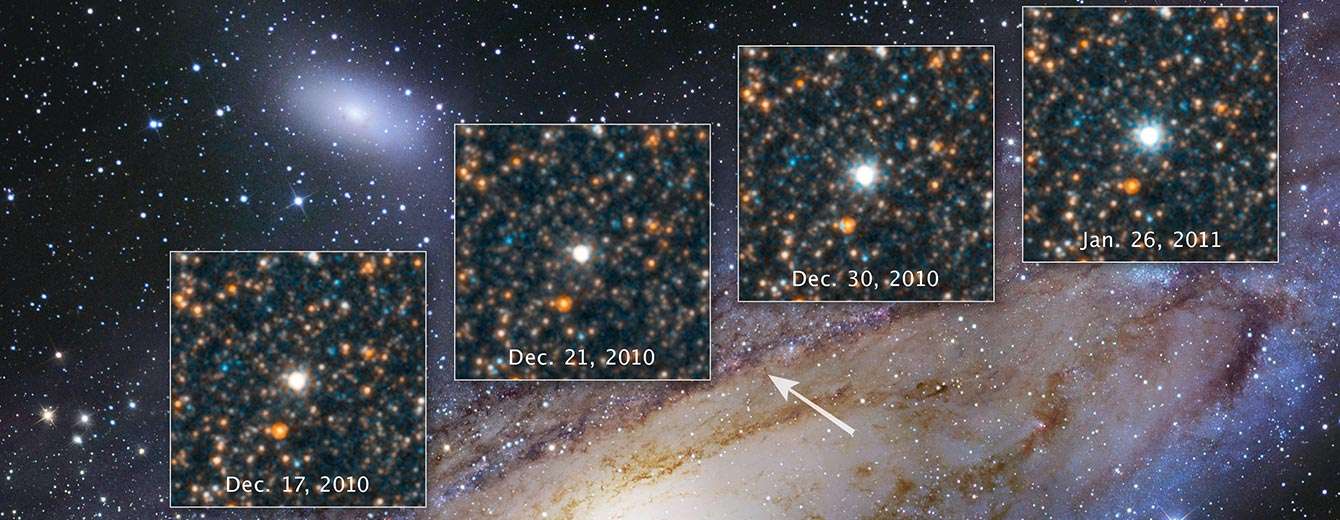
One hundred years ago, Edwin Hubble made a discovery that would forever change our cosmic perspective. By identifying a faint variable star, known as V1, in the Andromeda Galaxy, he proved that the universe is far more immense than previously conceived. This breakthrough ignited a century of astronomical discovery and transformed our understanding of the cosmos.
Solving the Enigma of Spiral Nebulae
At the start of the 20th century, astronomers were baffled by the nature of so-called “spiral nebulae.” These swirling formations stood out from other celestial objects cataloged by Charles Messier during the 18th century.
Using spectroscopy, Vesto Slipher detected that the light from these nebulae displayed redshift, indicating they were moving away from our planet. This posed a critical question: were these nebulae components of the Milky Way, or did they represent something far greater?
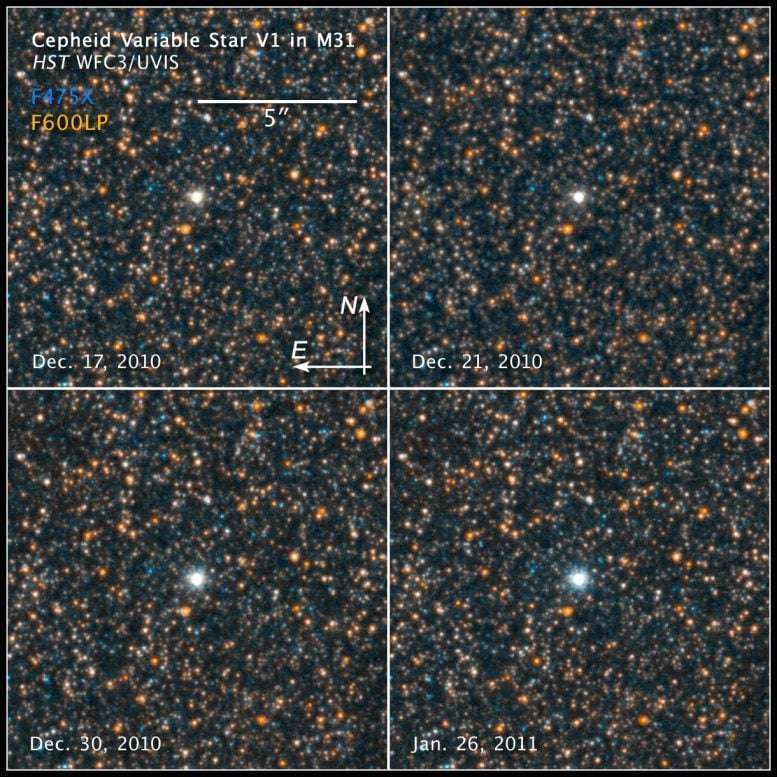
To solve this mystery, Edwin Hubble focused on Cepheid variable stars, a special class whose pulsation patterns directly relate to their true brightness. By analyzing a Cepheid in Andromeda, Hubble calculated that it was located more than 2 million light-years away—well beyond the Milky Way’s edges. This finding confirmed that spiral nebulae were not just cloud-like features in our galaxy, but entire galaxies themselves.

A Milestone in Astronomical History
Hubble’s discovery was a paradigm shift in science and altered humanity’s conception of the universe. Recognizing that the Milky Way was one of countless galaxies redefined cosmology. Further studies showed that galaxies are moving apart, establishing the universe’s expansion, which paved the way for the Big Bang theory.
Contemporaries appreciated the magnitude of Hubble’s work. Harvard astronomer Harlow Shapley, who once envisioned a much smaller universe, famously described Hubble’s findings as “the letter that destroyed my universe.”
The Enduring Impact of V1 and the Hubble Space Telescope
Over the last century, astronomers have advanced Hubble’s legacy with improved technology. The Hubble Space Telescope, launched in 1990 to honor him, has drastically expanded our cosmic vision.
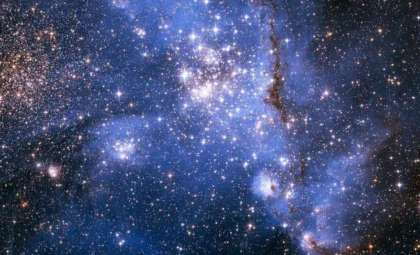
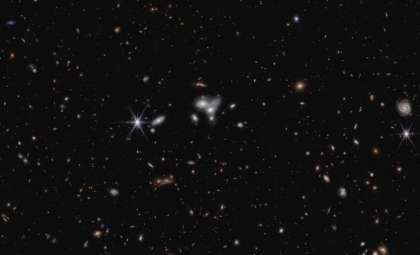
Orbiting above Earth’s atmosphere, the telescope has captured stunning images of remote galaxies, dynamic stars, and elusive phenomena such as dark energy. It has refined measurements of the universe’s age—now known to be approximately 13.8 billion years—and has enhanced our grasp of cosmic expansion.
Hubble’s identification of the star V1 marked the first rung on the “cosmic distance ladder,” a method that remains crucial for gauging distances to distant galaxies. Cepheid variables continue to be pivotal, now observed at distances over 100 times greater than in Hubble’s era thanks to modern telescopes.
From Discovering Dark Energy to Launching New Telescopes
In 1998, the Hubble Space Telescope uncovered another astonishing truth: the universe’s expansion is accelerating under the influence of a mysterious force called dark energy. This enigmatic energy challenges our understanding and suggests that the universe’s ultimate fate remains uncertain. Future missions, including the Roman Space Telescope, are set to investigate this phenomenon further.
Hubble’s pioneering efforts still deeply influence astronomy today. His observations linking galaxy distances to their redshifts form the basis of the Hubble-Lemaître law, a fundamental principle in modern astrophysics.
Transforming Our Cosmic Perspective
Hubble’s identification of V1 not only expanded our knowledge but also reshaped humanity’s place in the universe. The insight that Earth is but a tiny speck in a vast, largely unexplored cosmos evokes both humility and awe. The spirit of discovery inspired by these revelations continues as scientists delve ever deeper into the origins of stars, galaxies, and the universe itself.
- Categories:
- Space



0 comments
Sign in to Comment