
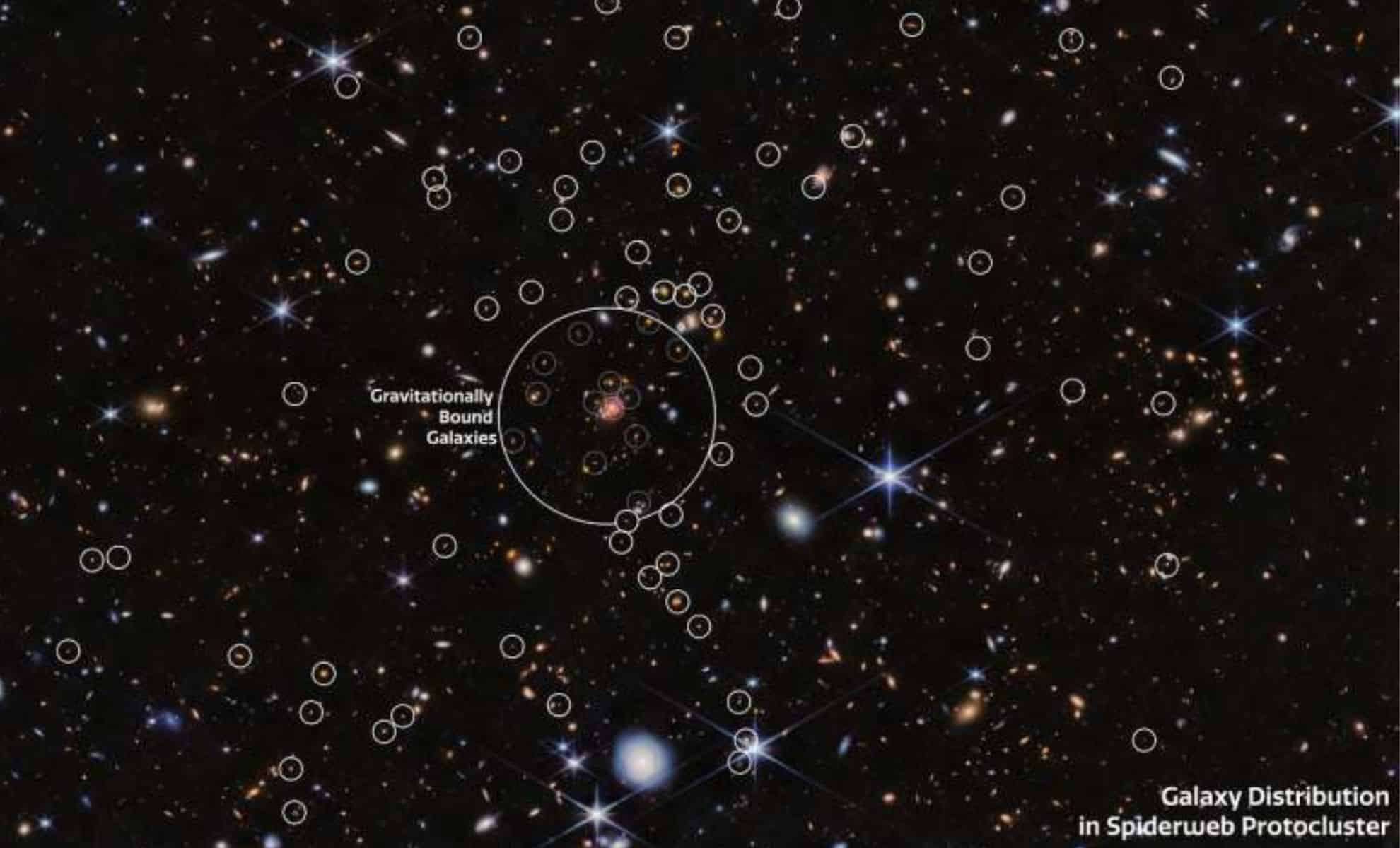
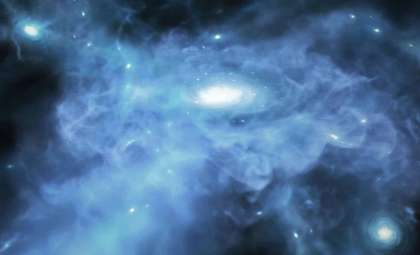
The James Webb Space Telescope (JWST) has once again expanded our cosmic horizons by revealing previously unseen details about the Spiderweb Protocluster, a densely packed galaxy assembly located over 10 billion light-years from Earth. Leveraging Webb’s sophisticated infrared instruments, astronomers have gained fresh perspectives on the early stages of galaxy formation and evolution, challenging longstanding theories about the growth of large-scale cosmic structures.
Discovery of Concealed Galaxies in the Spiderweb Cluster
For years, the Spiderweb Protocluster has attracted significant attention as a prime site for examining the birth of massive cosmic formations. This developing cluster already hosts upwards of a hundred identified galaxies, whose ancient light journeys through time to inform us about the universe's infancy.
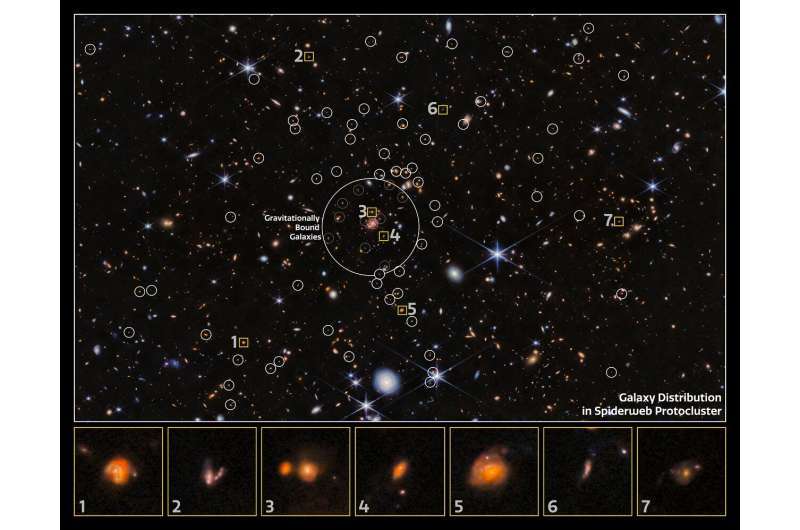
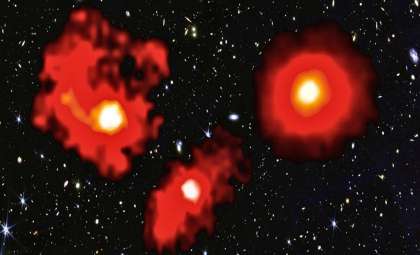
By utilizing the James Webb Space Telescope’s Near-Infrared Camera (NIRCam), researchers have unveiled additional, previously hidden galaxies embedded within this distant cluster. The team concentrated on characterizing these galaxies’ physical attributes and understanding their role in the protocluster’s evolution. Webb’s infrared vision allowed scientists to penetrate cosmic dust clouds that had obscured these galaxies in earlier surveys.

Jose M. Pérez-Martínez of the Instituto de Astrofísica de Canarias and Universidad de La Laguna in Spain emphasized the significance: “We are observing the build-up of one of the largest structures in the universe, a city of galaxies in construction.” These findings represent a pivotal advance in unpacking how vast galaxy conglomerates form and change over billions of years.
Unexpected Clarity: Less Dust Than Anticipated
One of the study’s surprising outcomes is the discovery that numerous galaxies in the Spiderweb Protocluster exhibit significantly less dust obscuration than scientists had expected. Rhythm Shimakawa from Waseda University in Japan stated, “As expected, we found new galaxy cluster members, but we were surprised to find more than expected. We found that previously-known galaxy members (similar to the typical star-forming galaxies like our Milky Way galaxy) are not as obscured or dust-filled as previously expected.”
This runs contrary to earlier assumptions predicting heavy dust presence in such dense regions that could mask galaxy visibility. Webb’s observations demonstrate that many cluster galaxies shine with surprising clarity, suggesting alternative developmental processes at play.
Rethinking Growth of Galaxies in Protoclusters
These revelations prompt a reassessment of how galaxies within tight protocluster environments mature. Earlier models proposed that galaxy expansion was predominantly driven by gravitational interactions and galaxy mergers, which typically spark bursts of star formation. However, researchers now propose a different picture for the Spiderweb Protocluster.
Helmut Dannerbauer from the Instituto de Astrofísica de Canarias commented, “The growth of these typical galaxies is not triggered primarily by galaxy interactions or mergers that induce star-formation. We now figure this can instead be explained by star formation that is fueled through gas accumulating at different locations all across the object’s large-scale structure.” This suggests star formation is stimulated by the accumulation of gas over widespread areas rather than direct galaxy collisions.
This fresh perspective challenges conventional narratives on galaxy formation, pointing to more diffuse, large-scale processes governing star creation in the early universe. The implications for cosmic evolution theories are profound.
Webb’s Infrared Vision: A Window Through Cosmic Dust
The breakthrough relies heavily on Webb’s powerful infrared sensors, which can penetrate clouds of cosmic dust that block visible light. This capability allowed astronomers to detect galaxies otherwise hidden from view within the Spiderweb Protocluster. Employing hydrogen gas diagnostics and sophisticated tracers, the researchers mapped these galaxies in extraordinary detail, advancing our knowledge of their features and how they grow.
Jose M. Pérez-Martínez remarked, “Now, Webb is giving us new insights into the build-up of such structures for the first time.” Examining distant galaxies at infrared wavelengths not only clarifies their physical makeup but also enhances our understanding of the evolution of the universe’s largest structures.
Future Directions: Spectroscopy and Extended Analysis
Building on this initial breakthrough, the team plans to deepen their investigation of the newly identified galaxies within the Spiderweb Protocluster. Upcoming studies, including spectroscopic observations conducted with Webb, will confirm their presence and provide richer detail on their characteristics. Continued research aims to refine models of galaxy formation and the developmental history of protoclusters.
These discoveries have been documented in two recent articles in The Astrophysical Journal, presenting results from Webb’s NIRCam observations. They are anticipated to inspire further scientific inquiry into how gas dynamics influence galaxy growth and the overall evolution of protocluster systems.
- Categories:
- Astronomy ,
- News ,
- Space ,
- Nasa






0 comments
Sign in to Comment