
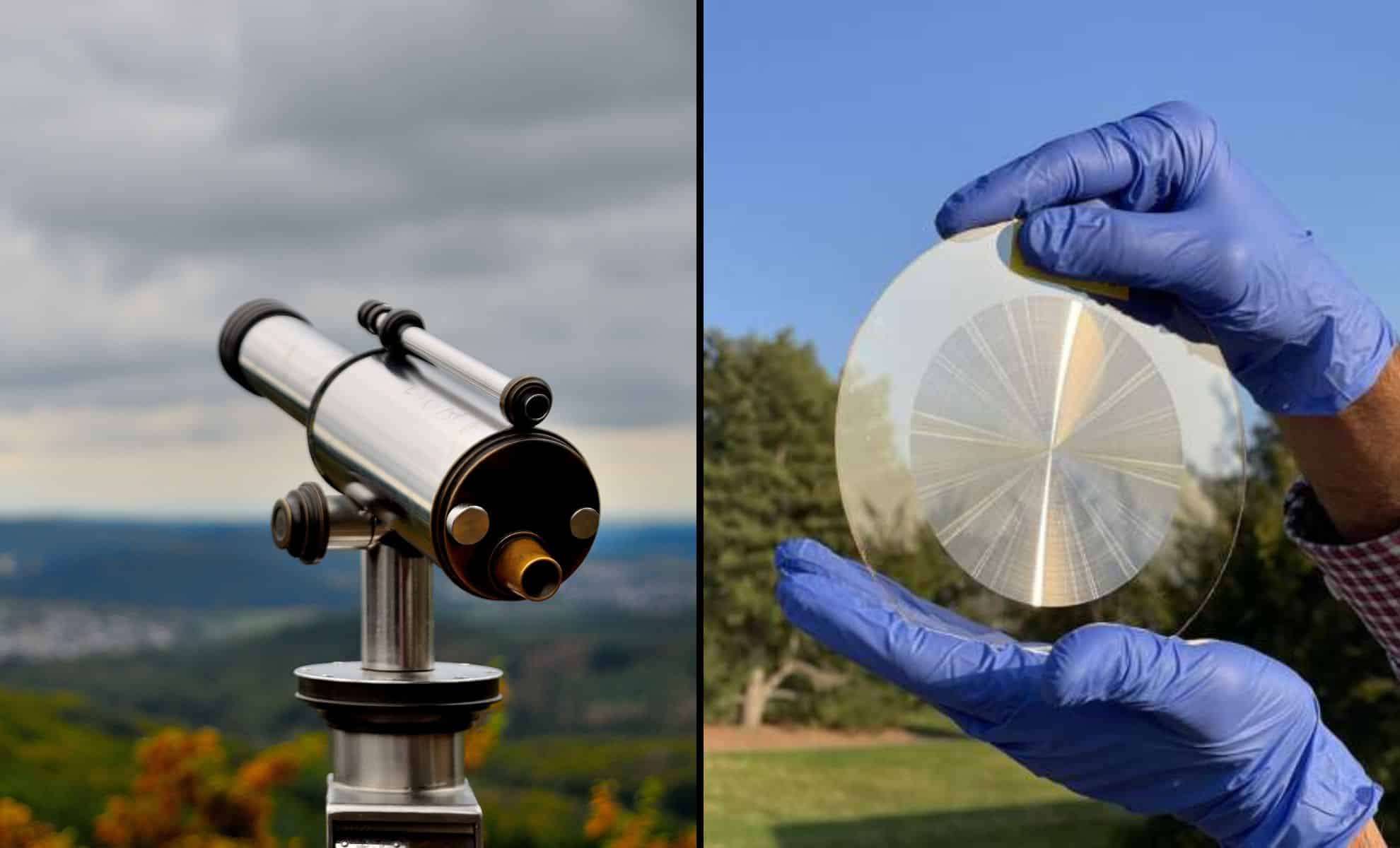
For hundreds of years, telescopes have depended on curved glass lenses to focus light and explore the universe. However, these traditional lenses become bulkier and heavier as their magnifying power increases, posing significant challenges for space telescopes and satellites where every gram counts.
A research group at the University of Utah has now introduced a groundbreaking flat telescope lens that accurately captures colors while detecting faint light from faraway stars. This sleek, lightweight innovation has the potential to reshape how telescopes are designed, making them slimmer, more precise, and easier to deploy in space.
Published in Applied Physics Letters, the study highlights how this ultra-thin lens focuses light as effectively as conventional curved lenses but without the common issues of color distortion encountered in earlier flat designs.

Challenges of Conventional Telescope Lenses
Optical lenses bend light to magnify remote objects, requiring increased curvature to achieve higher magnifications. While this works well for cameras or small telescopes, astronomical lenses need to be very large to gather sufficient light from remote galaxies and exoplanets.
Consequently, large observatories and space telescopes such as Hubble and James Webb use sizeable curved mirrors rather than lenses. Mirrors are typically lighter and can be thinner, which is ideal for space-based imaging. Yet, optical engineers have long sought flat lenses that offer the same capabilities as traditional optics but with reduced weight and size.
Up to now, flat lenses faced the major obstacle of color distortion. For instance, Fresnel zone plates (FZPs) use rings to bend light but fail to maintain accurate colors because different wavelengths focus unevenly, leading to chromatic aberrations.
The new lens concept developed at the University of Utah addresses this issue effectively.
A Color-Precise Flat Lens Innovation
This advancement stems from a novel multi-level diffractive flat lens created by Professor Rajesh Menon and his team at the University of Utah’s Optical Nanotechnologies Laboratory.
“Our computational modeling indicated that it’s possible to engineer multi-level diffractive flat lenses with large apertures that focus light uniformly across the visible spectrum, and we have the facilities at Utah Nanofab to fabricate them,” Menon explained.
Unlike earlier flat lenses impaired by color inaccuracies, the team crafted microscopic concentric grooves on the lens surface. These tiny structures are precisely tuned to simultaneously focus all light wavelengths, yielding vivid, sharp images free from chromatic errors.
“To simulate lens behavior across a broad spectrum—from visible to near-infrared—we tackled extensive computational challenges requiring large datasets,” said lead author Apratim Majumder.
By meticulously adjusting the indentations’ dimensions and spacing, the researchers fabricated a 100 mm-diameter flat lens with an f/2 aperture, matching the light focusing performance of traditional curved lenses.

Proof of Concept: Clear Images of the Sun and Moon
Demonstrating their flat lens, the team captured astrophotography images of the Sun and Moon with remarkable clarity and true-to-life colors. These results confirm the lens’s potential as a practical alternative to bulky traditional optics.
This success marks a critical advance toward lightweight, color-accurate imaging tools for space telescopes, satellites, and airborne platforms.
“Our demonstration lays the groundwork for creating large-aperture, lightweight flat lenses capable of full-color imaging for air- and spaceborne telescopes,” Majumder concluded.
- Categories:
- News












0 comments
Sign in to Comment