
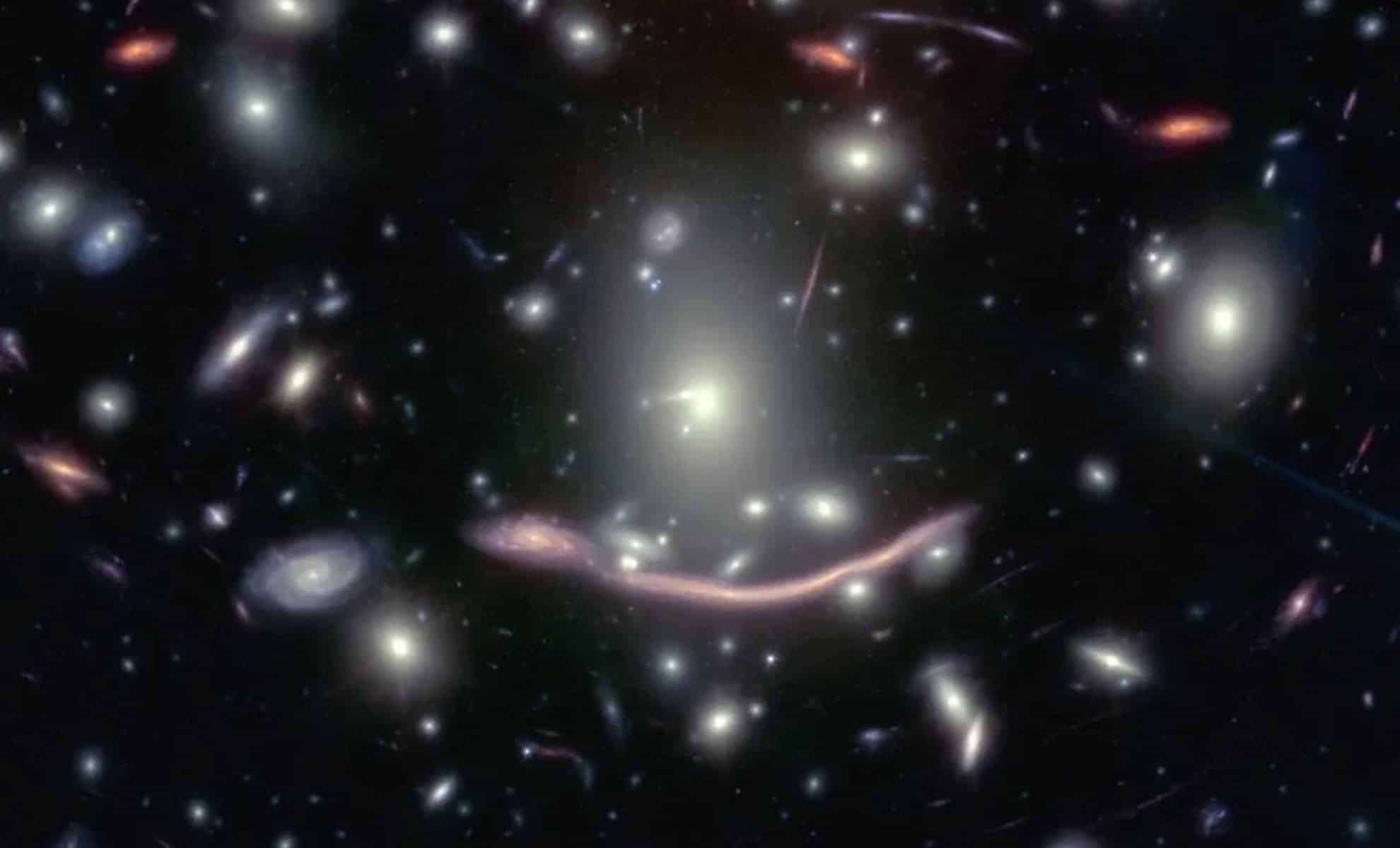
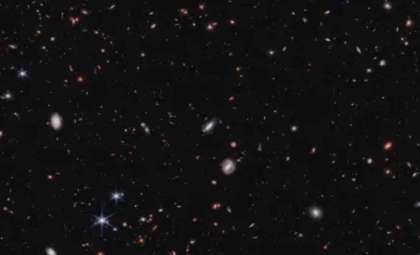
NASA’s James Webb Space Telescope (JWST) is unveiling the universe’s hidden marvels with stunning clarity. In a remarkable breakthrough, astronomers have pinpointed 44 individual stars in a galaxy situated 6.5 billion light-years away—capturing a view reaching back close to the Big Bang. This record-setting observation offers a remarkable window into the cosmos’s early periods.
The Dragon Arc and the Power of Gravitational Lensing
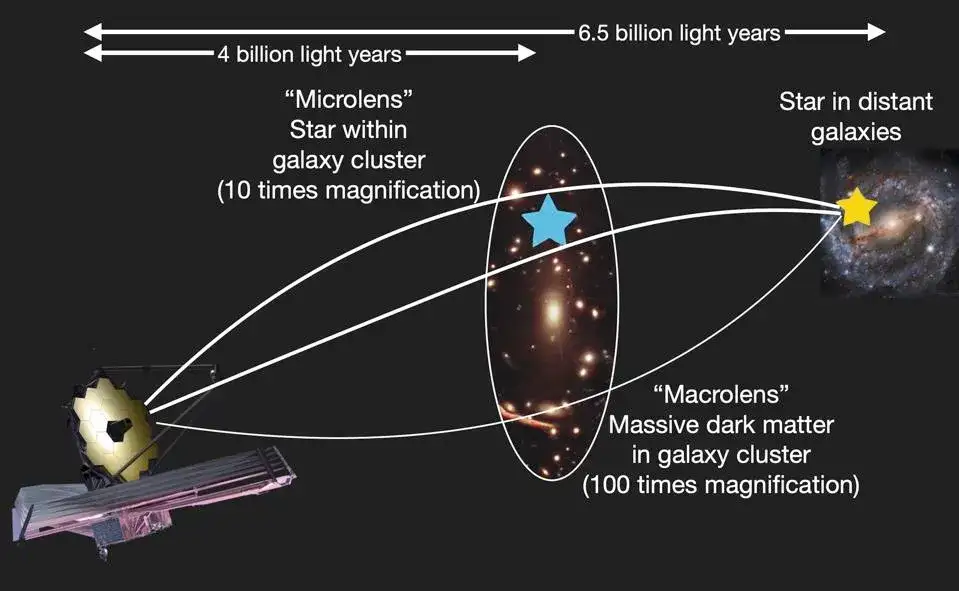
This breakthrough hinges on the extraordinary cosmic effect called gravitational lensing. Predicted by Albert Einstein, this phenomenon arises when a massive object like the galaxy cluster Abell 370 bends and amplifies the light from objects behind it. The resulting distorted light forms stunning arcs and rings, unveiling features otherwise hidden to observers.
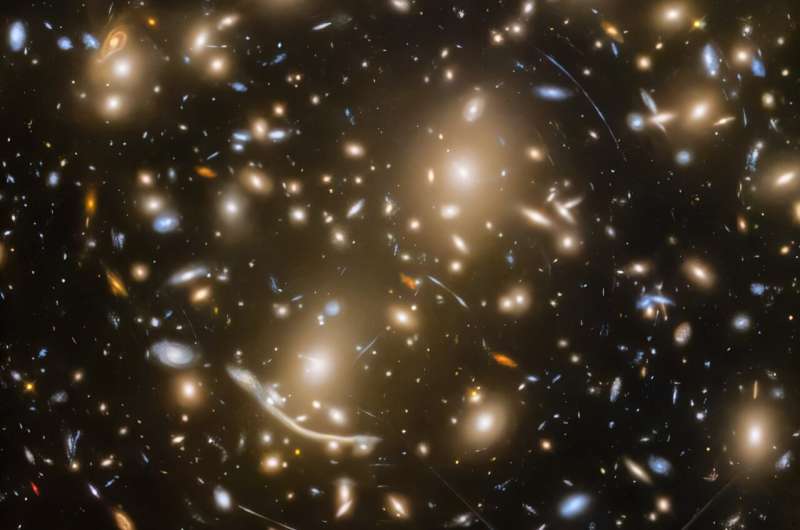
Among these features is the “Dragon Arc,” a luminous crescent where JWST was able to resolve the 44 stars. Gravitational lensing amplified their brightness by factors ranging from hundreds to thousands, allowing astronomers to detect individual stars at incredible distances—a feat impossible without this cosmic magnification, even with JWST’s advanced technology.

A New Benchmark in Star Detection at Great Distances
Until now, spotting individual stars in galaxies so far away was beyond reach. Even the Hubble Space Telescope had only uncovered about seven stars at these immense distances. Thanks to JWST’s superior resolution and infrared capabilities, scientists have dramatically expanded this frontier, opening fresh avenues to explore ancient stellar populations.
“This groundbreaking discovery demonstrates, for the first time, that studying large numbers of individual stars in a distant galaxy is possible,” said Fengwu Sun, postdoctoral researcher and co-author of the Nature Astronomy paper detailing the findings. The stars within the Dragon Arc are mainly red supergiants, colossal stars akin to Betelgeuse in the Orion constellation. These stars are pivotal for understanding the synthesis of heavy elements and their explosive deaths as supernovae.
Insights Into Our Universe’s Formative Epoch
Detecting 44 stars in such a remote galaxy offers crucial insights into how the early universe evolved. These stars emerged during the epoch when galaxies were in the initial stages of formation, providing clues about cosmic development at a time nearly halfway back to the Big Bang.
Red supergiant stars are of particular scientific interest because they generate and scatter essential elements like oxygen and carbon, which later foster the birth of life. Observing these stars in a distant galaxy helps researchers grasp how stellar evolution impacted the cosmic environment and influenced subsequent generations of stars.
Probing the Enigma of Dark Matter
This discovery’s implications extend beyond stellar astronomy. The remarkable lensing effect that revealed the Dragon Arc is shaped by dark matter, an elusive substance comprising 85% of the universe’s mass. Analysis of the gravitational distortions allows scientists to chart the dark matter distribution in the foreground cluster Abell 370.
“Observing more individual stars will help us better understand the dark matter in the lensing plane of these galaxies and stars,” Sun remarked. This finding advances efforts to decode dark matter’s nature, one of astrophysics’ greatest mysteries.
Charting the Course for Future Research
The 44 newly identified stars in the Dragon Arc are only a starting point. Using JWST’s capabilities, astronomers aim to locate additional magnified stars across other remote galaxies to deepen understanding of the universe’s formative periods. These studies could revolutionize concepts of star formation and cosmic structure on grand scales.
JWST continues to transform our knowledge of cosmic history by capturing light from the universe’s earliest days. As this mission advances, even more profound revelations about the cosmos and its origins are expected to emerge.
- Categories:
- Astronomy ,
- News





0 comments
Sign in to Comment