
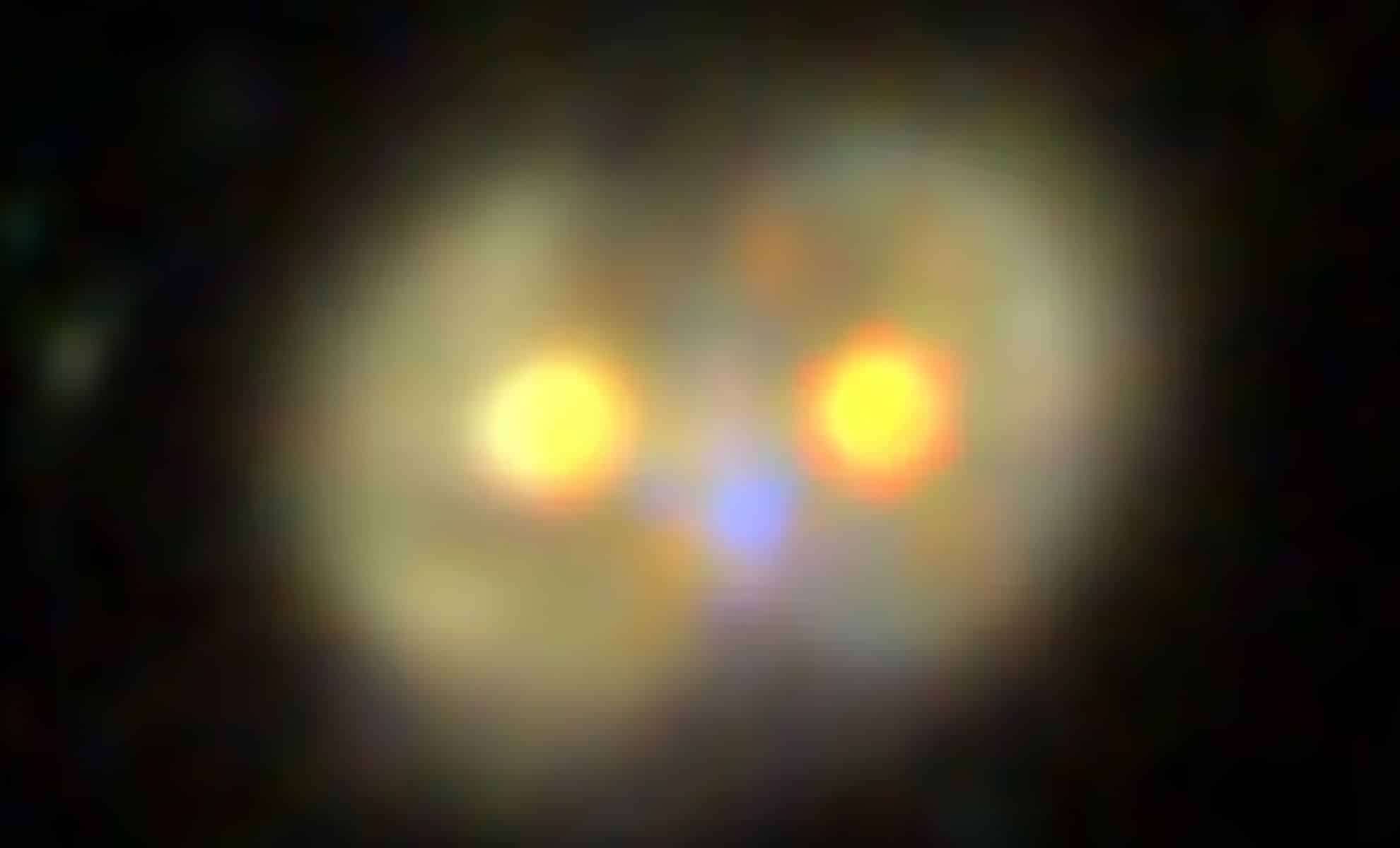
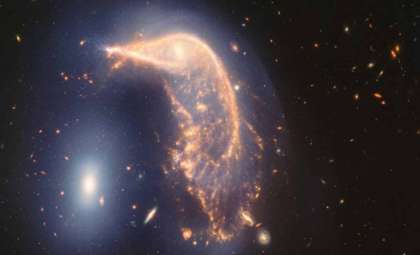
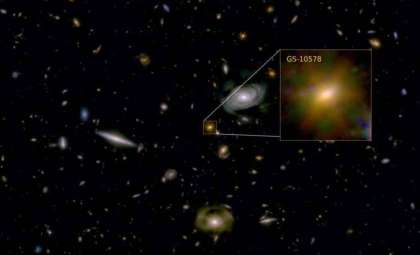
The James Webb Space Telescope has revealed an extraordinary celestial feature dubbed the “Cosmic Owl.” This unique formation, situated billions of light-years from Earth, originates from the unusual merger of two ring galaxies. It offers scientists an exceptional chance to investigate galaxy formation and their evolutionary dynamics.
Defining the ‘Cosmic Owl’ Phenomenon
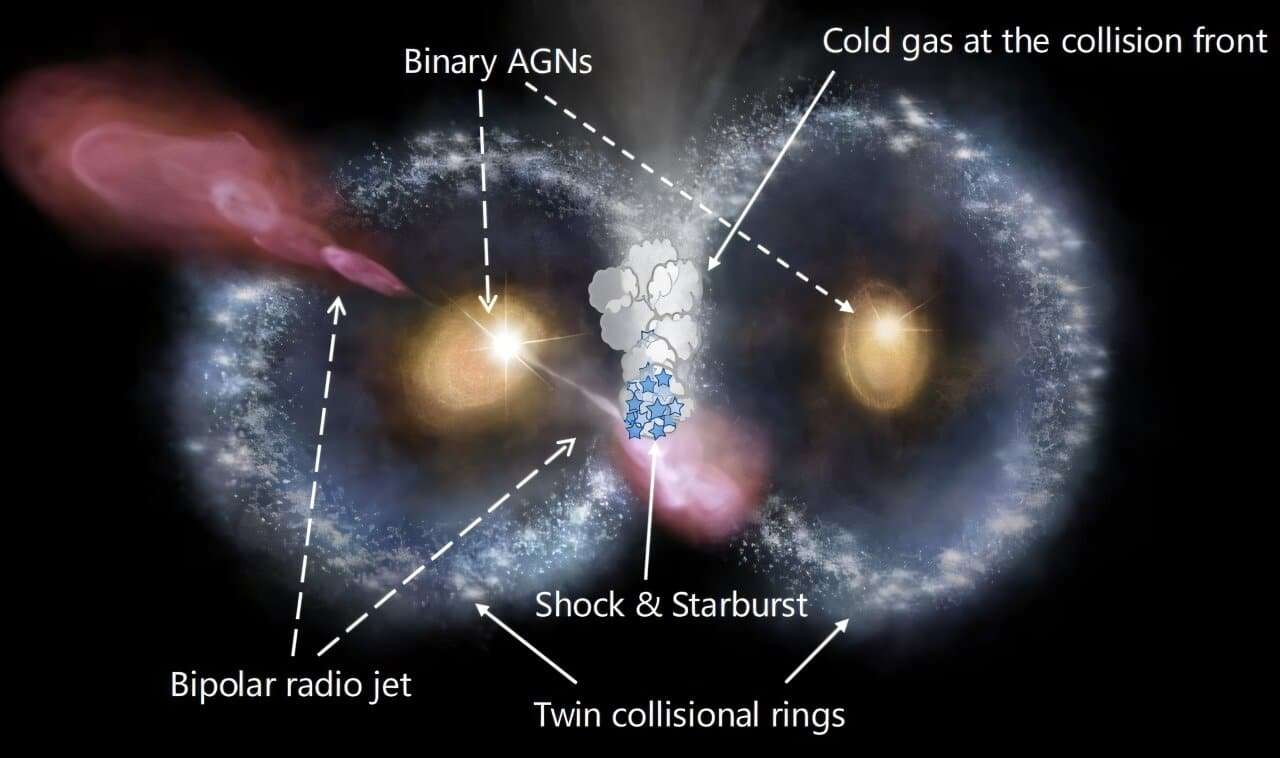
The “Cosmic Owl” gets its name from its owl-like shape evident in the detailed images captured by JWST. This form results from the interaction of two ring galaxies, producing a mesmerizing arrangement with two luminous cores resembling owl eyes and a central region akin to a beak. Each glowing “eye” harbors an active galactic nucleus (AGN), supermassive black holes that draw in surrounding matter. These black holes, each surpassing 10 million solar masses, fuel the intense activity found at the heart of the Cosmic Owl.
An Extraordinary Galactic Collision
Ring galaxies are extraordinarily uncommon, representing only about 0.01% of known galaxies. They form when a smaller galaxy pierces through a larger one, creating shock waves that compress stars and gas into a ring around a dense nucleus. The Cosmic Owl stands out even more, as it results from the rare collision between two ring galaxies. This event provides an illuminating glimpse into how galactic interactions influence their transformation.

The collision happened roughly 38 million years ago, involving two relatively modest galaxies, each about 26,000 light-years across—approximately a quarter the size of the Milky Way. Despite their smaller scale, the encounter significantly impacted their surroundings.
Star Formation Sparks at the Collision Core
In the area corresponding to the Cosmic Owl’s beak, scientists identified a highly active region where stars are being born. This zone, rich in molecular gas, serves as the critical material for star formation, compressed by the shock waves from the galactic impact. Observations with the Atacama Large Millimeter/submillimeter Array (ALMA) detected dense gas concentrations within this beak region, vital for igniting new stars. The starburst is likely triggered by both the shock-induced compression and energetic jets from one of the supermassive black holes.
This stellar nursery offers a rare opportunity to understand how galaxy collisions can accelerate star formation. The Cosmic Owl is providing researchers an unparalleled view of these energetic processes unfolding.
Unlocking Galactic Evolution Secrets
The Cosmic Owl discovery is not only visually impressive but also incredibly valuable scientifically. Mingyu Li, PhD candidate at Tsinghua University and lead researcher, emphasizes the collision’s role as a natural lab: “The Cosmic Owl allows us to witness multiple key processes involved in galaxy evolution happening simultaneously within one system.”
Studying this galactic encounter may shed light on the early stages of galaxy growth, especially how rapid gas-to-star conversion happened. Insights from the stellar mass buildup during this event could clarify how galaxies expanded swiftly in the young universe.
- Categories:
- News

0 comments
Sign in to Comment