
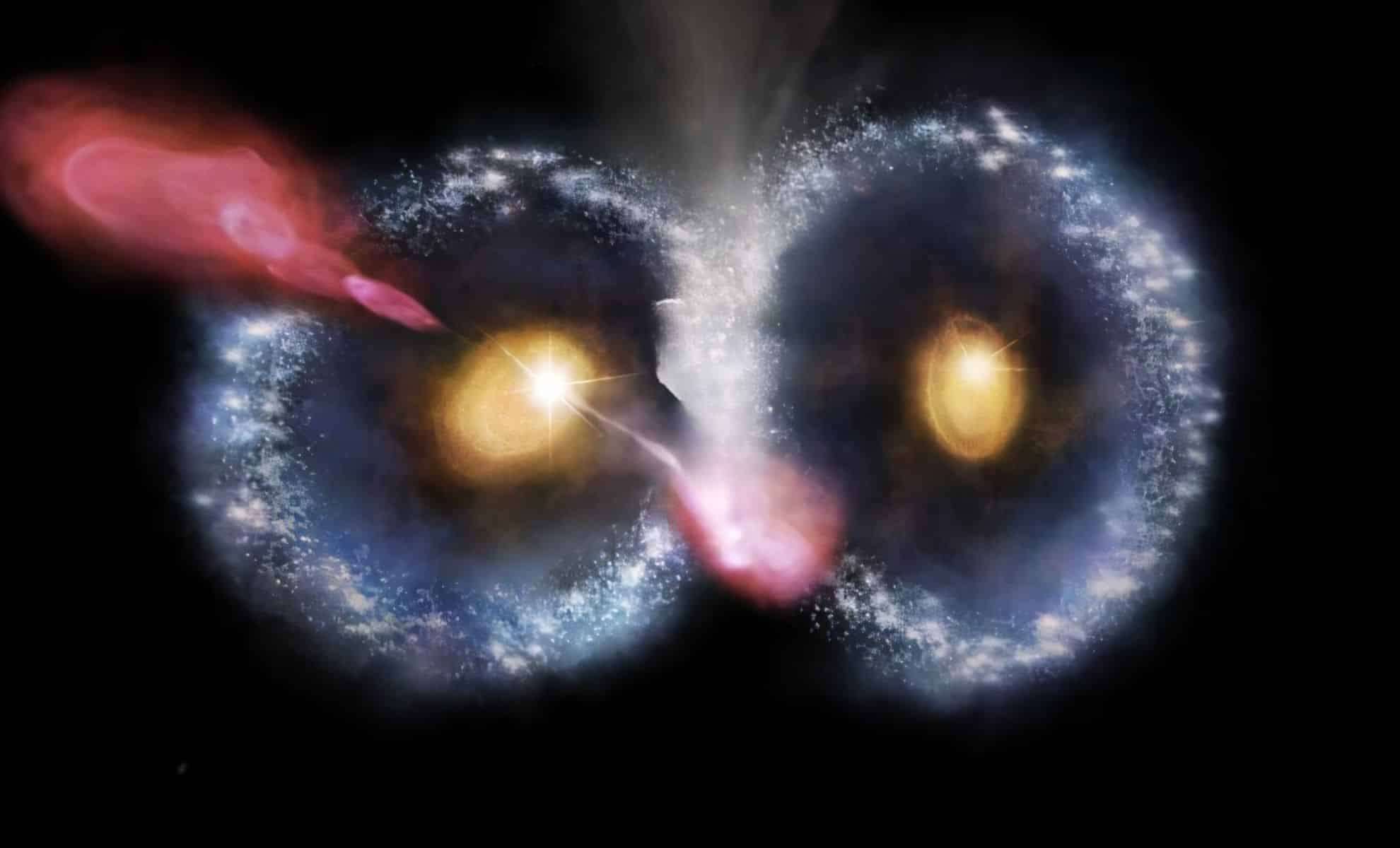
A major breakthrough has been announced by researchers from Tsinghua University in Beijing. The study, released on June 11, exposes a fascinating cosmic event termed the “Cosmic Owl.” This event is the result of two collisional ring galaxies merging, creating an image that closely resembles an owl’s visage. The discovery was made possible through observations from cutting-edge instruments such as the James Webb Space Telescope (JWST), Atacama Large Millimeter/submillimeter Array (ALMA), and the Very Large Array (VLA). Their paper, The Cosmic Owl: Twin Active Collisional Ring Galaxies with Starburst Merging Front at z=1.14, highlights novel insights into galactic development, starburst activity, and the formation of supermassive black holes during the universe’s early epochs.
Defining the Cosmic Owl Phenomenon
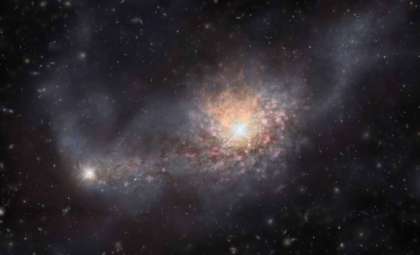
The designation “Cosmic Owl” originates from the eye-catching similarity between this galaxy merger and an owl’s face. This collision involves two rare collisional ring galaxies, which form when galaxies collide almost head-on, causing stars and gas to be flung outward into circular structures. Each of these ring galaxies spans approximately 26,000 light-years, with their cores resembling the “eyes.” Nestled between these is a bright star-forming region that mimics the owl’s beak.
This galactic interaction attracts attention due to its noticeable symmetry and the unique insights it offers into how galaxies grow and evolve. The merger triggers star formation in the central zones while shocks caused by the collision impact gas and dust, shedding light on galaxy evolution over cosmic timescales.

In-Depth Observations Reveal Details of the Cosmic Owl
At a redshift of 1.14, positioning it in the distant early universe, the Cosmic Owl was thoroughly examined using imaging and spectroscopic data. Combining observations from JWST, ALMA, and VLA allowed astronomers an unprecedented perspective of this extraordinary merger. The team remarked, “Deep imaging and spectroscopy from JWST, ALMA, and VLA reveal a complex system of twin collisional ring galaxies, exhibiting a nearly identical morphology,” emphasizing the exceptional symmetry observed.
The nearly identical collisional rings are the result of a precise galaxy alignment, indicating that the interacting galaxies are similar in size and mass. This remarkable near head-on collision provides valuable data that enables scientists to refine models of galaxy formation and evolution during their formative years.
Galaxy Mass, Central Black Holes, and Starbursts Triggered by Jets
This galactic merger serves as an illuminating example of how vast stellar masses and supermassive black holes emerge in the early universe. The combined stellar mass of the Cosmic Owl system totals roughly 320 billion times that of the Sun, characteristic of substantial, mature galaxies. Both galaxies host active galactic nuclei (AGN), with central supermassive black holes radiating intense energy. Their masses are estimated at 67 million and 26 million solar masses, respectively.
Additionally, observations captured a radio jet emanating from the northern “eye” galaxy. This jet extends into the space between merging galaxies and appears to stimulate further star production within this region. The finding is noteworthy because it implies that the jet could be a catalyst for additional bursts of star formation, illustrating the complex dynamic between galaxies, their black holes, and surrounding matter.
Understanding the Growth of Galaxies and Black Holes
Aside from its striking appearance, the Cosmic Owl provides invaluable knowledge about the mechanisms behind galaxy growth and supermassive black hole formation. The researchers pointed out that “The simultaneous occurrence of a head-on merger, twin ring formation, dual AGN activity, and a jet-triggered starburst offers a detailed snapshot of the mechanisms that assemble stellar mass and grow supermassive black holes in the early universe.” This highlights the importance of the Cosmic Owl as a remarkable glimpse into cosmic evolutionary processes.
Studying such mergers enriches our comprehension of galaxy formation and development, particularly under early universe conditions. The Cosmic Owl exemplifies the interplay between dual AGN phenomena, star formation, and jet-induced starbursts, shedding light on the complexities of galactic and black hole evolution.
What Makes the Cosmic Owl an Exceptional Find?
The Cosmic Owl’s distinctiveness arises from a rare blend of factors. Collisional ring galaxies themselves are infrequent, but the exact head-on collision creating twin rings, combined with dual AGN presence and jet-triggered starbursts, is unparalleled. Each aspect offers vital clues about the physical conditions and processes shaping galaxies during the universe’s early stages.
This extraordinary combination allows astronomers to investigate how galactic mergers influence star formation rates, black hole growth, and galaxy morphology. The discovery significantly advances our understanding of cosmic history and the intricate relationships between galaxies and their central black holes.
- Categories:
- News





0 comments
Sign in to Comment