
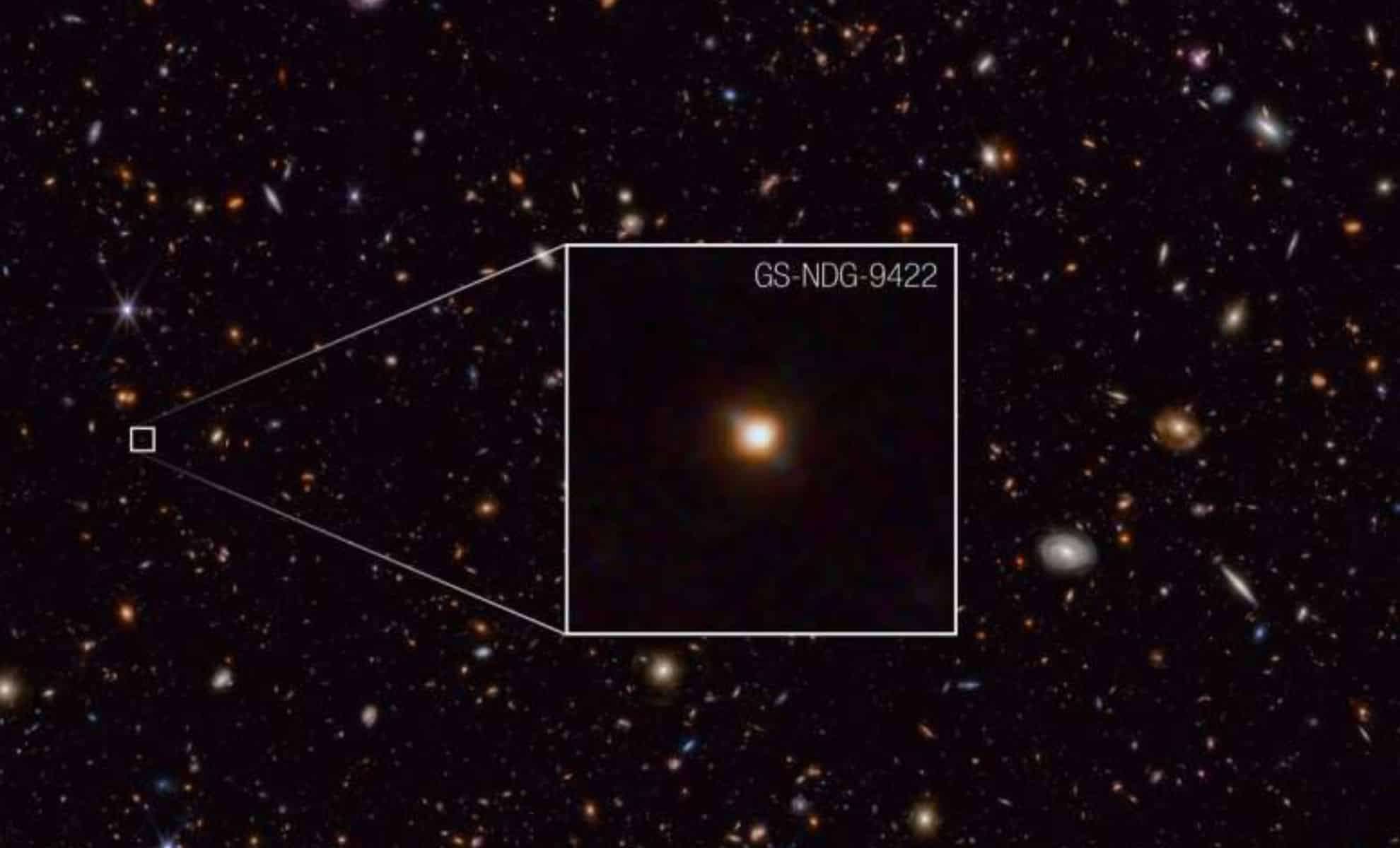
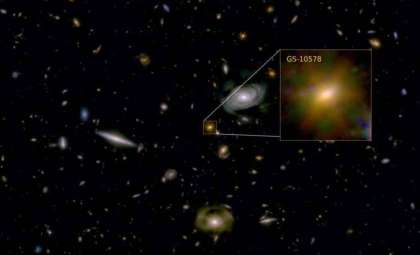
NASA’s James Webb Space Telescope (JWST) has unveiled a peculiar galaxy, GS-NDG-9422, dating back to roughly one billion years after the Big Bang.
This galaxy is unique due to an extraordinary feature: its gas outshines the stars within it, a rare characteristic offering fresh clues into galaxy formation and cosmic evolution.
An Unprecedented Galactic Discovery
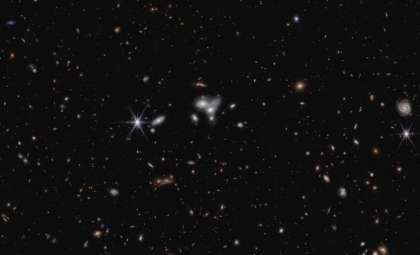
The galaxy GS-NDG-9422 was identified during JWST’s deep observations of the distant cosmos, aimed at detecting some of the universe’s earliest galaxies. Though initially faint and ordinary in appearance, it soon revealed an extraordinary light pattern. Rather than stars dominating the light emitted, the surrounding gas glows more intensely than the stars themselves—a phenomenon astronomers had not encountered until now.

Dr. Alex Cameron, who leads the study at the University of Oxford, described his surprise upon examining the spectrum: “When I first saw the galaxy’s spectrum, I thought, ‘this is unusual.’” This unique light emission likely signifies a previously unknown phase in galactic development. The gas surrounding the stars is thought to be heated to extreme temperatures by the galaxy’s massive, luminous stars, causing it to radiate more brightly than the stars themselves.
This finding aligns perfectly with JWST’s goal to uncover hidden aspects of the early universe. Designed to capture light from ancient cosmic objects, JWST allows astronomers to peer back to when the universe was less than one billion years old.

Extraordinary Hot and Massive Stars Illuminate the Galaxy
The stellar population of GS-NDG-9422 differs markedly from stars familiar in today’s universe. Collaboration between Dr. Cameron and theoretical astrophysicist Dr. Harley Katz from Oxford and the University of Chicago delved into this mystery. Katz observed, “The stars here appear to be considerably hotter and more massive than those found around us, which makes sense given the very different conditions in the early universe.”
While local universe giants typically reach temperatures between 70,000 and 90,000 degrees Fahrenheit, the stars in GS-NDG-9422 soar beyond 140,000 degrees Fahrenheit (80,000 degrees Celsius). This immense heat results from thick gas clouds undergoing intense star formation. The radiation from these colossal stars energizes the surrounding gas, causing it to shine far brighter than the stars themselves.
The team proposes this galaxy is experiencing a rare and intense period in its life, rapidly creating massive, hot stars that beam high-energy photons into the gas, making it spectacularly luminous. This discovery provides a valuable snapshot of early universe conditions and sheds light on how nascent galaxies might have emerged and transformed.
Possible Connection to the First Stars in the Cosmos
GS-NDG-9422 also prompts intriguing speculation about its relation to the universe’s earliest stars, the so-called Population III stars. These primordial stars, theorized to form from untouched gas after the Big Bang, were believed to be massive and hot like those in this galaxy. While GS-NDG-9422’s chemical makeup is too complex for it to contain true Population III stars, the similarities in stellar characteristics could reveal how early stars shaped the development of galaxies.
Katz emphasized the potential link: “Although Webb’s data rules out Population III stars here due to chemical complexity, the unusual stars in GS-NDG-9422 might guide understanding the transition from primitive stars to more chemically rich galaxies.” This connection could be crucial for piecing together how cosmic structures evolved from their primordial origins.
Examining GS-NDG-9422 may provide insights into the formative processes of early galaxies—a period when star formation and galactic growth were still unfolding. This could illuminate the interplay between massive early stars and their environments that molded later generations of galaxies.
Future Investigations and Mysteries Ahead
Despite these groundbreaking findings, many mysteries remain. Astronomers are eager to learn whether galaxies like GS-NDG-9422 were common in the universe’s infancy or represent a rare evolutionary flash. Drs. Cameron, Katz, and their teams are now searching for other galaxies exhibiting similar traits to understand the prevalence and significance of this luminous gas phenomenon during the first billion years after the Big Bang.
“There’s still much to uncover,” Cameron remarked. “Are these conditions widespread in early galaxies or infrequent? What insights do they offer about even earlier cosmic epochs?” The discovery opens exciting paths forward for exploration using JWST to identify more such galaxies and deepen our grasp of early cosmic history.
This breakthrough signals the start of a new chapter in studying galactic evolution. As Cameron concluded, “It’s thrilling to use Webb to explore previously unreachable eras of the universe. We’re only beginning to unravel its earliest secrets.” With JWST continuing to expand our view, astronomers anticipate uncovering even more stunning revelations about galaxy formation and the universe’s origin story.
- Categories:
- Astronomy ,
- News ,
- Science ,
- Nasa ,
- Physics




0 comments
Sign in to Comment