
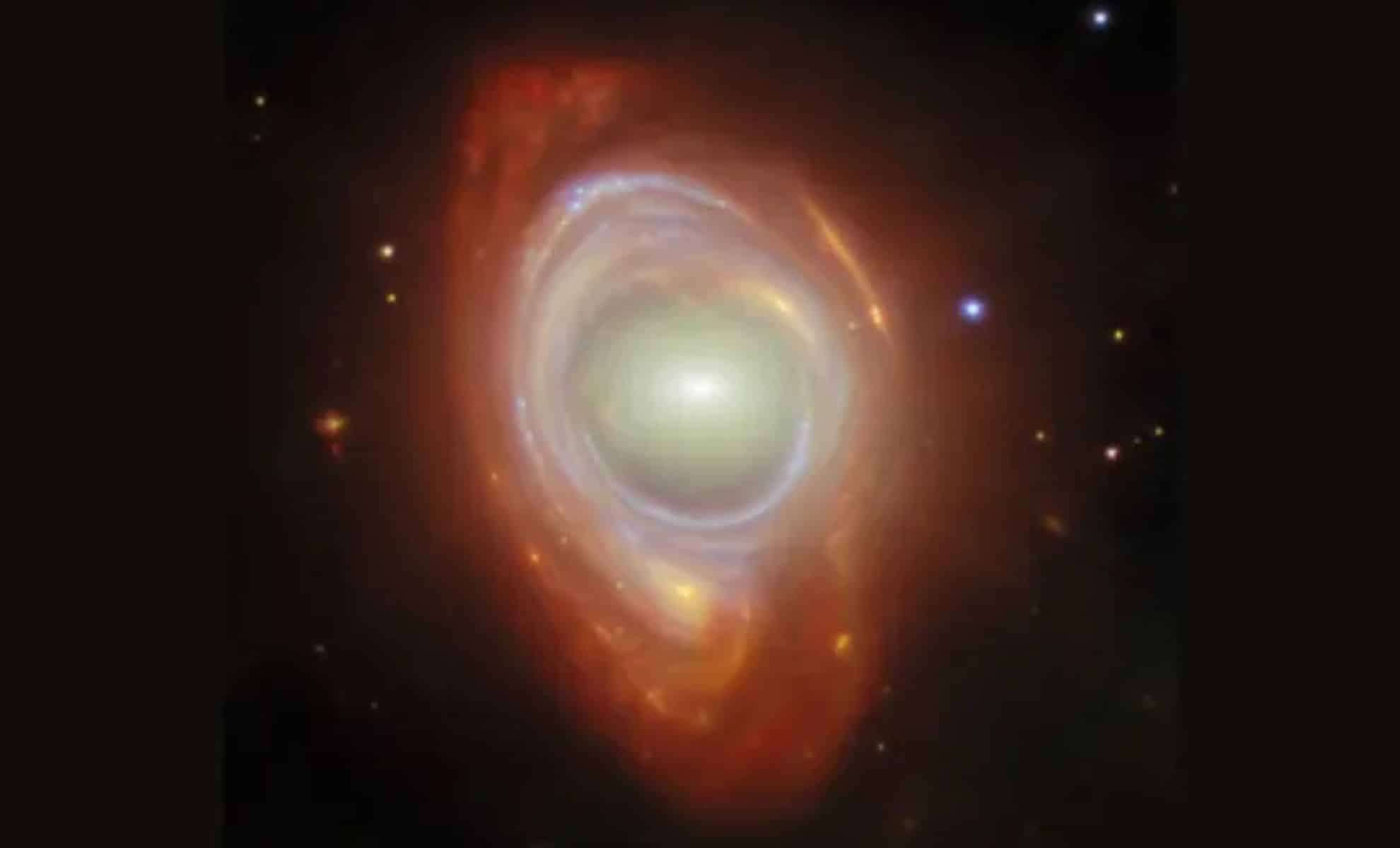
The James Webb Space Telescope (JWST) has delivered an extraordinary glimpse into the depths of space with a rare and mesmerizing sight: a nearly flawless Einstein ring. This cosmic spectacle arises when the light of a distant galaxy is bent by the immense gravitational pull of a foreground galaxy, producing a striking ring-shaped image. This remarkable photo was shared as the European Space Agency’s featured image for March 2025, illustrating a phenomenon Albert Einstein predicted over a century ago where mass distorts spacetime.
Appearing like a luminous eye suspended in the void, the image actually depicts two galaxies aligned in an extraordinary cosmic configuration, connected through gravitational warping despite vast separations.
An Extraordinary Gravitational Phenomenon
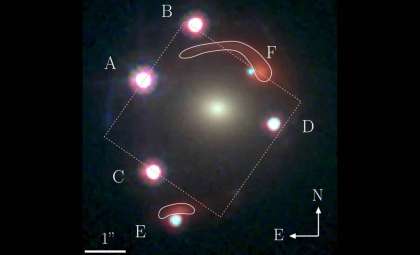
Known as an Einstein ring, this striking visual occurs when a massive foreground galaxy, a remote background galaxy, and the vantage point on Earth align almost perfectly. Light from the background galaxy bends around the gravitational field of the nearer galaxy, creating a distinctive ring.

This process, called gravitational lensing, is a direct testament to Einstein’s theory of general relativity, which predicts that massive objects curve the fabric of spacetime. While lensing effects are frequently observed, nearly complete rings are exceedingly rare and require near-perfect cosmic alignment.
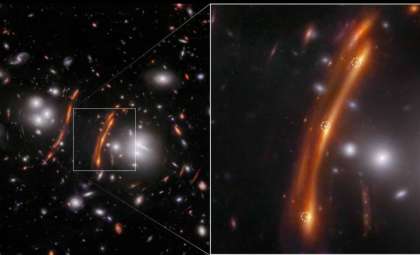
The ring in this image encircles an elliptical galaxy within the cluster SMACSJ0028.2-7537 in the constellation Hydrus. The vibrant orange and blue arcs represent distorted light from a spiral galaxy situated much farther away, magnified and bent by the gravitational influence of the foreground elliptical galaxy.
Peering Into the Depths of Space
JWST’s Near-Infrared Camera (NIRCam) captured this image, supported by historical observations from the Hubble Space Telescope. The level of detail unveiled in the warped spiral galaxy—from star clusters to gas clouds—demonstrates the unparalleled capabilities of JWST for exploring the universe’s distant reaches.
“Despite the light’s distortion as it curves around the mass of the foreground galaxy, distinct star clusters and gaseous features remain visible,” representatives from the ESA explained.
Beyond its aesthetic appeal, gravitational lensing is a powerful tool that enables astronomers to examine galaxies too faint or remote to study otherwise. By amplifying ancient light, these cosmic lenses provide insights into some of the earliest galaxies formed after the Big Bang.
Exploring Dark Matter, Black Holes, and the Invisible Cosmos
This lensing effect also plays a pivotal role in unveiling unseeable cosmic elements, such as black holes and dark matter. By observing how light from distant galaxies is deflected, scientists can map unseen mass distributions throughout the universe.
Einstein rings like the one captured by JWST thus serve not only as captivating images but also as natural laboratories that help unravel the hidden makeup of the cosmos.
“These objects provide perfect settings to investigate galaxies too faint and distant for direct observation,” according to ESA.
- Categories:
- News







0 comments
Sign in to Comment