
The Japan Atomic Energy Agency (JAEA) is pioneering the creation of a compact nuclear battery that harnesses the decay heat from americium, a type of radioactive waste, transforming it into usable electricity.
This innovative power source is designed to energize spacecraft navigating environments where solar energy is impractical, such as on asteroids, far-off planets, and the permanently shadowed regions of the Moon.
Joint Effort Among Leading Japanese Institutions
As reported by the Japan Times, JAEA is collaborating closely with the Japan Aerospace Exploration Agency (JAXA) and is targeting early 2029 for the release of a working prototype. The National Institute of Advanced Industrial Science and Technology (AIST), a government-backed research entity, also plays a crucial role in this project, accelerating the advancement of this specialized power system for space exploration.

Advantages of Using Americium
Americium is produced through the natural decay of plutonium in spent nuclear fuel. Unlike plutonium, which has long powered U.S. space missions since the 1960s, americium emits less decay heat.
More importantly, due to Japan's stringent legal restrictions on plutonium use and transport, americium presents a more feasible option. Its lower decay heat still provides adequate energy for extended space endeavors. According to Masahide Takano, a senior expert at JAEA’s NXR Development Center, these americium-powered batteries could virtually deliver enduring power sources for probes, supporting critical systems like communication and sensors on lengthy missions.
Obtaining Americium for Power Cells
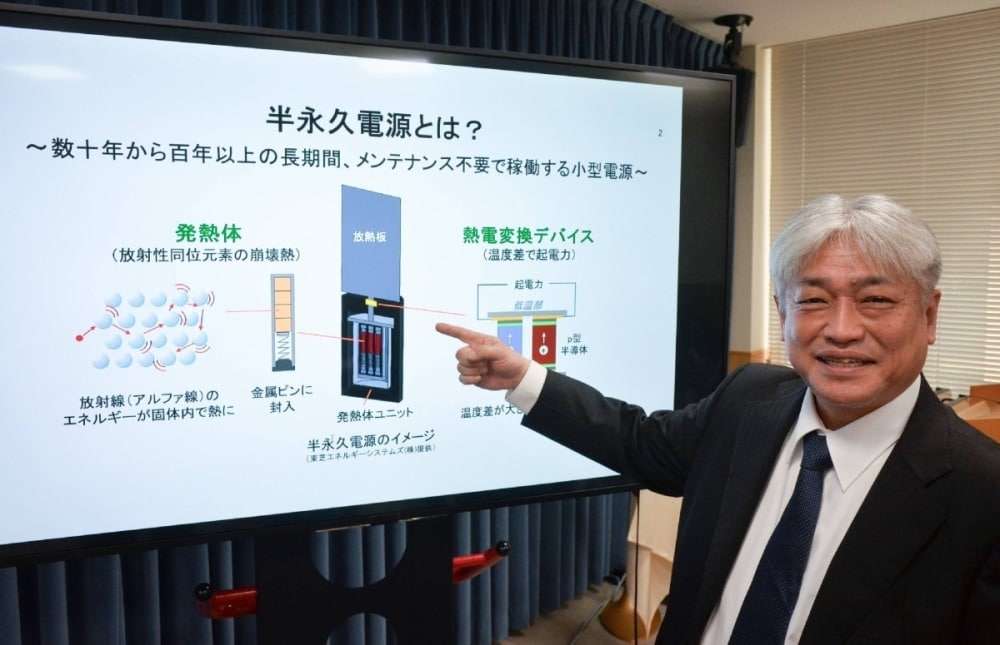
JAEA has developed a method to extract sufficient amounts of americium by isolating it from mixed oxide (MOX) fuels containing uranium and plutonium, materials already within their inventory. This nuclear research fuel acts as a key source for americium recovery.
To ensure safe handling, JAEA processes americium into pellet form combined with additives, encapsulating it within metallic pins. This containment strategy guarantees americium remains secure even in the unlikely event of a launch accident, bolstering launch safety protocols.
Progress in Practical Application
The agency has demonstrated americium's potential by successfully powering LED lights with electricity drawn from its decay heat, enabled by semiconductor-based technology. This achievement validates americium as a reliable, long-lasting power source for future space missions.
Project Outlook and Next Steps
JAEA aims to finalize the prototype battery system by 2029, prioritizing a design that is both lightweight and compact, suitable for deployment on space probes. The battery is being engineered to endure harsh space conditions, including the vacuum and extreme temperature variations caused by distance from the Sun.
Through the collaborative efforts of JAEA, JAXA, and AIST, this cutting-edge energy solution could enable groundbreaking space missions in locations previously inaccessible due to solar power limitations.
- Categories:
- News






0 comments
Sign in to Comment