
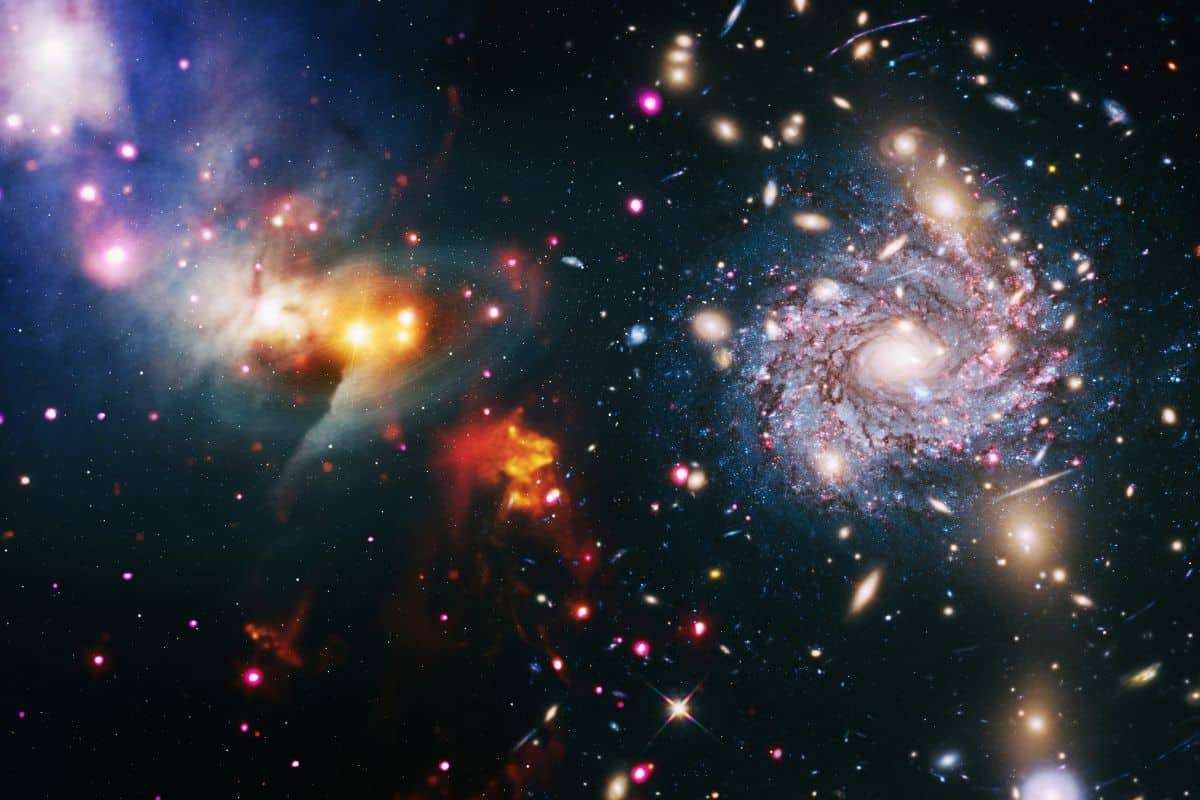
The mystery of what preceded the Big Bang has long puzzled physicists. Although the Big Bang is believed to mark the universe’s beginning about 13.8 billion years ago, its exact origins remain fiercely contested. A new investigation from the University of Texas at Austin proposes an innovative concept that could transform our understanding of both the early cosmos and the roots of dark matter.
Unraveling the Mystery of Dark Matter
Dark matter, an elusive and invisible component, makes up roughly 85% of all matter in the cosmos. Despite its ubiquitous influence, it has never been directly observed. This enigmatic substance remains one of cosmology’s greatest puzzles, although its gravitational forces on galaxies are clearly observed.
For years, scientists have speculated on how dark matter first appeared. This new work posits that it originated during a period of dramatic expansion known as cosmic inflation, which actually predated the Big Bang itself.
Unveiling the Warm Inflation Freeze-In Concept
The study introduces the novel WIFI (Warm Inflation Freeze-In) model, proposing that dark matter formed amid the universe’s hot, rapid inflationary phase.
In this scenario, dark matter not only came into existence but also endured. Lead scientist Katherine Freese emphasizes, “Our model stands out because dark matter is effectively generated during inflation.”

“Normally, particles created during inflation are ‘inflated away’ by the enormous cosmic expansion, leaving almost nothing behind.”
A More Complex Pre-Big Bang Cosmos
This fresh perspective envisions the early universe as far more complicated than previously thought. Before the Big Bang, matter and energy existed in an extraordinarily dense, chaotic state.
The proposed framework suggests dark matter might have emerged during this fleeting yet crucial stage. Instead of arising from a simple explosion, the universe’s birth involved intricate processes with dark matter playing a fundamental role.
WIFI Model’s Exceptional Efficiency
The remarkable aspect of the WIFI theory is its sheer productivity. The researchers claim this mechanism could generate dark matter with an efficiency up to 18 orders of magnitude greater than conventional explanations.
To understand this scale, imagine comparing a teaspoon of water to all the planet’s oceans combined. Such immense efficiency implies dark matter might predominantly owe its existence to the inflationary epoch.
Potential Impact on Future Cosmological Studies
Though still hypothetical, scientists hope forthcoming observations will test this idea. Investigations into the Cosmic Microwave Background (CMB) and vast cosmic formations could yield critical evidence supporting the WIFI hypothesis.
If these findings hold true, they would profoundly enhance our grasp of dark matter's origin, marking a milestone in decoding the universe's earliest chapter.
- Categories:
- Space










0 comments
Sign in to Comment