
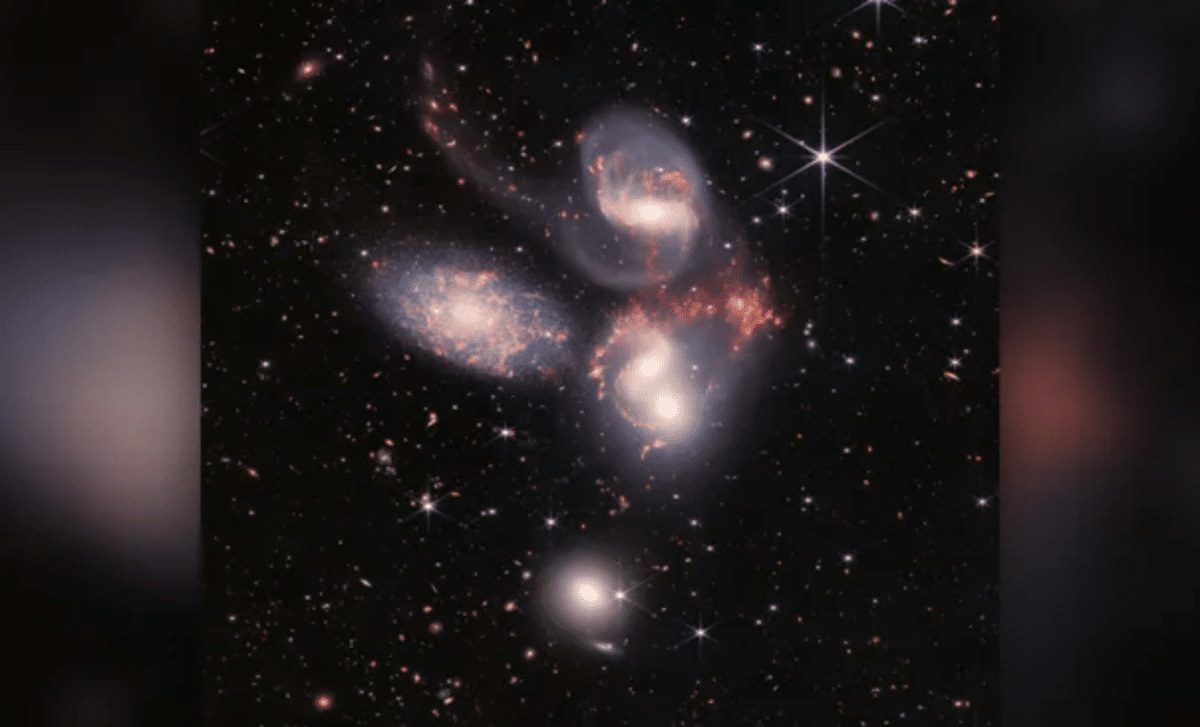
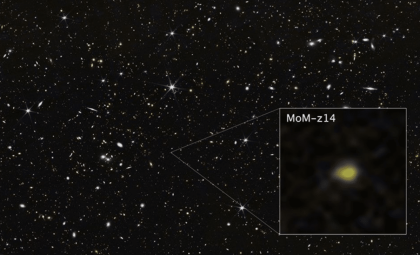
The James Webb Space Telescope has unveiled an exceptional cosmic structure comprising five galaxies merging when the cosmos was roughly 800 million years old, as reported in Nature Astronomy. This finding challenges existing theories of early galaxy formation, pointing to the presence of large, intricate systems earlier in cosmic history than previously believed.
A Dense Galactic Encounter in the Early Universe
This newfound system features five compact galaxies actively forging stars, all tightly clustered within a small volume of space. Their close spatial arrangement indicates gravitational binding and an ongoing merger, a surprising discovery given the epoch. JWST data reveal that these galaxies are separated by only tens of thousands of light-years, much nearer than typical galaxy distances observed in today's universe.
Such crowding was previously deemed rare during the universe’s formative years when galaxies were expected to be smaller and more isolated. Lead researcher Dr. Weida Hu from Texas A&M University noted,

“What makes this remarkable is that a merger involving such a large number of galaxies was not expected so early in the universe’s history, when galaxy mergers were thought to [be] simpler and usually involve only two to three galaxies.”
This discovery suggests a far more active and intricate early universe than previously modeled.
Vigorous Star Birth and Elemental Enrichment
Aside from the number of galaxies merging, the system is notable for its intense star formation and chemical complexity. Collectively, these galaxies are generating stars at an approximate rate of 250 solar masses annually, surpassing typical rates for that epoch. This rapid creation of stars has led to significant enrichment with heavier elements like oxygen, which are forged inside stars and spread through interactions within the galactic assembly.
Evidence of this enrichment, drawn from Nature Astronomy, reveals that oxygen- and hydrogen-rich gas extends beyond the galaxies themselves, indicating that gravitational forces are dispersing these heavier elements into the space between galaxies. This process sheds light on how early mergers influenced both galactic development and their broader cosmic surroundings.
Reevaluating Models of Galaxy Growth
Conventional galaxy formation theories describe a slow accumulation where small galaxies progressively merge into larger ones over extended periods. The discovery of this five-galaxy merger challenges that framework by showing complex, multi-galaxy interactions occurring within the first billion years after the Big Bang. It implies that cosmic material aggregated faster and more efficiently than current simulations predict.
Coauthor Professor Casey Papovich highlighted the significance of these results, saying,
“By showing that a complex, merger-driven system exists so early, it tells us our theories of how galaxies assemble — and how quickly they do so — need to be updated to match reality.”
This finding adds to mounting evidence from JWST that the early universe was capable of generating massive, well-developed galaxies at a remarkable pace.
- Categories:
- Space




0 comments
Sign in to Comment