
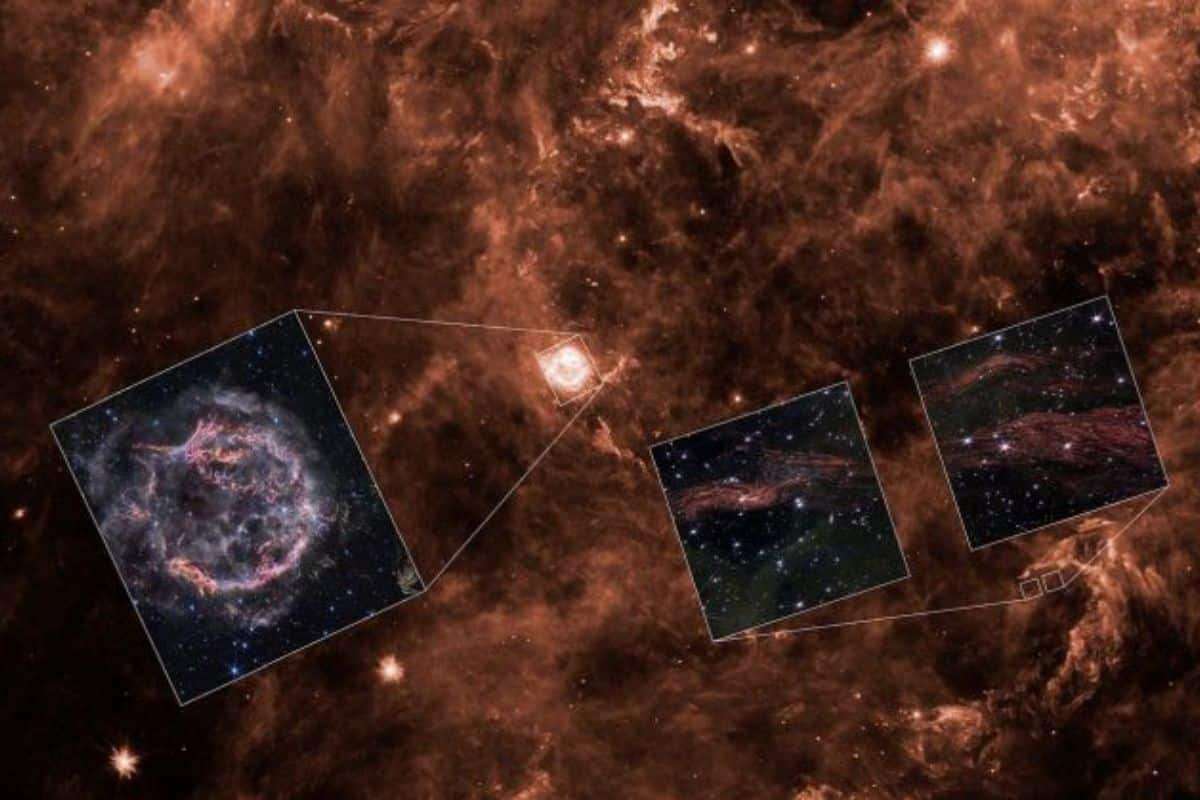
The James Webb Space Telescope (JWST) has delivered breathtaking images revealing the complex patterns of interstellar dust in extraordinary detail. By capturing the faint light reverberations from a supernova explosion dating back more than 300 years, JWST showcases the interstellar medium's dynamic formation in a way never seen before.
These pioneering observations not only provide a stunning cosmic portrait but also deepen our grasp of the forces shaping the universe.
The Tale of Cassiopeia A
During the late 1600s, a brilliant stellar explosion occurred, now identified as Cassiopeia A, located roughly 11,000 light-years away from Earth. This supernova left behind a glowing cloud of gas and dust that has become a focal point for astronomical research.
The lingering light from that event continues to illuminate nearby cosmic dust, producing subtle “light echoes” as it bounces off these particles. JWST’s advanced infrared instruments have enabled scientists to observe these faint reflections with remarkable clarity.
Earlier observations from instruments like the Spitzer Space Telescope hinted at the complexity of such regions, but Spitzer’s resolution was limited when compared to that of JWST. "Seeing this volume of detail was truly astonishing," commented Jacob Jencson from Caltech.
Revealing Hidden Cosmic Layers
The detailed imagery from JWST exposes layers of dense material embedded with intricate knots and swirling patterns, evoking the texture of tree rings. These observations extend beyond mere surface views to provide a three-dimensional perspective of the interstellar medium’s interior.
According to Josh Peek of the Space Telescope Science Institute, “We observe layered structures similar to an onion. Dense dusty regions, both visible and obscured, appear to have this internal composition. Previously, such internal views were unattainable.”

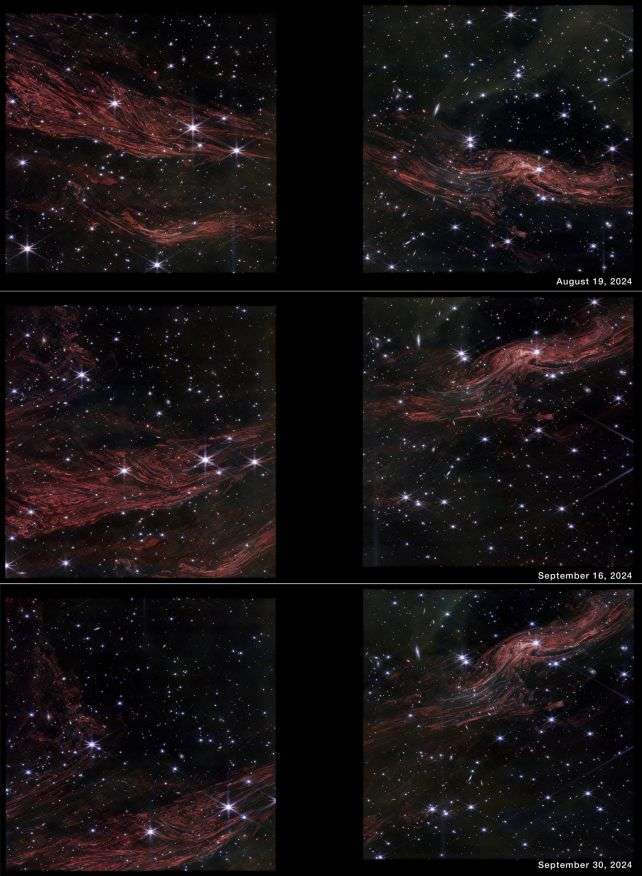
JWST’s sensitivity to faint infrared light, undetectable by former instruments, has been key to this insight. Observations conducted during August and September 2024 revealed subtle alterations in the dusty formations over just a few days, highlighting the ever-changing nature of this cosmic region. Light echoes — reflections of light off physical surfaces like dust — played a vital role in exposing these fine details.
New Perspectives for Studying the Cosmos
Thanks to the fine detail JWST captures, researchers can now analyze how interstellar dust interacts with magnetic fields, which are pivotal in shaping cosmic environments. The dust’s patterns may trace the framework of magnetic lines weaving through space and steering the turbulent motions of galactic material.
“This is tantamount to a medical CT scan for astronomy,” explained Armin Rest from the Space Telescope Science Institute. “We have three snapshots taken at different times, enabling us to unravel the true three-dimensional arrangements. It will revolutionize how we examine the interstellar medium.”
These advancements are poised to significantly enhance cosmic understanding. While past light echo studies focused on more intense events or denser dust clouds closer to their light sources—such as the notable V838 Monocerotis echoes from the early 2000s—JWST reveals subtler, more distant dust structures with unmatched precision.
Exploring Future Frontiers
The discoveries, unveiled at the 245th American Astronomical Society Meeting, mark just the start. Upcoming research will probe deeper into magnetic turbulences and the chemical makeup of these dust clouds. As JWST continues its observations, astronomers expect further breakthroughs that will reshape our cosmic knowledge.
For now, the images of Cassiopeia A stand as both a scientific landmark and a celebration of cosmic elegance. They illustrate the intricate interplay of light and matter far beyond our planet, brought to light through JWST’s state-of-the-art technology.
Astronomer Jencson captured the sentiment well: “The universe’s complexity exceeds our previous imagination, and JWST is unveiling it like never before.”
- Categories:
- Astronomy







0 comments
Sign in to Comment