
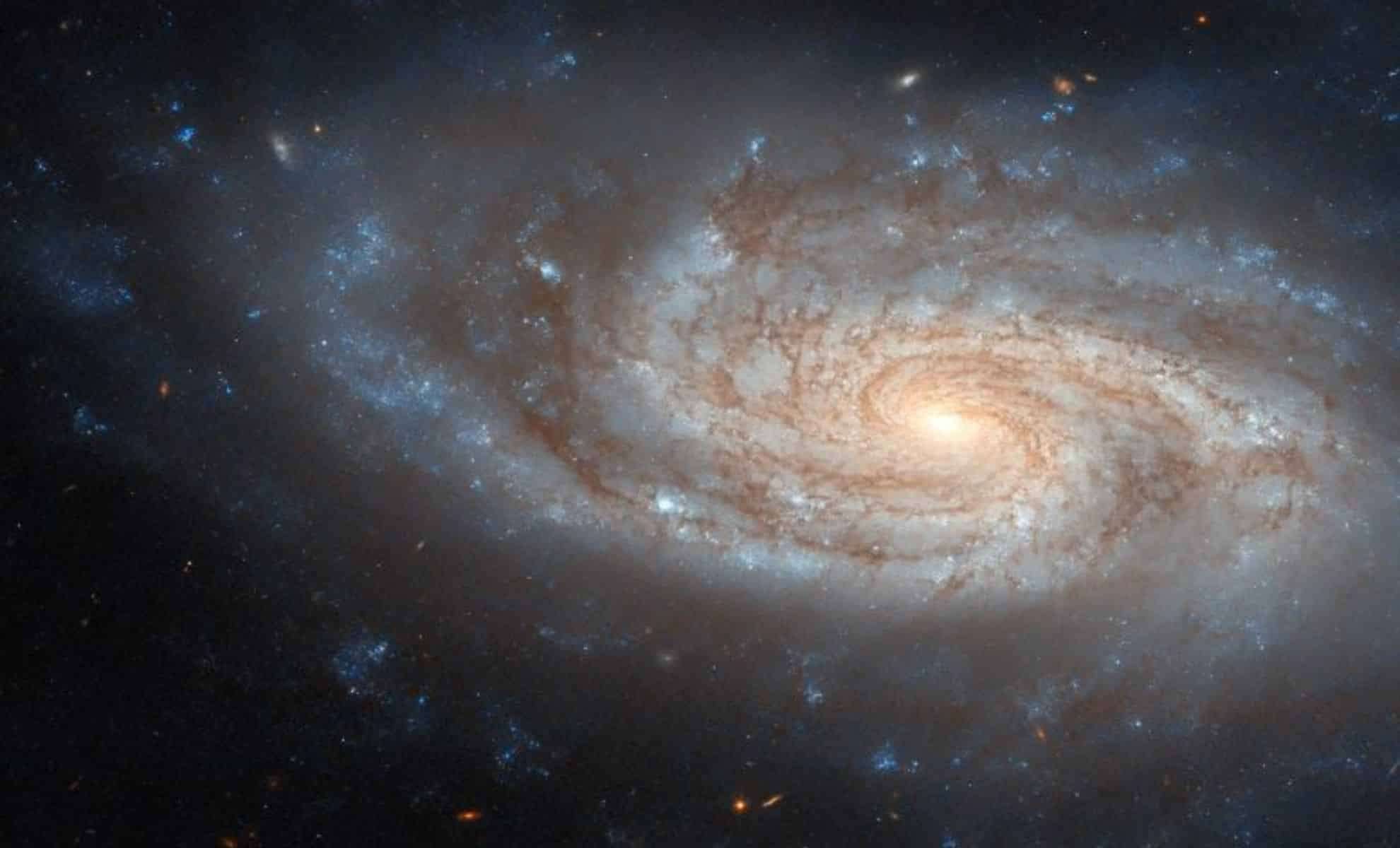
The Hubble Space Telescope has once again amazed both astronomers and enthusiasts by delivering an exquisite image of NGC 3430, a spiral galaxy situated about 100 million light-years away in the Leo Minor constellation.
This remarkable photograph showcases the galaxy’s complex spiral architecture and highlights Hubble’s enduring role in deepening our cosmic knowledge.
Tracing Back: The Initial Observation of NGC 3430
NGC 3430 was originally observed on December 7, 1785, by the notable German-British astronomer William Herschel. More than 200 years later, the Hubble Telescope offers an unprecedentedly detailed perspective of this celestial body. Also cataloged as IC 2613, LEDA 32614, or UGC 5982, this galaxy spans roughly 85,000 light-years across.

Its open, well-defined spiral arms categorize it as an SAc galaxy—a type of spiral galaxy without a central bar. Astronomers note that several neighboring galaxies, just beyond the captured frame, exert gravitational forces on NGC 3430, triggering regions of star formation. Such interactions exemplify the dynamic forces that mold and evolve galaxies over time.
Hubble’s Role in Galactic Categorization
The prominence of NGC 3430 as a classic spiral galaxy ties back to Edwin Hubble’s groundbreaking galaxy classification system. In 1926, Edwin Hubble, after whom the telescope is named, introduced a method to classify around 400 galaxies based on their morphological features, including spiral, barred spiral, lenticular, elliptical, and irregular.
This influential framework fundamentally shaped modern galaxy classification. Hubble’s research, building on Henrietta Leavitt’s discoveries involving Cepheid variable stars, resolved whether these so-called ‘nebulae’ were components of the Milky Way or external galaxies. Over time, the phrase ‘extragalactic nebulae’ transformed into the contemporary term ‘galaxy,’ reflecting our more accurate cosmic perspective.
The Evolution of Galactic Nomenclature
When Edwin Hubble published his study, astronomical investigation of galaxies was still emerging. The question of whether ‘nebulae’ were part of our own galaxy or standalone ‘island universes’ was a significant debate. Hubble’s findings verified that these nebulae were separate galaxies, prompting a shift in how astronomers referred to them.
The evocative name ‘island universe’ gave way to the precise term ‘galaxy.’ Presently, galaxies like NGC 3430 are understood as immense, complex collections of stars, gas, dust, and dark matter, each with distinctive shapes and histories—illustrating the growth of astronomical knowledge over the last century.
Advances in Technology and Hubble’s Impact
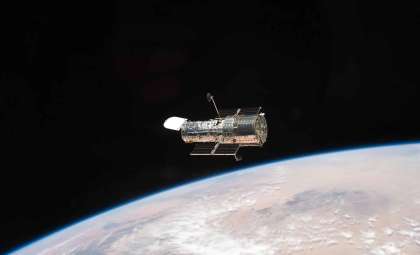
The Hubble Space Telescope has revolutionized cosmic observation by offering high-resolution images that illuminate the universe’s intricacies. The recent capture of NGC 3430 was achieved with Hubble’s Advanced Camera for Surveys (ACS), which records light across visible and near-infrared spectrums.
To create this vivid color image, astronomers combined separate monochrome exposures taken through different filters, assigning various hues to each. This technique reveals critical features, including star-forming zones, dust distribution, and the effects of gravitational interaction with nearby galaxies.
By examining these details, researchers gain valuable insight into the processes of galaxy formation and evolution. Beyond imaging, Hubble has also supplied essential data on phenomena such as black holes, dark matter, and the universe’s expansion trajectory.

Looking Forward: Hubble’s Enduring Influence and Future Missions
Hubble’s exceptional imagery continues to unravel the complexity and beauty of distant galaxies. While commemorating its achievements, the astronomical community eagerly anticipates upcoming projects like the James Webb Space Telescope, poised to deepen our cosmic insights.
The legacy established by Hubble, embodied in images like that of NGC 3430, fuels ongoing exploration and advances in astronomy. Each discovery enriches our understanding of galactic formation, interaction, and transformation, broadening our appreciation of the universe’s vastness.
Future observatories will build on Hubble’s groundbreaking work, using cutting-edge technologies to peer further back in time and uncover the mysteries surrounding the early universe. These endeavors will continue to expand the frontiers of human knowledge about the cosmos.
- Categories:
- Astronomy ,
- News ,
- Space ,
- Nasa





0 comments
Sign in to Comment