

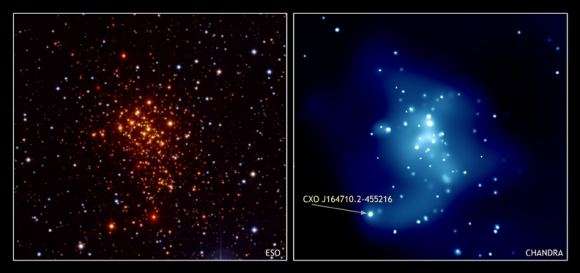
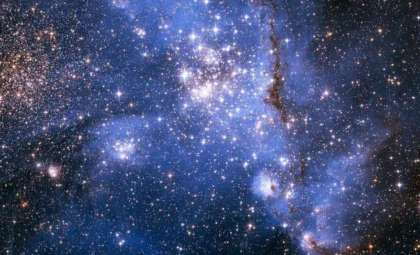
The James Webb Space Telescope (JWST) has unveiled a spectacular image of Westerlund 1, the largest known super star cluster in our galaxy, providing astronomers with fresh perspectives on the birth and evolution of the most massive stars.
Leveraging the power of the Near-Infrared Camera (NIRCam), scientists penetrated the thick clouds of gas and dust that shroud the cluster, uncovering stars with masses reaching up to 100,000 times that of the Sun. Led by Amy Simon from NASA’s Goddard Space Flight Center, this investigation forms part of the Extended Westerlund 1 and 2 Open Clusters Survey (EWOCS), dedicated to deepening our understanding of star formation. The results, published in The Astrophysical Journal, suggest that Westerlund 1 will witness over 1,500 supernova events throughout the next 40 million years.
Westerlund 1: A Stellar Giant
Westerlund 1 is a youthful super star cluster, estimated at 3.5 to 5 million years old, relatively new in cosmic terms. It boasts a mass between 50,000 and 100,000 times that of the Sun and stretches approximately six light-years in diameter. Its stellar residents include some of the universe’s most massive and radiant stars, such as yellow hypergiants that can outshine the Sun by a million-fold.

The astronomical community has been fascinated by Westerlund 1 due to not only its immense scale but also the valuable clues it offers regarding the life cycles of massive stars. These giants consume their nuclear fuel rapidly, resulting in significantly shorter lifespans compared to smaller stars like our Sun.
Webb’s Infrared Vision Unlocks Hidden Details
Thanks to JWST’s infrared observational capabilities, it can see through dense interstellar dust and gas that obscure much of Westerlund 1 from optical telescopes. This technology is essential for investigating clusters enshrouded in thick cosmic matter.
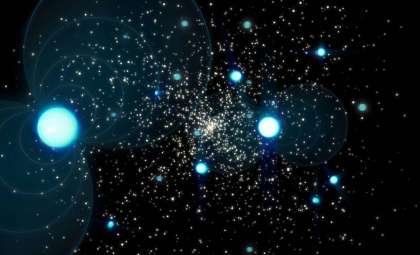
With Webb’s detailed images, astronomers have identified various stellar types within Westerlund 1, ranging from red supergiants and luminous blue variables to rare objects such as magnetars and X-ray pulsars. This diverse population aids scientists in decoding the cluster’s dynamics and refining models of the initial mass function, which describes how stars of differing masses originate and develop together.
Anticipating a Surge of Supernovae
While relatively young, many stars in Westerlund 1 are approaching the end of their existence. Massive stars live fast and die young, often exploding as supernovae within a few million years. Experts anticipate more than 1,500 supernovae will occur in this cluster over the next 40 million years, crafting a dramatic cosmic spectacle.
The scientific community eagerly awaits these explosions, which will spread heavy elements into space, fostering the birth of new stars and potentially forming planetary systems. Westerlund 1’s crowded environment serves as an exceptional natural laboratory to examine how supernovae affect star formation in such dense nurseries.
Exploring Massive Star Evolution
Westerlund 1 offers a window not only into recent star formation but also a vital research arena for investigating massive star life cycles. Clusters of this magnitude were likely more common in the Milky Way’s early days, when star formation rates peaked. Studying clusters like Westerlund 1 helps decode the galaxy’s evolutionary history and the conditions prevailing during its most intense star-forming epochs.
Additionally, by examining Westerlund 1 and comparable clusters in other galaxies, astronomers gain broader insights into universal star formation patterns. Continued observations with Webb of Westerlund 1 and other open clusters will expand our understanding of stellar birth, life, and explosive demise.
Peering Into the Cosmic Future
The James Webb Space Telescope once again demonstrates its transformational role in astronomy, granting unparalleled views of one of the Milky Way’s grandest star clusters. With Westerlund 1’s packed assembly of massive stars and predicted supernova activity, astronomers have a unique chance to study stellar evolution at an extraordinary scale. Ongoing Webb observations promise to deepen our grasp of the forces shaping stars and galaxies alike.
As decades pass, Westerlund 1 will remain at the center of astrophysical research, its stars progressing through final life stages culminating in a succession of brilliant supernova explosions. The James Webb Space Telescope enables us to witness this remarkable cosmic narrative unfold in real time.
- Categories:
- Astronomy ,
- News ,
- Nasa





0 comments
Sign in to Comment