

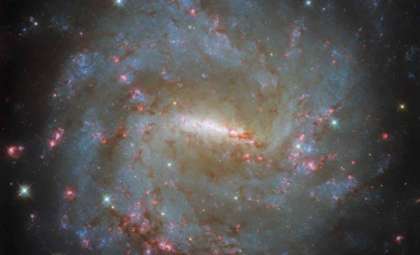
The Hubble Space Telescope, a collaboration between NASA and ESA, has recently unveiled a striking image of NGC 4951, a spiral galaxy situated about 49 million light-years away in the Virgo constellation.
This breathtaking snapshot reveals the galaxy in exceptional clarity, offering valuable perspectives on star formation and energy flow within cosmic structures.
Through high-resolution imaging, Hubble provides a window into the complex mechanisms shaping one of the universe's captivating spiral galaxies, enhancing our comprehension of galactic evolution.

Revealing the Splendor of NGC 4951
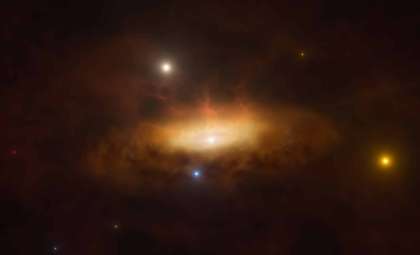
This fresh image emphasizes the detailed architecture of NGC 4951, showcasing a luminous core encircled by spiral arms highlighted by vibrant pink star-birth regions. Known alternatively as AGC 530015, IRAS 13025-0613, or LEDA 45246, this galaxy stretches roughly 65,000 light-years across, marking it as a notable presence in Virgo’s cosmic landscape.

First observed on April 17, 1784, by astronomer William Herschel, NGC 4951 has remained a significant subject for astronomical research. Its expansive size and position in the Virgo constellation make it a prominent target for studying galactic structure and behavior.
Technology Behind Hubble's Stunning View
The breathtaking image of NGC 4951 was created using Hubble’s Wide Field Camera 3 (WFC3), capturing data across ultraviolet, infrared, and visible wavelengths. This powerful tool enables astronomers to observe the galaxy’s features in unprecedented detail by combining multiple spectral perspectives.
Data from six separate filters were merged, assigning distinctive colors to each monochrome image. This technique allows scientists to observe the galaxy across diverse wavelengths, unveiling elements invisible in single-spectrum observations. The composite imagery facilitates deeper analysis of NGC 4951’s complex internal processes.
Investigating Star Formation and Feedback Loops
Captured during research focused on material and energy movement in nearby galaxies, this image illustrates the ongoing star formation cycle within NGC 4951. Gas within the galaxy condenses into molecular clouds, which eventually collapse to birth new stars. These young stars emit intense radiation and stellar winds that disperse surrounding clouds in a process termed feedback.
The displaced gas then moves through the galaxy before reassembling into molecular clouds elsewhere, continuing the star formation cycle. This feedback is essential in regulating the pace of star creation and the consumption of the galaxy’s gas reserves. Studying these mechanisms offers astronomers insights into the lifecycle and growth of galaxies over billions of years.
Decoding Galactic Growth and Change
Comprehending how galaxies like NGC 4951 evolve requires examining their components such as nebulae, stars, and clusters. Tracking the birth and evolution of these structures helps reconstruct a galaxy's past and predict its future path. Hubble’s detailed data is invaluable for such investigations.
Known for its capability to measure star populations accurately, Hubble provides data on their ages, compositions, and spatial distribution. For NGC 4951, analyzing gas distribution alongside star formation rates aids scientists in understanding the dynamic forces shaping its evolution, essential for building accurate galactic formation models.
The Vibrant Core of NGC 4951
Classified as a Seyfert galaxy, NGC 4951 features a highly luminous and active nucleus. This energetic galactic center emits vast radiation, often surpassing the brightness of the surrounding galaxy. The activity stems from matter falling into a supermassive black hole located at the core.
As matter spirals inward, it heats up and generates substantial energy, producing the intensely bright core visible in the image. This energetic phenomenon influences the entire galaxy by affecting star formation and the distribution of gas. Hubble’s image illustrates this energetic hub surrounded by swirling arms and vivid star-forming zones. Dense dust clouds and illuminated star birth regions highlight the galaxy’s dynamic nature.
The captivating Hubble image of NGC 4951 not only dazzles visually but also deepens our understanding of the forces driving galactic evolution. As Hubble continues to survey the universe, it brings us closer to unveiling the secrets of distant galaxies. Each new observation enriches scientific knowledge, refining our models and theories about the cosmos. Continuous study of NGC 4951 and its peers will yield crucial discoveries, expanding our grasp of the universe’s complex architecture.
- Categories:
- Astronomy ,
- Space ,
- Nasa ,
- Aircraft






0 comments
Sign in to Comment