
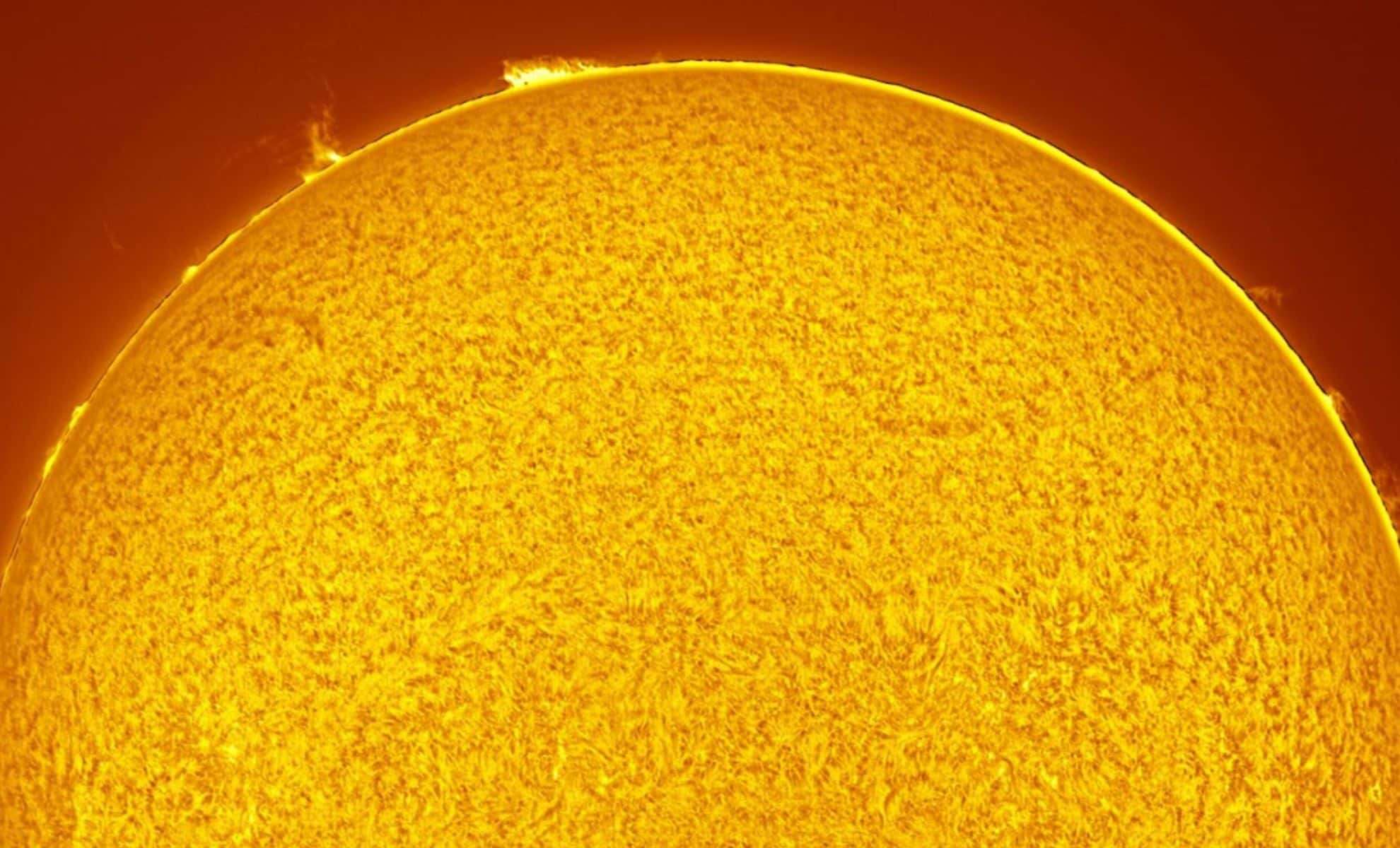
A remarkable event in our solar system was recently documented, featuring a powerful solar tornado alongside a happening simultaneously on the Sun’s surface. This extraordinary sight was photographed by Romanian astrophysicist Maximilian Teodorescu from the Institute of Space Science on Wednesday, August 20, resulting in an extraordinary and rare solar snapshot.
Sun’s Magnetic Fields Shape Colossal Phenomena
Live Science reports that while the tornado and the eruptive prominence emerged independently, both stem from complex disruptions in the Sun’s magnetic field. These hidden magnetic forces control the movement of plasma and sculpt it into striking structures visible on the solar surface.
In this instance, one plasma structure twisted into a spiraling funnel resembling a tornado, while another erupted outward in a phenomenon called an eruptive prominence. Though solar prominences often occur, spotting one simultaneously with a solar tornado is exceptionally uncommon.

Tornado Towering Over Earth by Tenfold
The tornado recorded by Maximilian Teodorescu soared approximately 130,000 kilometers high (about 80,000 miles), representing nearly one-tenth of the Sun’s diameter. This immense column of plasma stands taller than stacking ten Earths atop each other. Despite their resemblance to terrestrial tornadoes, solar tornadoes operate differently, driven by magnetic forces acting on ionized gas rather than atmospheric winds, and remain anchored in place.
Generally, solar tornadoes, also known as tornado prominences, range from 25,000 to 100,000 kilometers tall. Teodorescu’s find surpasses this, establishing it as one of the largest observed in recent memory.
Since August 17, astronomy enthusiasts worldwide have monitored this phenomenon, with initial observations shared by Spaceweather.com, which continues to highlight ongoing global fascination.
An Enormous Plasma Eruption
The eruptive prominence captured alongside the tornado extended roughly 200,000 kilometers across, comparable in size to the famous eruption nicknamed "The Beast" observed last July. This vast plasma arch, held stable by magnetic forces before destabilizing, dramatically erupted into space.
Such eruptions often produce coronal mass ejections (CMEs) — massive clouds of charged particles that can interfere with satellites, power systems, and communications if Earth-bound. Thankfully, Teodorescu confirmed the CME from this event is not Earth-directed, posing no risk to our planet or typical auroral displays at mid-latitudes.
Precision, Collaboration, and Timing
Teodorescu initially spotted the solar tornado on Monday, August 18, while reviewing data from the Global Oscillation Network Group (GONG) platform. Managed by the National Solar Observatory, GONG offers near-real-time solar images using six telescopes positioned worldwide. This early alert enabled Teodorescu, with support from his wife and fellow scientist Eliza Teodorescu, to adjust their equipment precisely and capture the concurrent solar phenomena.
Solar prominences arise from the photosphere and extend into the corona, the Sun’s outer atmosphere. When the magnetic field maintaining a prominence fails, the plasma contained within erupts violently. Teodorescu’s images showcase this process vividly, demonstrating how magnetic instability triggers intense solar events, as explored in related research.
As the Sun nears the height of its 11-year solar cycle, known as the solar maximum, events like this grow more frequent and intense. Teodorescu urges both amateur and professional observers to study the Sun using safe equipment, remarking, “It’s the most dynamic thing you can actually see as both [an] amateur and a professional in the sky.”
Meanwhile, high-latitude regions may still witness auroral displays, as Space.com notes that solar winds from unrelated solar activity continue to interact with Earth's magnetosphere.
- Categories:
- News



0 comments
Sign in to Comment