
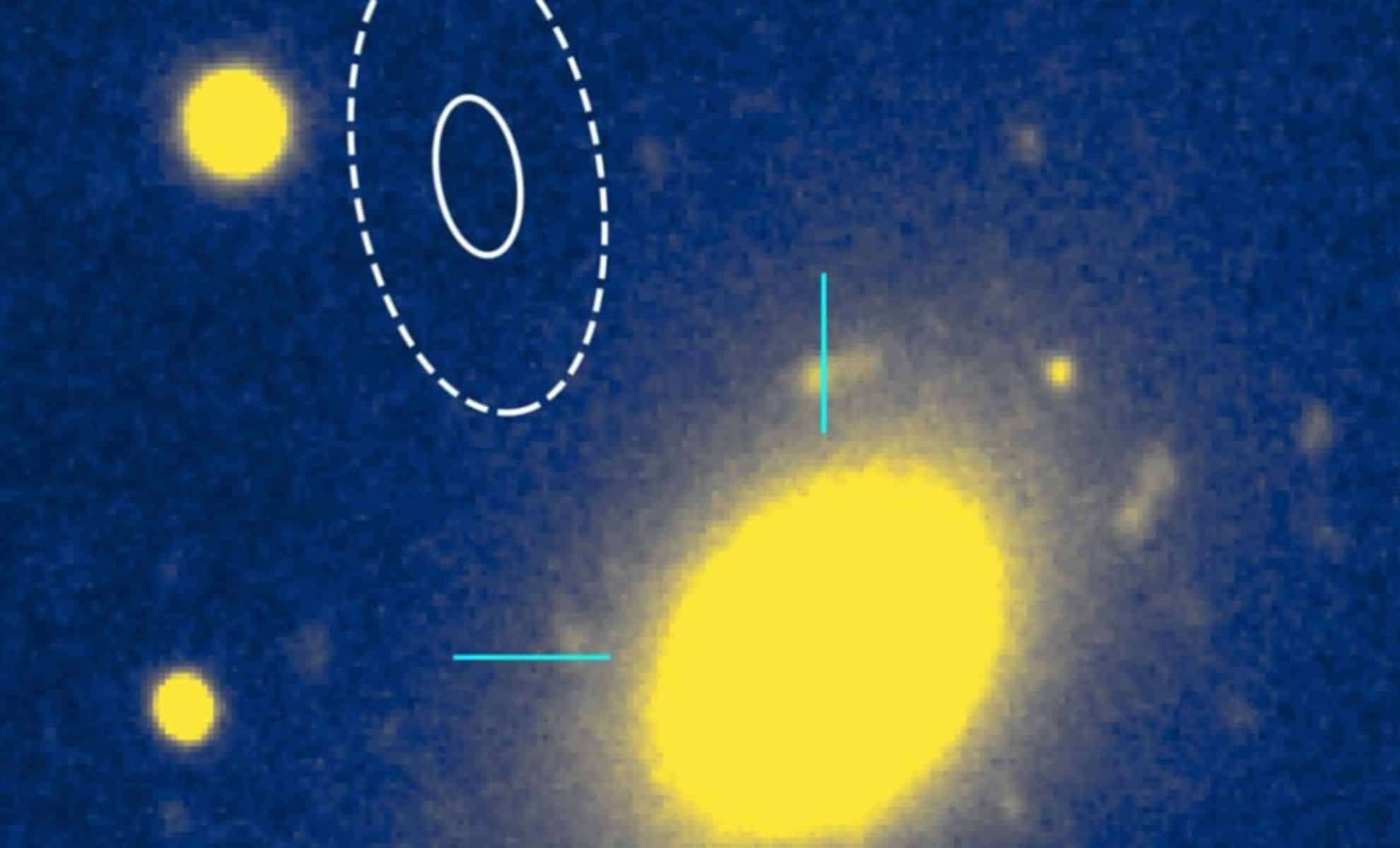
In a remarkable breakthrough, researchers have pinpointed a fast radio burst (FRB) to the outer region of a large elliptical galaxy situated approximately two billion light-years away. This exceptional detection, facilitated by the Canadian Hydrogen Intensity Mapping Experiment (CHIME) and corroborated by observations from the W.M. Keck Observatory, challenges prior assumptions about FRB origins. Unlike earlier bursts associated with youthful, star-forming galaxies, this event emerges from a quiescent galaxy with no recent star formation activity spanning billions of years.
“Just when we believe we understand an astrophysical phenomenon, the universe surprises us,” remarked Wen-fai Fong, senior author and associate professor of physics and astronomy at Northwestern University. “This ongoing dialogue with the cosmos is what makes the exploration of time-domain astronomy so exhilarating.”
An Unanticipated Revelation
Designated FRB 20240209A, this cosmic burst originates from a “dead elliptical galaxy” that has long halted stellar formation. Such ancient galaxies contain mostly old stars and lack the youthful populations previously linked to FRB production.

Tarraneh Eftekhari, who led one study and co-authored another, emphasized the importance of this finding. “Current models suggest FRBs originate from magnetars born through core-collapse supernovae,” she noted. “However, this galaxy shows no signs of young stars required for that process. This discovery hints that not all FRBs stem from young stellar populations, suggesting an alternative subcategory linked to older systems.”
Situated within the Leo constellation, this massive galaxy stands out as one of the heftiest identified as an FRB source. “It appears to be the largest FRB host galaxy recorded so far,” Eftekhari added.
Pinpointing FRB 20240209A’s Location
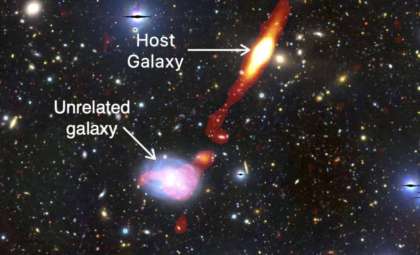
What surprised astronomers greatly was the burst’s location—far from the galaxy’s core, where most bursts usually arise—positioned around 130,000 light-years from the center. “This FRB is the farthest from its host’s center among known bursts,” explained Vishwangi Shah, a McGill University graduate student who led the localization effort.
“It’s particularly intriguing because FRBs are often detected in active star-forming zones within galaxies,” Shah noted. “Finding one this distant from its galaxy raises new questions about how such potent bursts can occur in regions devoid of recent star formation.”
Relating FRB 20240209A to Previous Anomalies
The event recalls the 2022 discovery of the M81 FRB, which was traced to a globular cluster—a densely packed, ancient star cluster—located at the edge of the spiral galaxy Messier 81. That earlier finding challenged traditional FRB theories, encouraging exploration of other progenitor possibilities.
“A few years ago, the M81 FRB was surprisingly discovered within a dense cluster of stars called a globular cluster,” Fong explained. “That event single-handedly halted the conventional train of thought and made us explore other progenitor scenarios for FRBs. Since then, no FRB had been seen like it, leading us to believe it was a one-off discovery—until now.
“In fact, this CHIME FRB could be a twin of the M81 event. It is far from its home galaxy (far away from where any stars are being born), and the population of stars in its home galaxy is extremely old. It’s had its heyday and is now coasting into retirement. At the same time, this type of old environment is making us rethink our standard FRB progenitor models and turning to more exotic formation channels, which is exciting.”
Exploring Possible FRB Sources
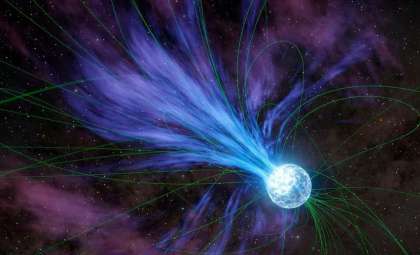
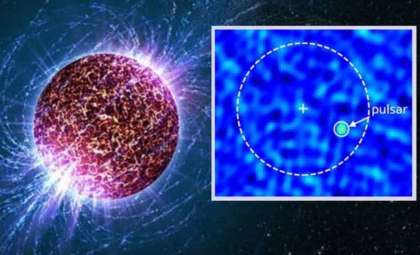
While magnetars—neutron stars with extraordinarily strong magnetic fields arising from massive star collapses—are often seen as the source of most FRBs, this new case indicates alternative origins might exist. The absence of young stars and the FRB’s remote galactic position suggest involvement of older stellar environments.
A likely explanation is that FRB 20240209A emanated from a globular cluster, akin to the M81 FRB. These clusters harbor ancient stars and may generate magnetars via processes such as neutron star mergers or white dwarf collapses.
Potential progenitors include:
- Globular Clusters: Compact star clusters containing aged magnetars or stellar interactions.
- Neutron Star Mergers: Collisions between neutron stars producing intense energy releases.
- Exotic Formation Theories: Hypothetical scenarios involving interactions between black holes and compact objects.
Comparative Overview of FRB Characteristics
Advancing the Study of Fast Radio Bursts
The identification of FRB 20240209A reinforces the complexity and varied nature of FRBs, emphasizing the need for ongoing research to unravel their mysteries. Each detection offers new clues that challenge existing models and deepen insights into the cosmos.
Fong reflected, “This remarkable finding highlights the gaps in our knowledge about FRBs. We are embarking on a promising journey where every new discovery holds the potential to transform astrophysics.”
Future observations, including plans to utilize the James Webb Space Telescope (JWST) to scrutinize the burst’s surroundings, aim to determine if it indeed originated from a globular cluster. Such efforts could significantly enhance our comprehension of FRB progenitors and their connection to ancient star systems.
- Categories:
- News






0 comments
Sign in to Comment