

A remarkable radio burst, having journeyed 8 billion light-years, has been detected by astronomers here on Earth. Designated FRB 20220610A, this event ranks among the farthest and most intense fast radio bursts ever recorded, offering a unique look into the early universe’s history.
Understanding Fast Radio Bursts
Fast radio bursts (FRBs) are intense, millisecond-scale bursts of radio energy. These brief flashes emit in mere milliseconds the equivalent of decades’ worth of the Sun’s output. Since their initial discovery in 2007, FRBs have intrigued scientists, yet their origins remain largely enigmatic.
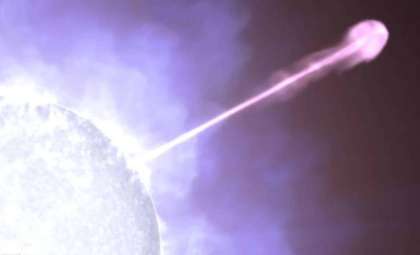
One prevailing hypothesis links FRBs to magnetars—neutron stars with extraordinary magnetic fields formed after supernova explosions. These exotic stars might produce the colossal energy that characterizes FRBs. For example, FRB 20220610A unleashed as much energy as the Sun does over a span of 30 years. Nevertheless, many aspects of what generates these bursts continue to puzzle researchers.

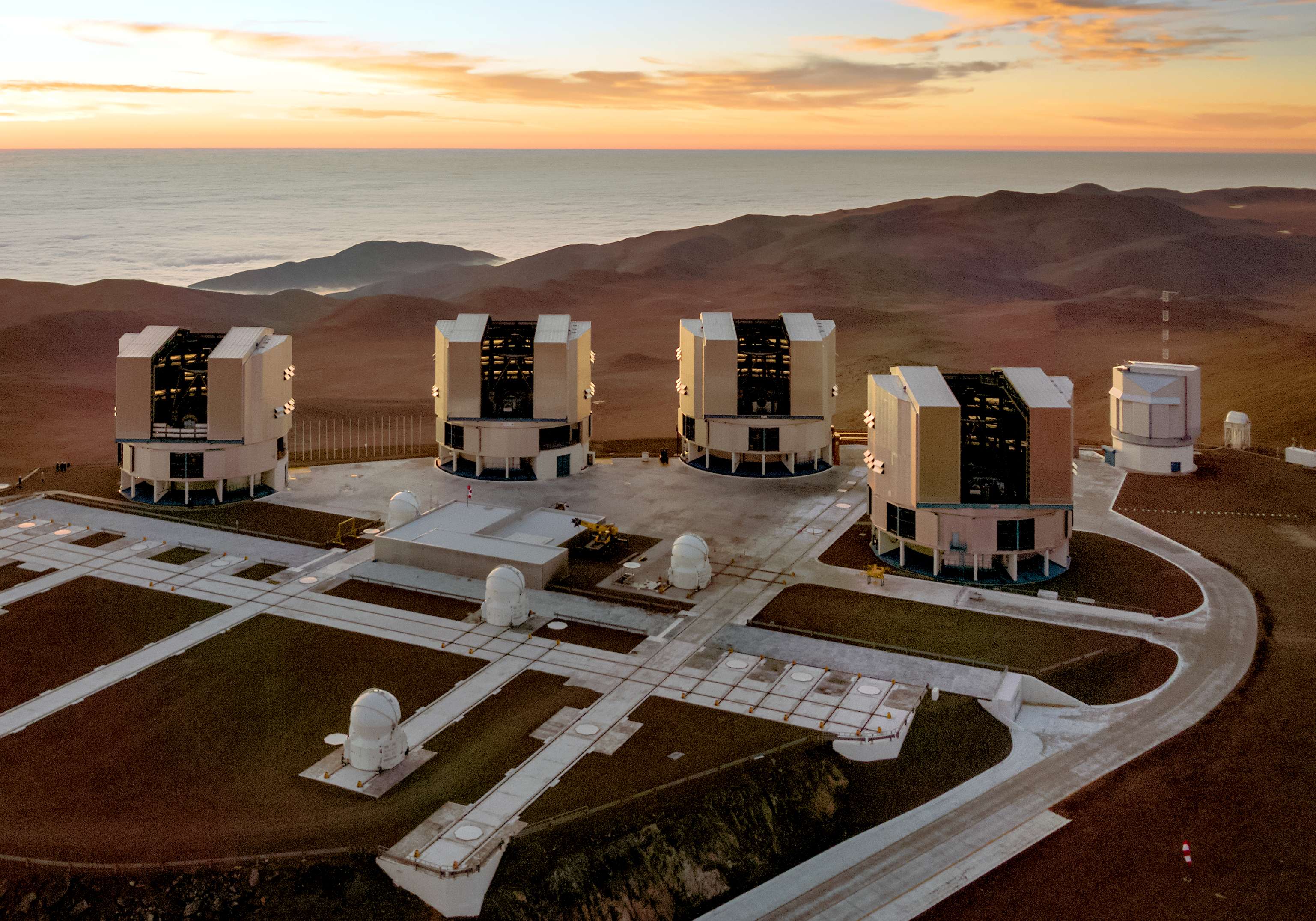
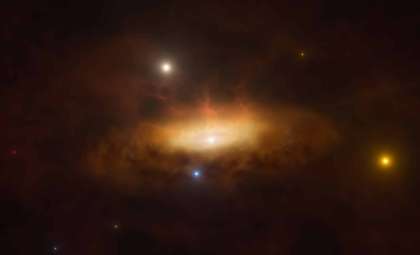
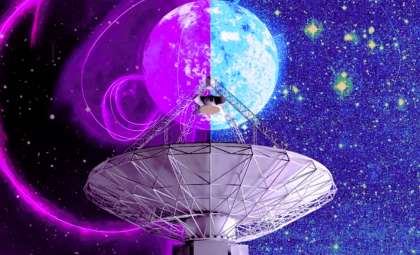
The detection of FRB 20220610A was made possible by the Australian Square Kilometre Array Pathfinder (ASKAP). “ASKAP’s array of antennas allowed us to accurately determine the burst’s location,” said Dr. Stuart Ryder, a lead investigator. Using instruments like the European Southern Observatory’s Very Large Telescope, the team pinpointed the origin of this signal in a galaxy far older and more remote than any previously known FRB source.
Utilizing FRBs to Measure the Universe’s Missing Matter
Though FRBs remain among the cosmos’s most baffling signals, they offer a promising avenue to address critical astronomical puzzles. One significant challenge has been the missing matter problem, where much of the universe’s expected ordinary matter has eluded detection due to its diffuse distribution across intergalactic space.
Professor Ryan Shannon explained, “A substantial portion of baryonic matter is still unaccounted for in our current observations.” This missing material likely exists as ionized gas sprawling between galaxies, making it challenging to observe directly. However, FRBs provide a novel approach: as their radio waves travel across the cosmos, they interact with this ionized medium, which alters the signal in measurable ways. Analyzing these distortions reveals the quantity of intervening matter.
This innovative approach was pioneered by Jean-Pierre Macquart in 2020. Dubbed the Macquart relation, the method uses FRBs to detect and quantify elusive cosmic matter. As Dr. Ryder stated, “Our observation of this burst on the far side of the universe validates the Macquart relation, confirming FRBs’ role as cosmic probes of hidden matter.”
Peering into the Ancient Universe
The discovery of FRB 20220610A offers an invaluable window into conditions 8 billion years ago. Traveling across vast cosmic distances, the burst’s signal carries information from a period when the universe was considerably younger, shedding light on galaxy formation and the evolution of large-scale structures.
Identifying the burst’s source in a profoundly ancient galaxy deepens the scientific intrigue. Observations with the Very Large Telescope revealed that this galaxy is both older and more distant than any previously linked to an FRB. Examining such a signal aids astronomers in understanding galactic evolution and the broader cosmic architecture of that epoch.
The sheer energy of FRB 20220610A despite its enormous distance challenges existing theories about cosmic energy production. Its powerful signal underscores the extreme phenomena that can occur across space and time.
Advancing FRB Exploration
The identification of FRB 20220610A marks an exciting step forward in the burgeoning field of FRB research. Progress in radio astronomy and the advent of cutting-edge telescopes like the Square Kilometre Array promise to exponentially increase the rate at which these bursts are found. This will enable precise localization of sources and deeper cosmological insights.
As Professor Ryan Shannon highlighted, “FRBs are surprisingly prevalent and represent a powerful tool for mapping the universe's structure and tackling fundamental cosmological questions.” Ongoing and future detections are set to illuminate both the nature of FRBs and the universe's hidden features.
The path ahead in studying FRBs is promising, bringing us ever nearer to resolving mysteries such as the universe’s missing baryonic matter and unlocking secrets of galaxy development and cosmic evolution.
- Categories:
- Astronomy ,
- News ,
- Science ,
- Space ,
- Physics







0 comments
Sign in to Comment