
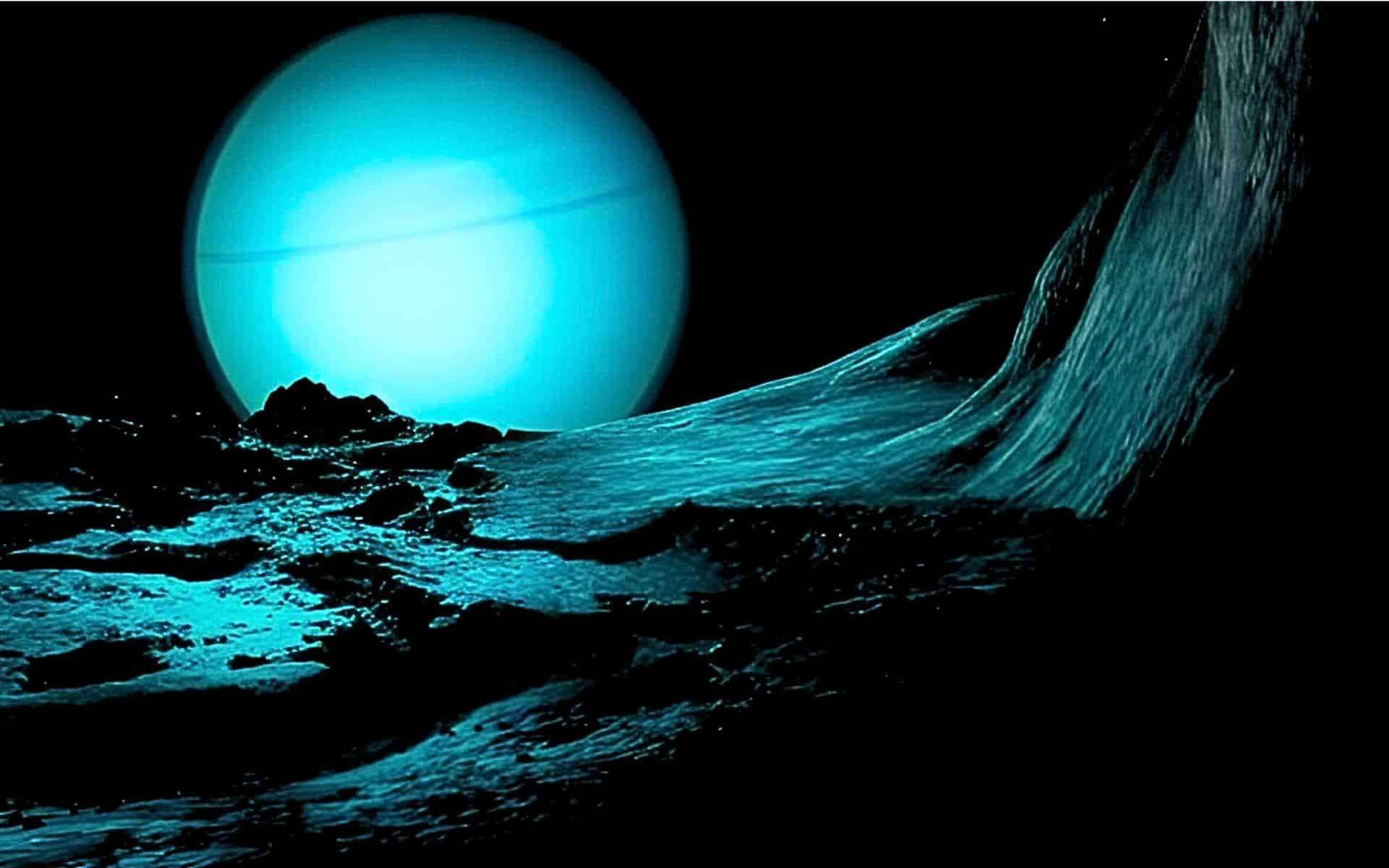
New findings indicate that Miranda, one of Uranus’ intriguing satellites, might conceal an underground ocean, challenging prior beliefs about its evolution and capacity to harbor life.
Miranda's unique, patchwork surface has piqued scientific curiosity for years, and recent research proposes that this small moon is more geologically active than once thought.
A Surprising Candidate for an Ocean World
The idea that an ocean could exist beneath Miranda’s icy crust is astonishing. “Discovering signs of an ocean within a small body like Miranda is truly unexpected,” stated Tom Nordheim, planetary scientist at the Johns Hopkins Applied Physics Laboratory and co-author of the new study.

This insight raises the intriguing notion that Uranus, known for being one of the most distant planets in our solar system, might possess several ocean worlds. Nordheim remarked, “This enhances the narrative that some of Uranus’ moons could be fascinating, which is both thrilling and peculiar.”
Back in 1986, Voyager 2’s landmark flyby provided mankind’s sole up-close view of Miranda, unveiling a moon of striking geological diversity. The spacecraft’s images uncovered massive cliffs, deep valleys, and unique trapezoidal formations called coronae, indicating a vivid geological past. Nevertheless, researchers have grappled with how a relatively tiny moon could generate enough inner heat to form such complex terrains.
Piecing Together Miranda’s Subsurface Secrets
In search of answers, graduate student Caleb Strom from the University of North Dakota and his team re-analyzed those vintage images. Collaborating with experts like Alex Patthoff from the Planetary Science Institute, they charted Miranda’s fractured terrains and ridges. Using computer simulations of various internal configurations, they aimed to connect surface stress signatures with likely subsurface activity.
The findings were remarkable: Miranda probably housed a subsurface ocean between 100 and 500 million years ago. This ocean was roughly 62 miles (100 kilometers) deep beneath a crust about 19 miles (30 kilometers) thick.
Considering Miranda’s small radius of just 146 miles (235 kilometers), this ocean would have made up nearly half the moon’s volume. Strom commented, “This outcome was a significant and unexpected revelation for our team.”
Tidal Heating as the Ocean’s Fuel
What mechanism could maintain liquid water on such a small, distant moon? The answer lies in tidal heating. Interactions with neighboring moons likely contributed critically. Orbital resonances—repetitive gravitational influences between moons—may have generated enough frictional heat, similar to the processes active on Europa, a moon of Jupiter. For Europa, a 2:1 resonance with Io keeps its interior warm enough to sustain a liquid ocean beneath the ice.
Miranda may have undergone comparable warming during its history. Although these resonances have diminished over time, scientists believe its ocean didn’t completely freeze. Nordheim explained, “If the ocean were fully frozen, certain characteristic cracks would appear on the surface, but they are absent.” This suggests that a thinner, residual ocean might persist beneath Miranda’s icy shell today.
Parallels with Enceladus
This discovery evokes memories of Enceladus, Saturn’s icy moon, which surprised scientists by revealing an active internal ocean. Before the Cassini mission in 2004, Enceladus was thought to be a frozen relic. Cassini’s data uncovered a global ocean and ongoing geological activity, highlighted by water and ice plumes erupting from its southern regions. “Few expected Enceladus to be geologically vibrant,” said Patthoff. Enceladus is now a prime target in the quest for extraterrestrial life.
Similarly, Miranda might hold important clues about habitability, despite its remote location. A 2023 report by APL scientist Ian Cohen proposed that Miranda could be releasing material into space, hinting at phenomena ripe for future investigations.
However, Nordheim advises caution: “We’ll need more exploration before confirming that an ocean truly exists on Miranda.” As researchers continue analyzing Voyager 2’s decades-old data, enthusiasm grows around the possibility of a future Uranus mission.
The prospect that several ocean worlds orbit one of the solar system’s most distant planets opens new pathways for groundbreaking discoveries and expands the search for environments that might support life. For now, Miranda remains a captivating mystery, enticing scientists and enthusiasts with secrets that could reshape our understanding of life beyond our planet.
- Categories:
- Space









0 comments
Sign in to Comment