
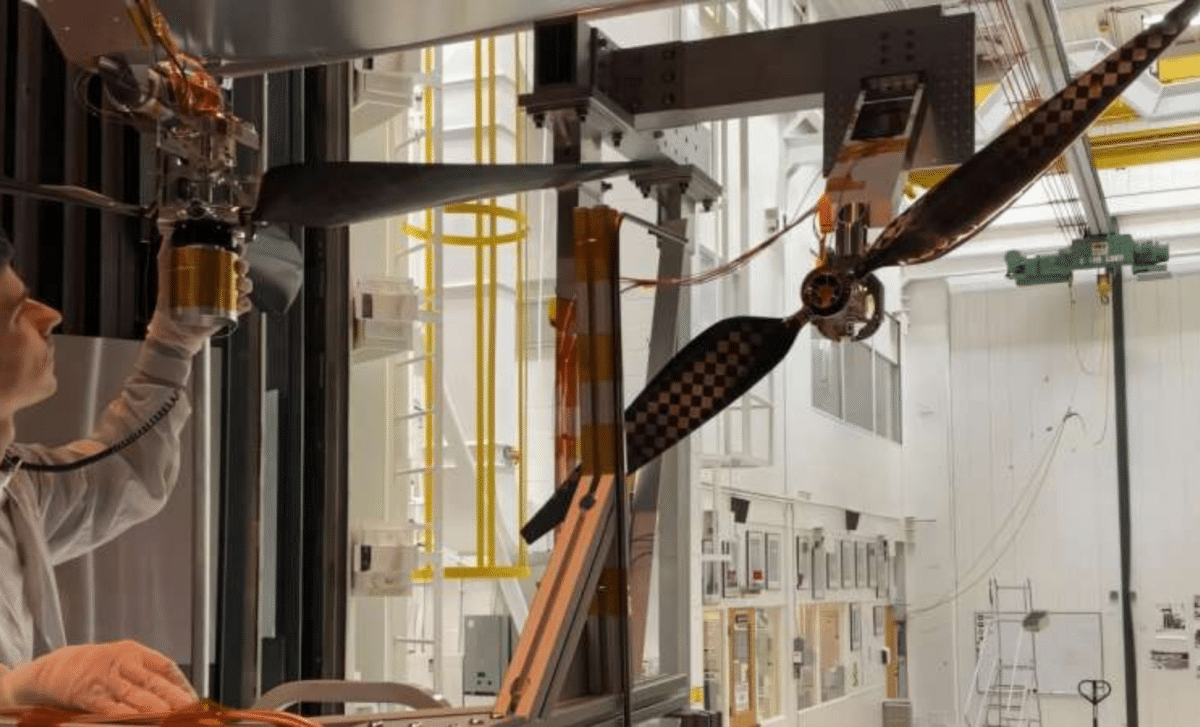
NASA has reached a pivotal milestone by accelerating the rotor blades of its next-generation Mars helicopters beyond the speed of sound. Tested at the Jet Propulsion Laboratory (JPL) in Southern California, the rotors surpassed Mach 1, setting the stage for aerial vehicles on Mars to carry larger payloads, including essential scientific equipment.
As part of NASA’s SkyFall initiative, this breakthrough showcases the future possibilities of low-altitude aerial reconnaissance on Mars, a planet with unique flight challenges. Data gathered from 137 test cycles in a chamber simulating Martian atmospheric conditions provides critical guidance for upcoming mission designs and scientific exploration.
Understanding Mars Flight: Sparse Atmosphere and Gravity Implications
Mars presents extreme conditions for aviation. Its atmosphere is only about 1% as dense as Earth’s, while gravity stands at roughly 38% of Earth’s, making lift generation especially difficult despite sufficient gravity to keep objects grounded.

“NASA had a great run with the Ingenuity Mars Helicopter, but we are asking these next-generation aircraft to do even more at the Red Planet,” said Al Chen, Mars Exploration Program manager at JPL. “That’s not an easy ask. While everything about Mars is hard, flying there is just about the hardest thing you can do. That’s because its atmosphere is so incredibly thin that it is hard to generate lift, and yet Mars has significant gravity.”
To overcome these hurdles, the rotor blades need extraordinarily high rotational speeds to achieve required thrust. Unlike Earth rotors, which operate in thicker air at lower tip speeds, Martian blades must approach supersonic tip velocities to generate sufficient lift in the thin atmosphere.
Surpassing Mach 1: Testing Supersonic Rotor Performance on Mars
The extensive rotor evaluations occurred inside JPL’s iconic 25-Foot Space Simulator, where engineers replicated Mars’ atmospheric conditions by replacing the air with carbon dioxide at appropriate pressures and temperatures. A three-bladed rotor was spun up to 3,750 rpm, causing the blade tips to break the sound barrier at Mach 1.08, boosting lift capacity by approximately 30%.
“If Chuck Yeager were here, he’d tell you things can get squirrely around Mach 1,” said Jaakko Karras, rotor test lead at JPL. “With that in mind, we planned Ingenuity’s flights to keep the rotor blade tips at Mach 0.7 with no wind so that if we encountered a Martian headwind while in flight, the rotor tips wouldn’t go supersonic. But we want more performance from our next-gen Mars aircraft. We needed to know that our rotors could go faster safely.”
This accomplishment confirms that Mars helicopters can push rotor speeds into supersonic regimes to lift heavier and more complex payloads, crucial for future missions equipped with advanced instruments and extended capability batteries.
Advancing Mars Aerial Exploration with Enhanced Rotor Designs
Building on these successful trials, NASA teams are optimistic about the capabilities of future Martian rotorcraft. An additional SkyFall rotor with a two-bladed design and longer blades achieved near-supersonic speed at just 3,570 rpm, proving design versatility in achieving high-speed performance.
“The successful testing of these rotors was a major step toward proving the feasibility of flight in more demanding environments, which is key for next-gen vehicles,” said Shannah Withrow-Maser, an aerodynamicist from NASA’s Ames Research Center and a member of the test team. “We thought we’d be lucky to hit Mach 1.05, and we reached Mach 1.08 on our last runs. We’re still digging into the data, and there may be even more thrust on the table. These next-gen helicopters are going to be amazing.”
This technical breakthrough heralds new possibilities for future Mars missions. Scheduled to launch in December 2028, the SkyFall project will deploy three advanced helicopters featuring this innovative rotor technology, unlocking aerial exploration potential previously deemed unattainable on the Martian surface.
- Categories:
- News







0 comments
Sign in to Comment