

NASA has enlisted seven aerospace companies to investigate groundbreaking methods to improve the Mars Sample Return (MSR) program, targeting more cost-effective and timely delivery of Martian samples.
The chosen firms—Aerojet Rocketdyne, Blue Origin, Lockheed Martin, Northrop Grumman, Quantum Space, SpaceX, and Whittinghill Aerospace—each will receive funding up to $1.5 million to develop 90-day feasibility studies focused on alternative concepts for the MSR mission.
This move is part of NASA’s broader effort to revisit and potentially redesign the existing MSR framework, which has faced criticism due to its estimated $11 billion price tag and a projected timeline extending to 2040, as highlighted here. By exploring unconventional solutions, NASA aims to accelerate the mission's schedule and cut costs considerably.

Reexamining Strategies for Mars Sample Return
The initiative to explore new MSR approaches follows a comprehensive independent review in September, which raised concerns about the current plan’s expenses and duration. Seen as financially demanding and lengthy, a strategic reassessment is necessary to establish achievable objectives within a reasonable timeframe.
NASA Administrator Bill Nelson highlighted the mission’s inherent challenges, stressing the importance of a faster, safer, and more budget-conscious plan. These studies will delve into critical components of the MSR mission, particularly the Mars Ascent Vehicle (MAV), which must launch collected Martian samples into orbit.
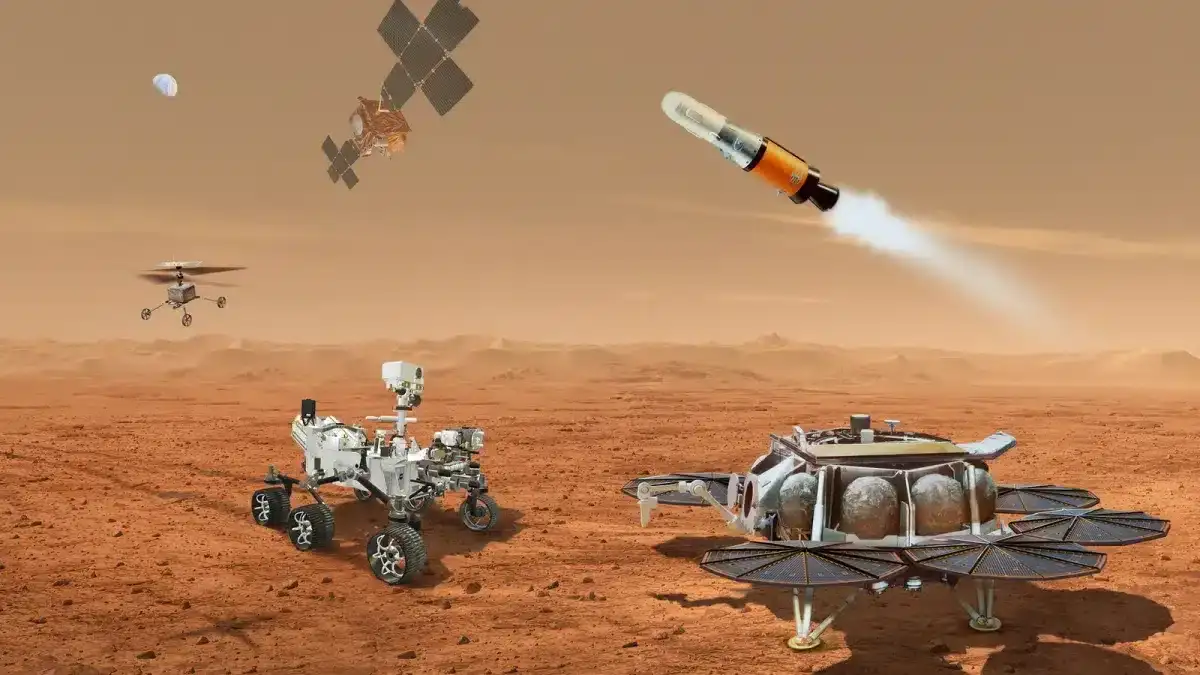
Among the proposals, Aerojet Rocketdyne, Northrop Grumman, and Whittinghill Aerospace focus on enhancing the MAV, whereas SpaceX plans to incorporate its Starship vehicle, and Blue Origin aims to adapt technologies from NASA’s Artemis lunar program.
The MAV plays a pivotal role since it must overcome Mars’ gravity, adding complexity and expense. Sandra Connelly, NASA’s deputy associate administrator for science, pointed out that the MAV is a primary driver of the mission’s intricacy and cost.
The companies will investigate diverse propulsion methods and designs to create a more efficient, reliable MAV. For instance, Aerojet Rocketdyne will concentrate on a high-performance, liquid-fueled MAV, while Northrop Grumman will explore propulsion systems with advanced Technology Readiness Levels (TRL).
Varied Innovations from Industry Leaders
Each organization brings a distinct expertise to this initiative. Lockheed Martin, with its extensive background in Mars spacecraft, will conduct rapid mission design assessments. Northrop Grumman, the current MAV solid-fuel developer, intends to leverage its existing technology to streamline the sample return.
Aerojet Rocketdyne, renowned for precision rocket propulsion, will explore using mature liquid-fueled technology to boost performance, reduce costs, and adhere to tight schedules.
SpaceX, driven by an ambitious Mars colonization vision, will study the feasibility of using its Starship system for MSR tasks. Their project, "Enabling Mars Sample Return with Starship," explores Starship’s potential to transport cargo to Mars and safely bring samples back to Earth.
SpaceX’s participation underscores the potential for Starship to revolutionize Mars missions, though such milestones depend on advancing technology and successful mission demonstrations. Elon Musk, SpaceX’s CEO, has expressed optimism about Starship’s capability for Mars landings.
Blue Origin will assess the possibility of integrating Artemis lunar program elements into the MSR mission. This integration could leverage NASA’s Space Launch System and the lunar Gateway, fostering synergies between lunar and Martian exploration, potentially lowering overall costs.
Collaboration with NASA Centers and Emerging Players
Aside from these commercial studies, NASA’s Jet Propulsion Laboratory (JPL), Applied Physics Laboratory (APL), and multiple NASA centers will undertake parallel research efforts starting mid-July, with interim and final results expected within 45 and 90 days.
These investigations will guide NASA’s decisions regarding MSR mission revisions, aiming to set a clear course by early 2025. The objective is to curtail total and peak yearly spending while potentially advancing the timeline for sample return.
The inclusion of emerging companies like Quantum Space and Whittinghill Aerospace introduces fresh perspectives. Quantum Space, founded by entrepreneur Kam Ghaffarian, specializes in space infrastructure and will conduct its "Quantum Anchor Leg Mars Sample Return Study," possibly concentrating on the final Earth return stage. Whittinghill Aerospace focuses on a streamlined single-stage MAV concept designed for efficient sample launch from Mars.
Shaping the Future of Mars Sample Return
NASA’s strategy of engaging a diverse array of entities for these studies mirrors its commitment to thoroughly exploring innovative solutions for the MSR mission. Nicola Fox, head of NASA’s science directorate, emphasized the necessity for creative ideas to achieve the goal of returning Martian samples by the 2030s, instead of the previously anticipated 2040s or later. The blend of established aerospace giants and entrepreneurial startups underlines NASA’s dedication to incorporating a broad spectrum of expertise and technology.
The collective findings will equip NASA with comprehensive insights to devise a renewed MSR plan. This strategy is likely to combine the best elements from various proposals, melding industry breakthroughs with NASA’s capabilities and contributions from the European Space Agency. This collaboration reflects the global and interdisciplinary nature of space exploration, setting the stage for significant breakthroughs in planetary science and exploration.
- Categories:
- Astronomy ,
- Space ,
- Nasa ,
- Aircraft










0 comments
Sign in to Comment