
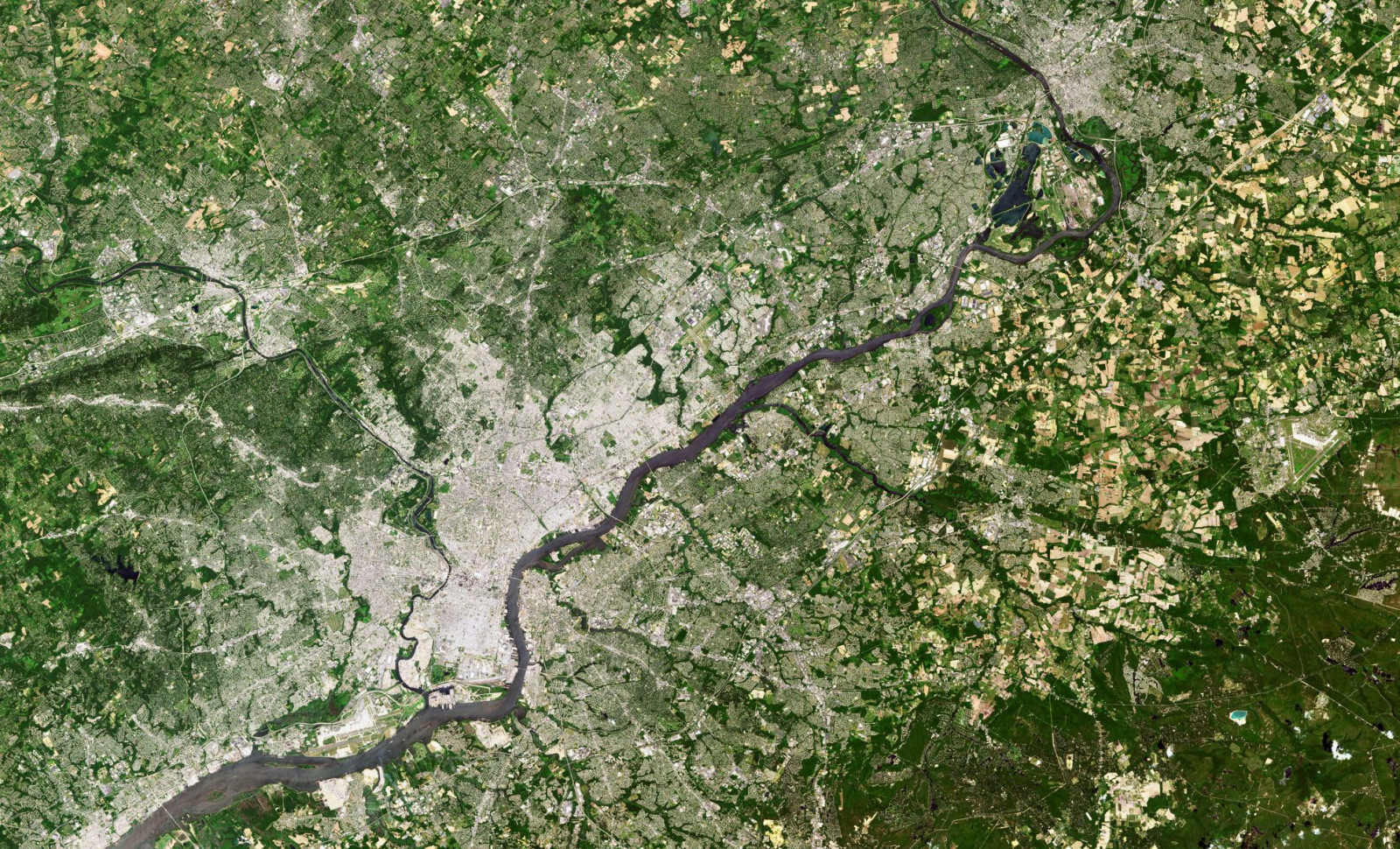
On June 1, 2013, the Landsat 8 satellite captured a striking image of Philadelphia, showcasing its lush greenery more than 300 years after William Penn established the city. This snapshot, taken by the Operational Land Imager on Landsat 8, is featured in a NASA Earth Observatory article commemorating the landscapes instrumental to early U.S. history.
Philadelphia’s location between the Schuylkill and Delaware rivers greatly influenced its early development and helped shape its role in the formation of the United States government. These rivers naturally defined the settlement’s borders and offered vital access for trade from the city’s inception.
Founded in 1682 as the headquarters for a Quaker community, Penn arrived to a region once inhabited by Swedish and Dutch settlers, as well as the Lenni Lenape (Delaware) Indigenous people. He formalized agreements with the Lenape, securing peace and land for the fledgling colony.

Penn originally named the area Sylvania due to its dense forests, a title that endures within the state’s name, Pennsylvania. Contemporary descriptions of the site describe a landscape of elevated, dry terrain dotted with pine trees—still evident from space today.
Philadelphia’s Strategic River Location Fueled Its Growth
Being positioned upstream from Delaware Bay and the Atlantic Ocean turned Philadelphia into a major industrial and cultural center during colonial times. The rivers enabled seamless movement of goods and people between the settlement and the Atlantic trade routes, accelerating its expansion beyond many neighboring colonies.
Colonial ships could navigate directly from the ocean into Delaware Bay and onward to Philadelphia, making the city an essential stop for commerce. This accessibility spurred rapid growth compared to inland towns without maritime connections.
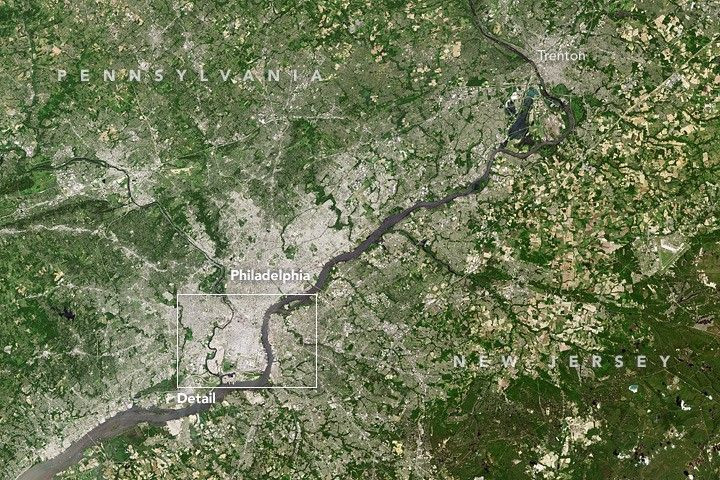
The Landsat 8 image emphasizes the city’s enduring greenery. Despite centuries of urban expansion, much of the original forest cover remains, a noteworthy feature considering the city’s present-day size, as highlighted by the Earth Observatory.
Moreover, the rivers situate Philadelphia near the middle of the original 13 colonies, a centrality that proved crucial when the Founding Fathers selected a meeting place, making it convenient for representatives traveling from colonies to the north and south.
The City Witnessed Key Moments in American Independence
About a century after its founding, Philadelphia became the site where American leaders convened to draft foundational documents. In 1776, they approved the Declaration of Independence in Carpenter’s Hall, near the colonial government’s red-brick building.
Later, in 1787, the same location—later renamed Independence Hall—hosted the signing of the U.S. Constitution. Both historic events occurred within a compact area of the city.
Between 1781 and 1788, Philadelphia also served as the U.S. capital, underscoring its political significance following the Revolutionary War before the government relocated.
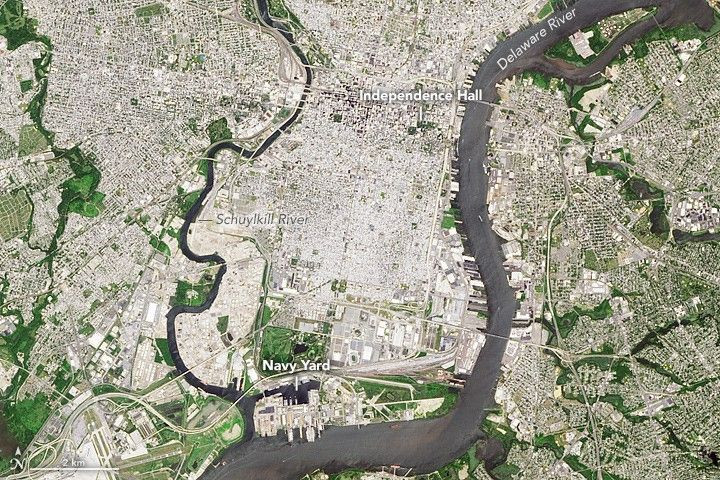
This rich history is evident in the city’s design. Center City, dominated by taller buildings around Independence Hall, contrasts with the densely packed residential blocks extending into South Philadelphia, known for its Italian Market.
Initially a separate community, South Philadelphia merged with the larger city in 1854 following population growth, expanding Philadelphia beyond Penn’s original riverside settlement.
Modern Philadelphia: A Blend of Heritage and Diversity
Today, Philadelphia ranks as the fifth-largest U.S. city, with a metropolitan population exceeding 6 million. This makes it one of the country’s few metropolitan areas of such scale.
The city’s industrial peak occurred in the 19th century, a period that influenced much of its urban form. Many row houses and street layouts visible in the Landsat images date back to this era.
Currently, education and health services dominate Philadelphia’s economy, mirroring a nationwide shift away from manufacturing that unfolded over many decades, while the historic downtown maintains its historic character.
South Philadelphia, in particular, reflects its immigrant past, housing vibrant African American communities alongside descendants of former Italian, Irish, and Jewish populations. This multicultural heritage stems from the neighborhood’s longstanding role as an entry point for new residents.
- Categories:
- News










0 comments
Sign in to Comment