
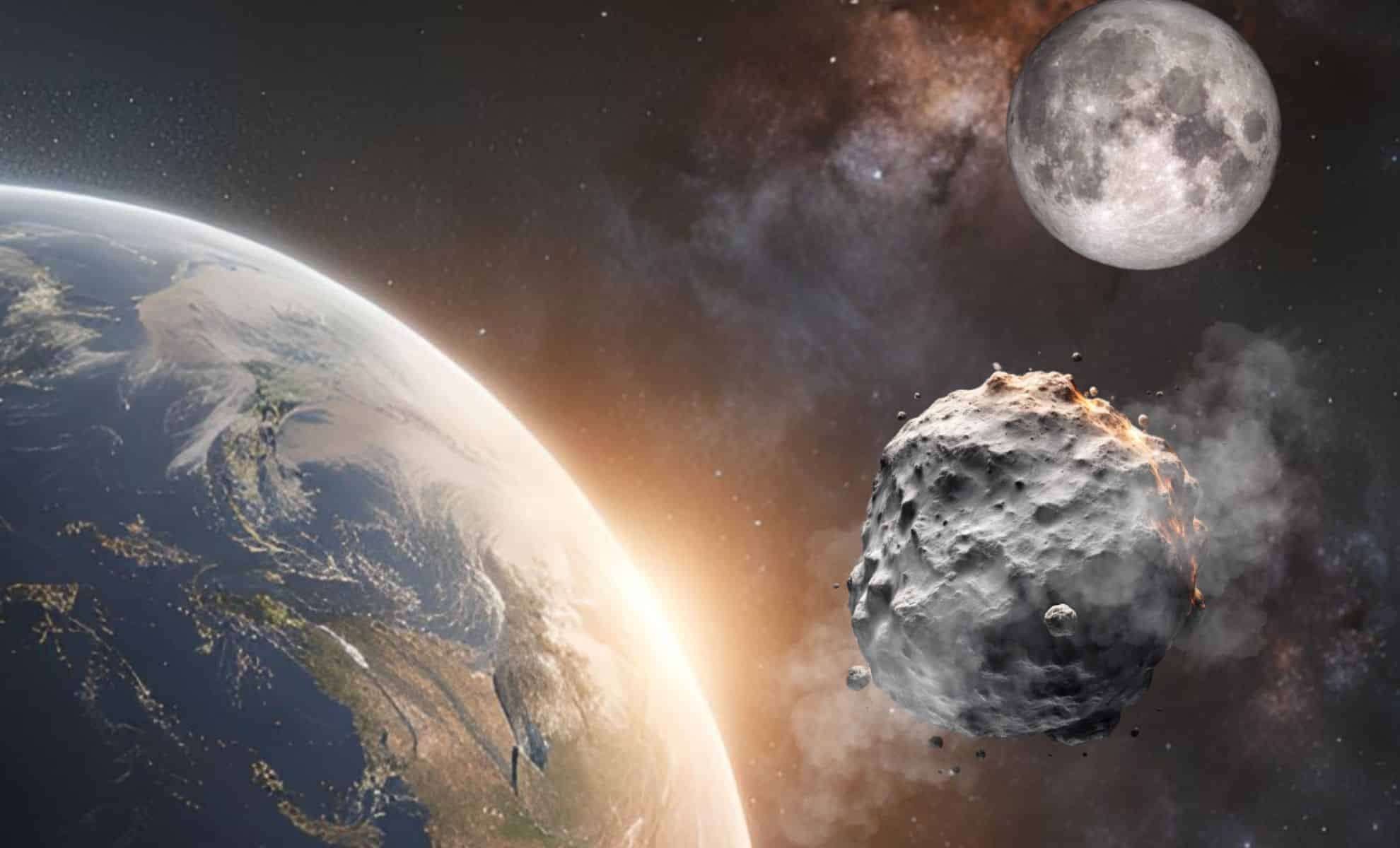
Researchers have unveiled compelling evidence linking 2024 PT5, a small asteroid temporarily held by Earth's gravity in late 2024, to debris originating from the Moon. This mini-moon, measuring just around 10 meters (33 feet) across, orbited Earth for almost two months before resuming its journey around the Sun. What distinguishes this object is its distinctive composition, directly confirming its lunar origin.
Published in the Astrophysical Journal Letters, the study demonstrates how fragments blasted off the Moon by ancient impacts can travel long distances and occasionally settle into Earth-like orbits. This exceptional finding offers fresh insights into the violent events that sculpted the lunar surface and opens new doors for future space investigations.
Confirming the Lunar Heritage of 2024 PT5
The initial indication that 2024 PT5 might hail from the Moon came from its orbit, which closely mirrors Earth’s path around the Sun. First observed on August 7, 2024, by the Asteroid Terrestrial-impact Last Alert System (ATLAS) in South Africa, the object was initially classified as a typical near-Earth asteroid. However, further analysis revealed surprising characteristics.

“We suspected that this asteroid could be lunar in origin, but the definitive proof was finding its surface rich in silicate minerals typical of lunar rock samples rather than common asteroid material,” explained Dr. Teddy Kareta, an astronomer affiliated with Lowell Observatory.
Advanced observations via the Lowell Discovery Telescope and the NASA Infrared Telescope Facility in Hawai’i showed that the sunlight reflected off 2024 PT5 matched the spectral signature of lunar rocks collected during Apollo missions. This spectroscopy provided solid evidence of its Moon-based source.
A Relatively Fresh Visitor
Another fascinating feature of 2024 PT5 is its apparent youth. Its surface bears minimal signs of space weathering, a phenomenon that typically alters the color and texture of objects exposed to cosmic conditions over millions of years.
“The asteroid appears to have been free-floating in space for only a few thousand years at most, as indicated by the absence of reddening from space weathering,” noted Dr. Kareta.
This suggests 2024 PT5 likely originated from a recent major impact event on the lunar surface. Studying such fresh fragments offers scientists a unique glimpse at the Moon’s more contemporary geological activity, with minimal alteration from aging processes.
An Emerging Collection of Lunar Origin Asteroids
The identification of 2024 PT5 joins a small but steadily expanding group of asteroids suspected to come from the Moon. Back in 2016, Asteroid 469219 Kamo’oalewa was discovered following a similar Earth-like trajectory and is believed to be lunar ejecta from a large impact.
“Increasing telescope sensitivity to smaller near-Earth objects means more potential lunar fragments will be uncovered, offering valuable research possibilities both for asteroid science and lunar geology,” researchers stated.
These findings are crucial not only for scientific knowledge but also for understanding impact histories in the Earth-Moon system. They could even provide access to materials from beneath the Moon’s surface, revealed thanks to these transient visitors.
Revealing the Moon’s Secluded History
Linking lunar fragments like 2024 PT5 to particular impact craters on the Moon could transform lunar studies. By analyzing these objects, scientists might unlock new information about the processes shaping the Moon's cratered landscape.
“Establishing a direct connection between a lunar asteroid and a specific lunar impact site could illuminate the mechanisms of crater formation,” the research team highlighted.
Furthermore, such asteroids may provide otherwise inaccessible samples from beneath the lunar surface. “These fragments potentially carry deep lunar material that future missions could study,” the astronomers added.
Expanding Horizons for Lunar and Asteroid Research
For astronomers like Dr. Kareta, the discovery of 2024 PT5 merges asteroid science with lunar exploration, provoking new research questions and opportunities.
“This case exemplifies how asteroid studies can reveal unexpected stories about the Moon,” Dr. Kareta commented. “Studying 2024 PT5 pushed us into uncharted territory regarding lunar science.”
This remarkable find underscores how even the smallest cosmic objects can provide profound insights into our solar system's history. As more lunar fragments are identified and examined, they will reveal hidden details about the Moon’s surface, subsurface composition, and its dynamic relationship with Earth.
- Categories:
- News








0 comments
Sign in to Comment