
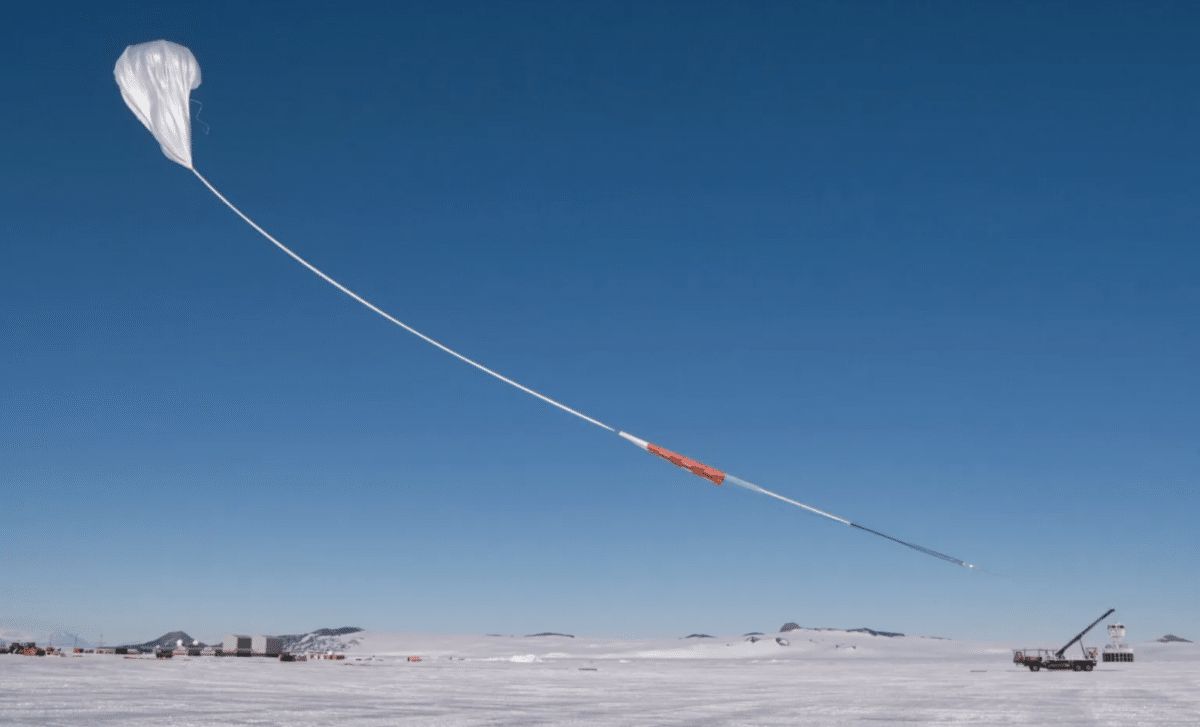
NASA’s Scientific Balloon Program has reached new milestones with four successful long-duration balloon flights over Antarctica. These high-altitude platforms are instrumental in exploring antimatter and neutrinos, providing vital clues about dark matter and the universe’s early history.
Exploring Cosmic Mysteries From Antarctica’s Edge
For many years, Antarctica has been a vital launch site for NASA’s long-term scientific balloon missions. In the latest operation, coordinated by the Wallops Flight Facility in Virginia, four enormous balloons set off from the Ross Ice Shelf, near McMurdo Station, during December and January. Measuring as large as a stadium, these balloons carried sophisticated detectors intended to capture rare particles rarely observed directly, offering researchers significant insight into the unseen universe.
The centerpiece of this mission, the GAPS (General Antiparticle Spectrometer), took off on December 15 with the aim of identifying antimatter particles entering Earth's atmosphere. Antimatter detection is crucial because it could confirm the presence of dark matter, an elusive substance that constitutes over 80% of all matter in the cosmos. After an impressive flight spanning 25 days and two hours, the GAPS payload safely landed back on Antarctic ice on January 9, marking one of the program’s lengthiest and most fruitful flights.

Cutting-Edge Observations From NASA’s Balloon Campaign
A significant part of the operation was the Payload for Ultrahigh Energy Observations (PUEO), which launched on December 19. PUEO is designed to detect neutrinos, nearly massless subatomic particles that can traverse billions of light-years without being absorbed or deflected. This unique characteristic allows neutrinos to reveal information about cosmic events like supernovae, black hole mergers, and even conditions following the Big Bang.
This flight also marked a significant achievement for NASA’s Astrophysics Pioneers Program, which focuses on small yet impactful missions offering high scientific return at lower budgets. Additionally, two smaller “HiCal” balloons were deployed to help calibrate PUEO’s detectors by producing well-characterized radio pulses that imitate neutrino signals. Impressively, for a short period spanning four days, all four balloons were airborne simultaneously, showcasing remarkable coordination and technical skill.
According to the original NASA Wallops report, this campaign reflects years of meticulous engineering, testing, and collaboration between NASA, Peraton, and Aerostar International, the manufacturer responsible for the balloon hardware.
Innovative Balloon Technology Above the Antarctic
NASA’s balloons distinguish themselves from conventional weather balloons by being zero-pressure balloons, which maintain pressure equilibrium with the surrounding atmosphere during ascent. These colossal structures feature ducts allowing gas venting, which stabilizes internal pressure as they float through the stratosphere, soaring over 100,000 feet above Earth.
Thanks to the unique conditions of Antarctica’s continuous summer daylight, these balloons can stay aloft for several weeks, circling the continent propelled by consistent polar wind systems. One major advantage of these flights is their ability to support heavy science instruments, sometimes weighing thousands of pounds, while simulating near-space environments at costs far lower than satellite launches. This capability enables sophisticated astrophysics research that bridges the gap between ground observatories and orbital spacecraft.
Shaping the Future of Astrophysical Exploration
Each Antarctic balloon campaign further lays groundwork for upcoming space science missions. Data gathered from GAPS, PUEO, and HiCal not only deepen our understanding of fundamental physics but also guide the development of advanced sensors for detecting cosmic rays, antimatter, and high-energy particles.
By blending creative engineering with affordable experimentation, NASA demonstrates that pioneering discoveries are achievable without rocket launches alone. As these balloons quietly navigate the Antarctic skies, they carry humanity’s quest for knowledge to the outer limits of the atmosphere and beyond.
- Categories:
- Physics








0 comments
Sign in to Comment