
A team of astronomers has discovered an extraordinary cosmic arrangement that challenges our understanding of how dark matter influences the cosmos. Within an Einstein Cross gravitational lens, they identified a colossal, unseen halo — not by direct sight, but through its effect on bending light.
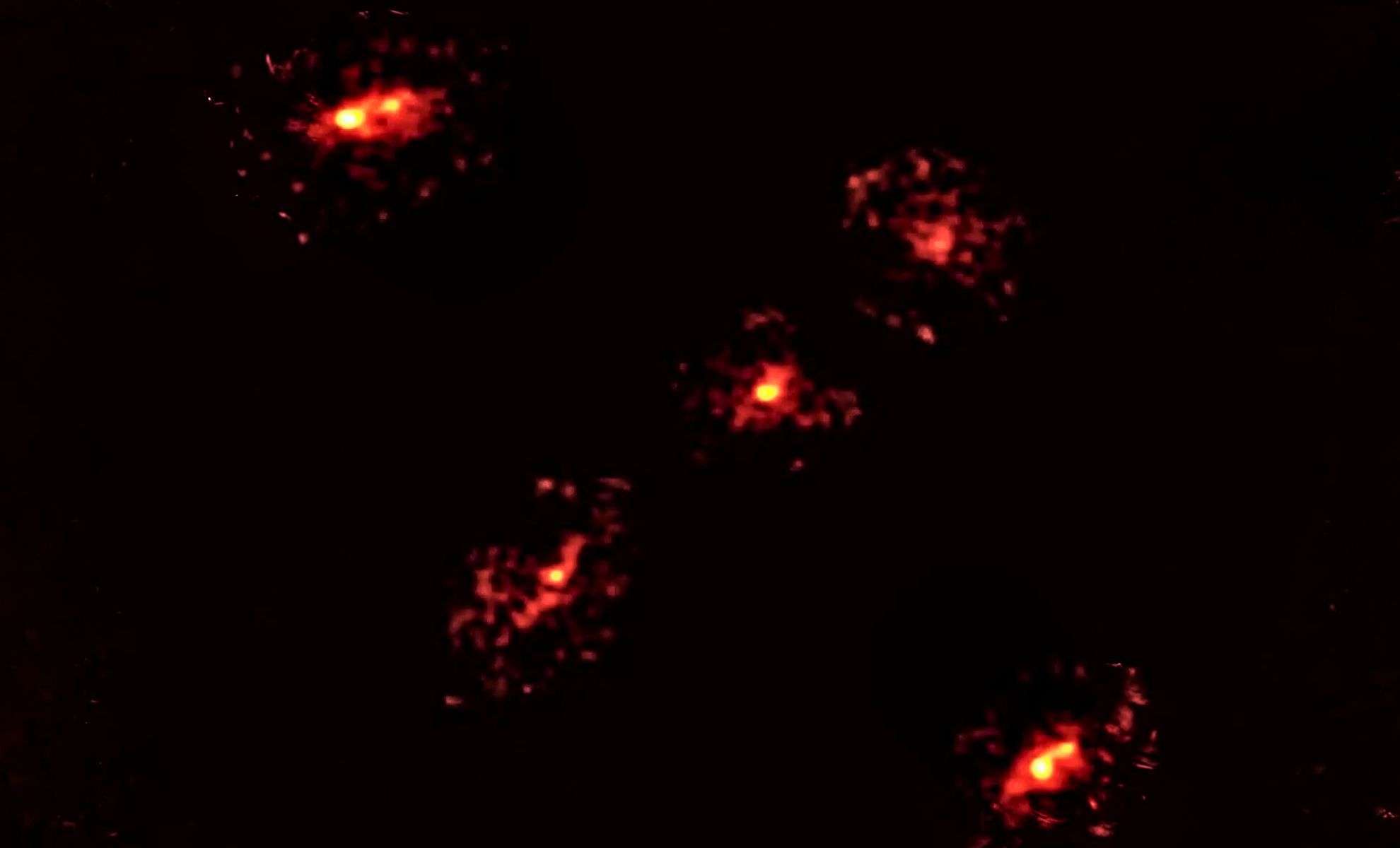
Published in The Astrophysical Journal, the research focuses on the distant galaxy HerS-3, observed as it existed around 12 billion years ago. Utilizing a suite of advanced telescopes including ALMA, NOEMA, and the Hubble Space Telescope, scientists noticed something unusual: instead of the standard four lensed images, five distinct points appeared.
The unexpected fifth, faint image near the center shouldn't exist unless an unseen gravitational influence is at work. The researchers propose this is evidence of a dark matter halo ranging in mass between 1.6 and 10 trillion times that of the Sun, silently shaping light from behind the scenes.

An Unexpected Gravitational Twist
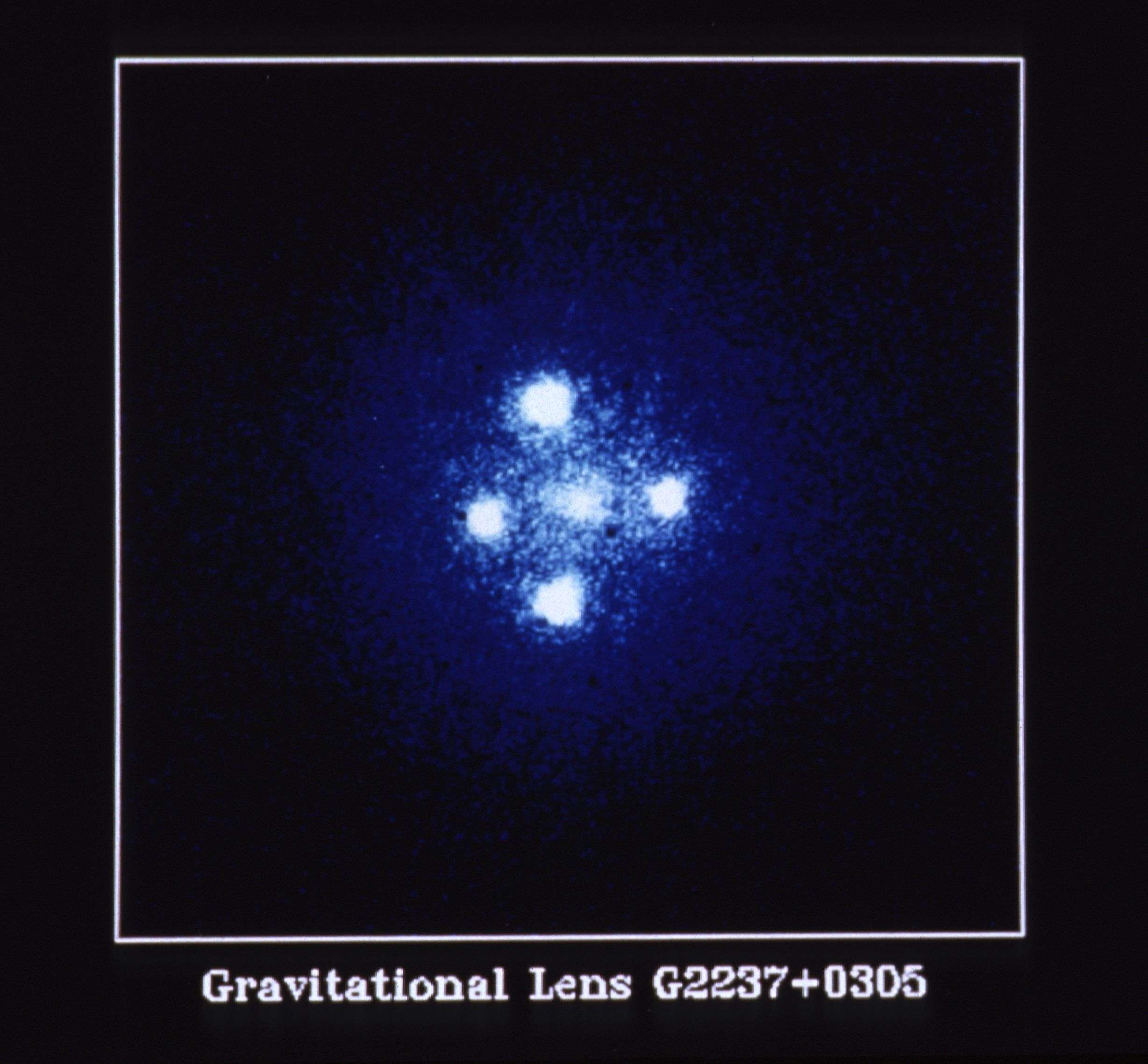
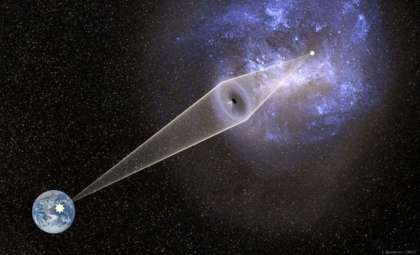
Gravitational lensing, a phenomenon predicted by Einstein’s general relativity, occurs when massive bodies curve the texture of space-time, redirecting light paths. Typically, a distant galaxy perfectly aligned behind a massive foreground object forms four distinct images, creating what astronomers call an Einstein Cross. However, the lensing seen in HerS-3 defied this classic pattern.
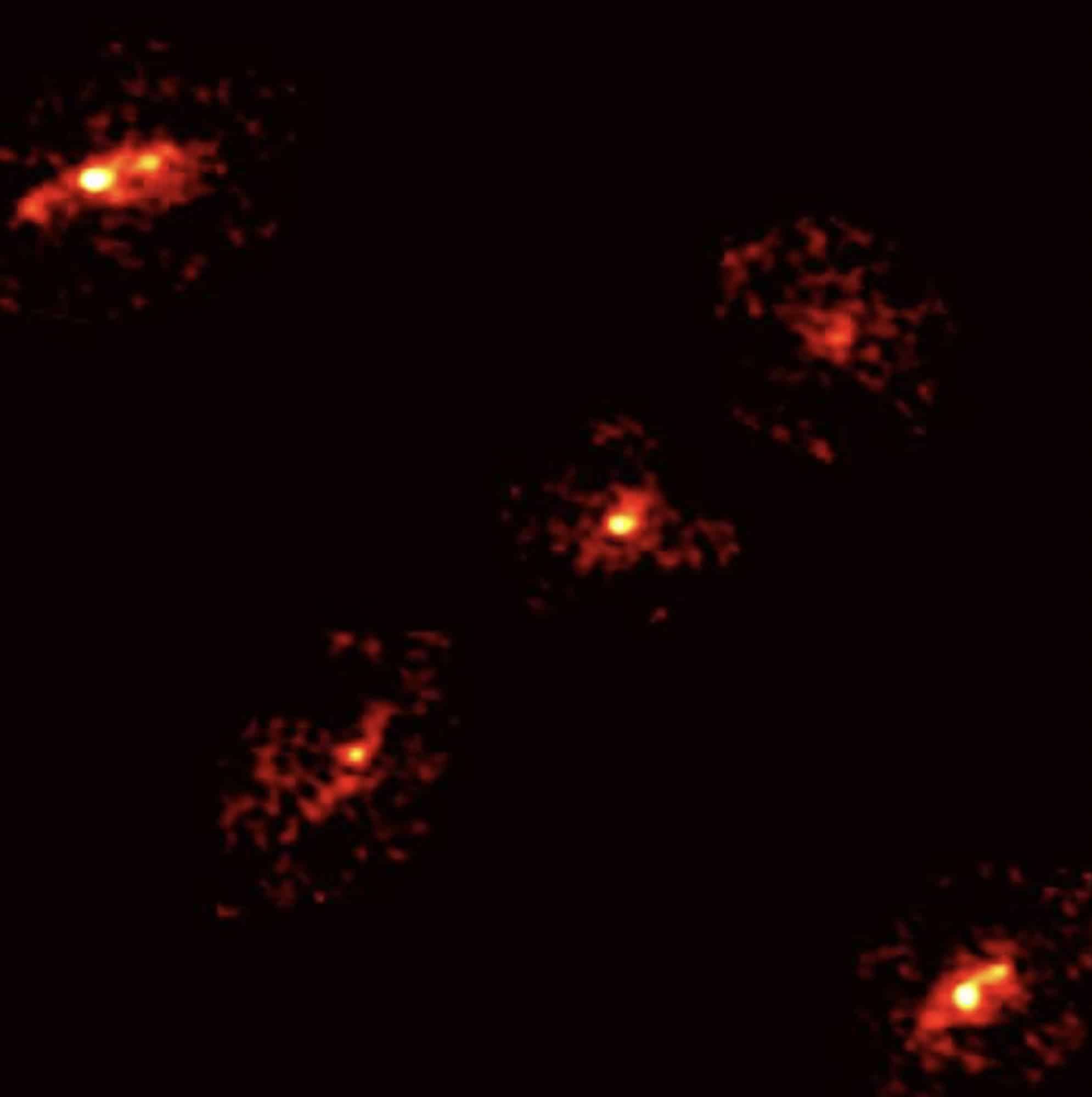
Initial detection of HerS-3 in submillimeter wavelengths—a pioneering observation for an Einstein Cross—revealed the unusual fifth, centrally located image. While this anomaly might have been dismissed as an error, multiple independent observations from observatories in France, Chile, and New Mexico confirmed its presence.
To make sense of this, scientists simulated the lensing scenario using only known foreground galaxies but consistently failed to replicate the observed five-image layout. The solution came by adding a massive, non-luminous structure positioned southeast of the galaxy cluster — an invisible but gravitationally influential entity.
The Presence of a Hidden Giant
This unseen agent is interpreted as a dark matter halo — a dense, spherical mass that neither emits nor absorbs light yet exerts gravitational pull. By including such a halo in the model, estimated to be between 80,000 and 200,000 light-years from the foreground galaxy, simulations matched the observed lensing perfectly, aligning light paths, image locations, and brightness.
Lead researcher Pierre Cox from the Institut d’Astrophysique de Paris likens this invisible mass to "an unseen glass lens bending and amplifying light as if it were visible." Unlike earlier dark matter studies relying on indirect clues like galaxy rotation speeds or cosmic structure patterns, this case demonstrates a rare, direct gravitational fingerprint of dark matter with no visible counterpart.
Zooming in on a Dynamic Distant Galaxy
Beyond revealing the hidden halo, gravitational lensing acts as a powerful cosmic magnifier, increasing HerS-3’s apparent brightness by a factor of 17 to 19. This amplification aids astronomers investigating galaxies from the early universe.
HerS-3 is far from serene; it forms stars at a pace hundreds of times that of the Milky Way, featuring energetic gas outflows exceeding 350 km/s likely caused by intense stellar winds. These properties paint a picture of a young galaxy undergoing rapid, turbulent evolution during cosmic dawn.
Notably, the two most luminous lensed images are separated by an unusually wide 7.5 arcseconds, ranking this among the largest known Einstein Crosses, reinforcing the lensing interpretation and hinting at the immense mass behind the phenomenon.
A Promising Method to Probe Cosmic Expansion
Besides advancing dark matter insights, the HerS-3 system offers a novel approach to measuring cosmic expansion. The five images’ light paths vary, meaning brightness fluctuations reach observers at staggered times.
This time-delay effect could allow refined calculations of the Hubble constant, which quantifies the universe’s expansion speed. While not the primary focus of the work, the researchers highlight these rare lenses as natural observatories for future distance measurements. Paired with instruments like the James Webb Space Telescope and forthcoming high-resolution missions, such phenomena could play an essential role in resolving key cosmological questions.




0 comments
Sign in to Comment