

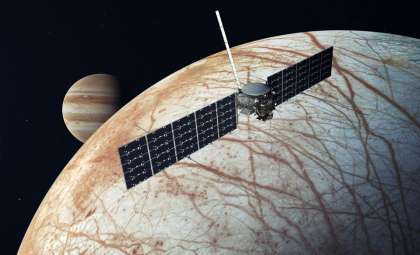
Continuing its ambitious voyage toward Jupiter’s enigmatic moon Europa, NASA’s Europa Clipper spacecraft recently executed a close encounter with Mars, yielding remarkable infrared photographs of the Red Planet. This maneuver, performed on March 1, fulfilled two critical roles: fine-tuning the spacecraft’s path and calibrating an instrumental sensor vital for investigating Europa’s concealed ocean.
Executing a Deliberate Approach for a High-Precision Objective
During the flyby, the spacecraft skimmed just 550 miles (884 kilometers) above Mars' surface. In this short but pivotal window, Europa Clipper captured over a thousand infrared images in grayscale at a rate of one per second throughout an 18-minute span. The data was relayed to Earth starting May 5, with subsequent processing applying colors to reflect temperature variations—red indicating warmer regions and blue symbolizing cooler zones.
Scientists at NASA seized this opportunity to verify the functionality of the Europa Thermal Imaging System (E-THEMIS), an infrared camera set to play a key role in charting Europa’s surface temperatures. Phil Christensen, principal investigator at Arizona State University, explained the intention was to “capture imagery of a planetary body we understand exceptionally well and confirm that the data aligns perfectly with the extensive record accrued from two decades of Martian observations.”

Benchmarking Performance Against Established Data
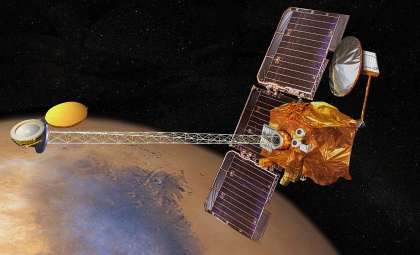
To validate instrument accuracy, the team correlated the new infrared imagery with longstanding thermal datasets collected by NASA’s Mars Odyssey orbiter. Since its launch in 2001, Odyssey has been equipped with a comparable camera, THEMIS, which has studied Mars’ thermal properties in infrared for more than 20 years. Coordinating with the Europa Clipper flyby, the Odyssey team timed their observations to overlap, capturing data before, during, and after the event to enable thorough cross-validation.

This thorough comparison goes beyond routine calibration. Eventually, E-THEMIS will scan Europa’s icy exterior searching for thermal disturbances—signs that could indicate recent geological activity or subsurface oceans nearer to the surface than previously detected. Christensen noted, “If Europa maintains geological activity, fractures in the ice will exhibit elevated temperatures where the ocean lies beneath.”
Real-World Testing for Radar Systems
Additionally, the Mars encounter provided an opportunity to evaluate the spacecraft’s radar setup under genuine space conditions for the first time. The radar employs antennas with long wavelengths that couldn’t be entirely tested pre-launch. Early assessments confirm that all radar components performed within expectations, though comprehensive analysis continues.
This radar will be instrumental in determining the thickness of Europa’s ice shell and understanding interactions between the ice and underlying ocean. By integrating radar findings with thermal data, researchers aim to achieve a holistic view of the moon’s geological landscape and its potential to harbor life.

Evaluating Communications and Gravitational Instruments
Beyond imaging and radar, this flyby enabled NASA engineers to test Europa Clipper‘s communication capabilities while influenced by Mars’ gravity. The probe sent data to Earth as it navigated the planet's gravitational field, a rehearsal critical for future Europa passes when subtle gravitational shifts will be measured.
Utilizing Mars’ gravity for a velocity boost is part of Europa Clipper’s sophisticated navigational plan. Launched from Kennedy Space Center on October 14, 2024 aboard a SpaceX Falcon Heavy rocket, the spacecraft is set on a 1.8-billion-mile (2.9-billion-kilometer) course to Jupiter. This Mars flyby was the first of two gravity assists, with a second scheduled near Earth in 2026 to accelerate the probe further towards its ultimate target.
Approaching the Frozen Ocean World
Upon arriving at Jupiter in 2030, Europa Clipper will spend roughly a year entering orbit around the gas giant before conducting 49 close approaches to Europa. The mission aims to analyze the moon’s surface makeup, geological processes, and hidden ocean, probing whether conditions beneath the icy crust could support life.
Managed by NASA’s Jet Propulsion Laboratory in California, with development assistance from the Johns Hopkins Applied Physics Laboratory in Maryland, this effort involves multiple NASA centers including Goddard, Marshall, and Langley. The Europa Clipper mission is a cornerstone in NASA’s initiative to explore the outer reaches of the solar system.
With its Mars flyby accomplished and data flow ongoing, Europa Clipper advances steadily toward unlocking the secrets beneath Europa’s icy facade.
- Categories:
- Space





0 comments
Sign in to Comment