
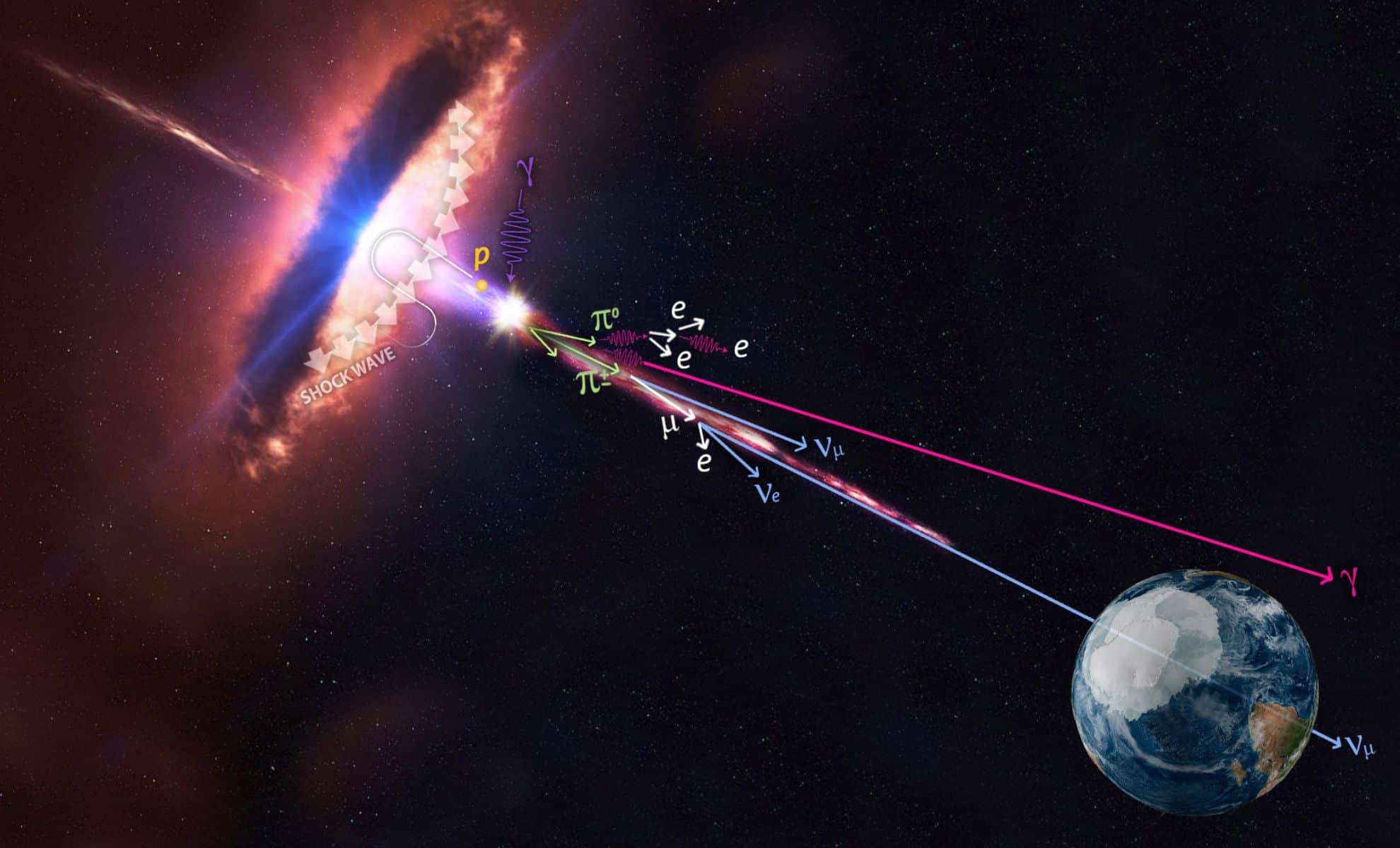
Astronomers have long sought the origins of ultra-high-energy cosmic rays, the universe’s most energetic particles. These particles, traveling close to light speed, pack energies far beyond what any human-made collider, such as the Large Hadron Collider (LHC), can produce. Historically, their source was assumed to be violent cosmic phenomena like supernova explosions, neutron star mergers, or supermassive black holes consuming matter.
However, a recent study presents a surprising alternative to this view. A Russian astrophysicist’s paper, available on arXiv, argues that these exceptional cosmic rays may actually emerge from processes within our own Milky Way. Specifically, they could result from the annihilation of hypothetical dark matter particles called scalarons scattered throughout our galaxy.
If validated, this concept could reshape current models of dark matter, energetic particle physics, and the fundamental forces influencing the cosmos.

Understanding Cosmic Rays and Their Incredible Energies
Cosmic rays are charged particles, mainly protons or heavier nuclei, constantly striking Earth from outer space. Discovered in the early 1900s, most originate from known sources such as supernova remnants, pulsars, or active galactic nuclei. Yet, some cosmic rays possess such astounding energies that their origins defy explanation.
These especially perplexing are the ultra-high-energy cosmic rays (UHECRs), exceeding energies of 10¹⁸ electron volts (eV). Properties of these particles include:
- Traveling at nearly light speed
- Holding energy trillions of times greater than particles produced in labs
- Maintaining their energy despite long journeys through space
The puzzling part is that if these particles were emitted from sources billions of light-years away, they should weaken due to interactions with cosmic microwave background radiation and galactic magnetic fields. Their intact arrival indicates a much nearer origin.
An Innovative Hypothesis: Dark Matter Annihilation as the Source
The new hypothesis challenges conventional wisdom, suggesting ultra-powerful cosmic rays arise not from distant cataclysms but from the annihilation of scalarons, a rare dark matter candidate, within our galaxy.
Defining Scalarons
Scalarons are hypothetical, extremely massive dark matter particles theorized to have formed during the universe’s initial cosmic inflation phase. Unlike ordinary matter, scalarons:
- Are invisible to light, making them extremely difficult to observe directly
- Permeate the universe, possibly explaining dark matter’s elusive mass
- Can sometimes collide and annihilate, releasing tremendous energy bursts that may manifest as cosmic rays with staggering energies
This mechanism could account for the seemingly random directions from which UHECRs arrive, contrasting with expectations that they originate from specific distant astrophysical phenomena.
Implications for Unlocking the Dark Matter Mystery
Dark matter, constituting roughly 85% of the universe’s mass, remains invisible and undetectable except through its gravitational influence on galaxies and large-scale cosmic structures.
Should the scalaron model prove accurate, it might offer the first observational proof of dark matter particles interacting and producing measurable energy emissions. Such a breakthrough could dramatically advance research into both cosmic rays and dark matter’s elusive nature.
Nevertheless, alternative explanations exist. Some scientists propose that ultra-high-energy cosmic rays originate from massive star-forming regions or intense magnetic fields within the Milky Way, models which align more closely with Einstein’s general relativity and do not require the new physics associated with scalarons.
- Categories:
- News




0 comments
Sign in to Comment