

Researchers have identified the Milky Way’s most intense gamma rays, emerging from its chaotic central region.
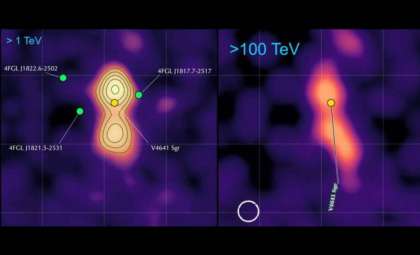
Recorded at energies surpassing 100 teraelectron volts (TeV), these gamma rays were observed by the High-Altitude Water Cherenkov (HAWC) observatory based in Mexico. This achievement sheds light on the extreme conditions near the Milky Way’s Galactic Center Ridge, a zone known for harboring some of the universe’s most energetic phenomena.
PeVatrons: Exploring the Universe’s Ultimate Particle Accelerators
This breakthrough detection of ultrahigh-energy gamma rays marks an essential advancement, revealing the presence of a PeVatron, a cosmic accelerator capable of boosting protons and other particles to staggering energies around 1 quadrillion electron volts (PeV). Pat Harding, a physicist from Los Alamos National Laboratory, highlighted the importance: “These results offer a view into the Milky Way’s core at energies an order of magnitude higher than before.” The gamma rays recorded by HAWC provide the first solid evidence of a PeVatron within the Galactic Center Ridge, a region known for exceptional energetic activity.

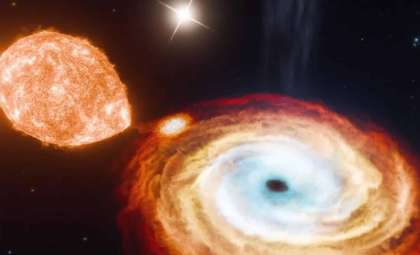
PeVatrons are exceedingly rare celestial engines that propel cosmic rays to near-light speeds. When these rays collide with dense gas and magnetic fields in the galactic nucleus, they generate gamma rays of unparalleled energies. These highly energetic gamma rays rank among the strongest particles ever detected in our galaxy. Harding added, “This research is the first to confirm a PeVatron source of ultrahigh-energy gamma rays in the Milky Way’s Galactic Center Ridge.”
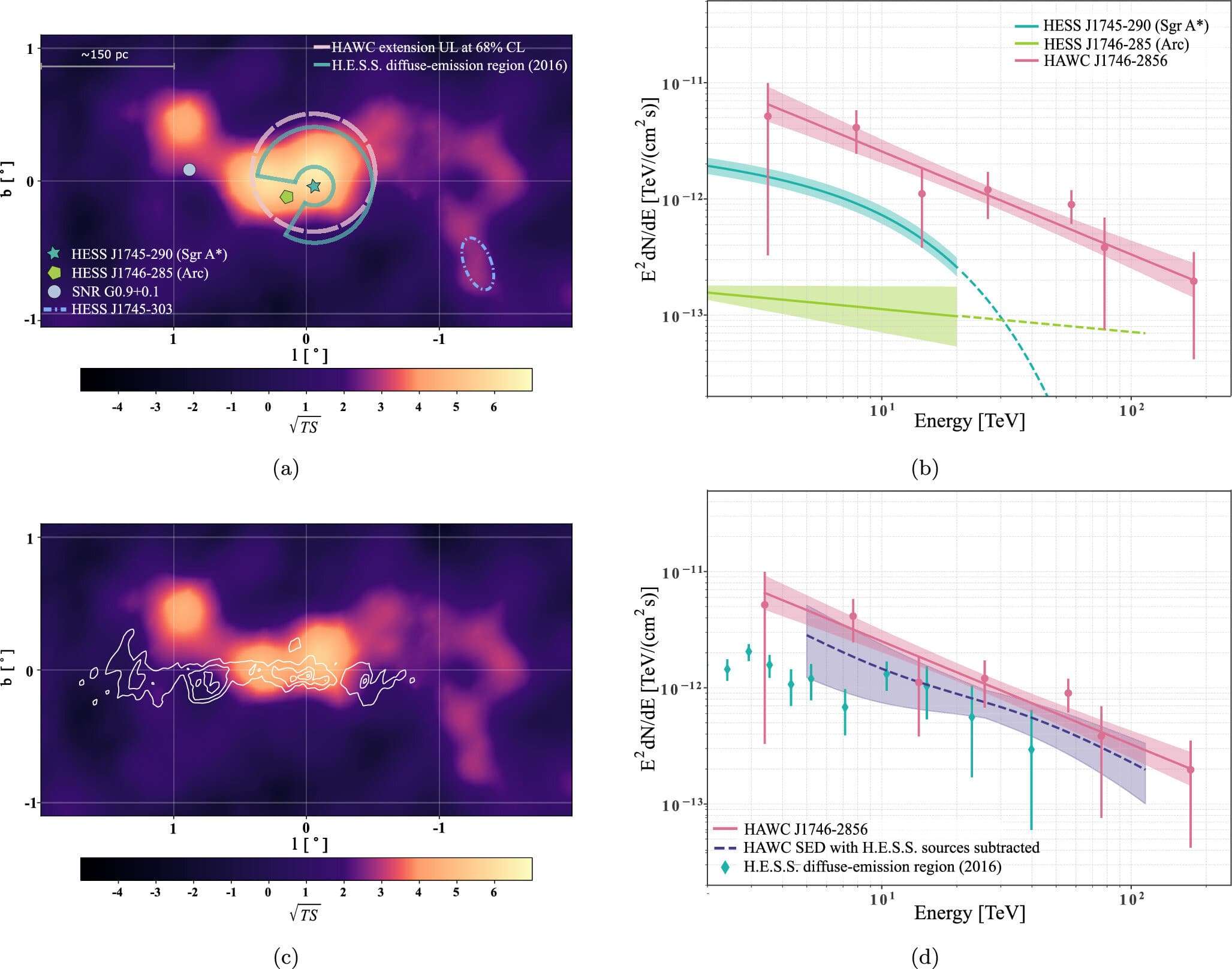
Intense Activity in the Milky Way’s Central Region
The Galactic Center of the Milky Way hosts the supermassive black hole Sagittarius A*, yet this focal point remains relatively calm. In contrast, the surrounding environment brims with vigorous action, featuring neutron stars, remnants of supernovae, and dense gas clouds that stimulate a tumultuous cosmic realm. Because this area is heavily shrouded by gas and dust, traditional visible light observations are limited, making gamma-ray data essential in uncovering the extraordinary phenomena at play.
Thanks to the HAWC observatory, detecting these ultrahigh-energy gamma rays marks a milestone in revealing this turbulent locale. The study, which analyzed 98 gamma-ray occurrences over seven years, was published in The Astrophysical Journal Letters. This work presents the first confirmation of a PeVatron within the Galactic Center Ridge, offering a clearer understanding of how such formidable particles are produced.
Next Steps in Studying PeVatrons’ Mysteries
Although the discovery of ultrahigh-energy gamma rays within our galaxy’s center is remarkable, many aspects of PeVatrons remain elusive. While theoretical models suggest their existence, the mechanisms behind their acceleration processes require further exploration. The presence of such energetic particle accelerators inside the Milky Way, typically linked with more distant or massive galaxies, presents an intriguing surprise.
Future investigations will focus on pinpointing the precise sources of the gamma rays and expanding observations. The upcoming Southern Wide-field Gamma-ray Observatory (SWGO), currently under construction in Chile’s Atacama Desert, promises to enhance these efforts by detecting a broader spectrum of gamma ray emissions. The goal is to deepen knowledge about PeVatrons’ role in galactic dynamics and evolution.
Sohyoun Yu-Cárcamo, the lead physicist on the study, remarked on the discovery’s significance by noting elevated cosmic ray densities compared to the galactic average in this center portion, implying an active accelerator of fresh protons. Continuing to examine these dynamics will illuminate how galaxies like the Milky Way develop and generate some of the universe’s most potent forces.
Impacts on Astronomy and Particle Physics
Capturing such extremely energetic gamma rays has wide-ranging consequences for both the fields of astronomy and particle physics, expanding the comprehension of fundamental cosmic forces. As the most energetic electromagnetic radiation, gamma rays provide a critical window into the mechanisms behind particle acceleration in space. These findings may influence future space exploration missions by enhancing awareness of the hazards posed by cosmic rays and energetic particles to astronauts and spacecraft, especially beyond the shielding bounds of Earth’s magnetosphere.
Confirming a PeVatron within the Milky Way advances the quest to unravel how particles achieve extraordinary energies and how such energetic phenomena influence galactic growth and transformation.
- Categories:
- Astronomy ,
- News






0 comments
Sign in to Comment