

Researchers have identified hydrogen sulfide within the atmosphere of the exoplanet HD 189733b, marking the inaugural detection of this compound beyond the confines of our solar system.
This finding sheds fresh light on the chemical structure of exoplanet atmospheres and highlights sulfur's significance in planetary development.
Presence of Rotten Egg Scent Confirmed on Remote Exoplanet
The exoplanet HD 189733b, infamous for its tempestuous weather including glass precipitation and ferocious winds, has revealed another remarkable attribute: traces of hydrogen sulfide, a gas known for its pungent sulfur odor reminiscent of rotten eggs. This molecule was observed through cutting-edge infrared technology, empowering astronomers to detect atmospheric substances previously beyond reach.


The study, spearheaded by Guangwei Fu from Johns Hopkins University, marks a pivotal progression in characterizing the chemistry of gas giants outside our solar system. Fu remarked, “Hydrogen sulfide is a significant molecule we previously hadn't detected. We anticipated its presence since it's found in Jupiter, but detecting it beyond our solar system is groundbreaking.”
About HD 189733b and the Observation Mission
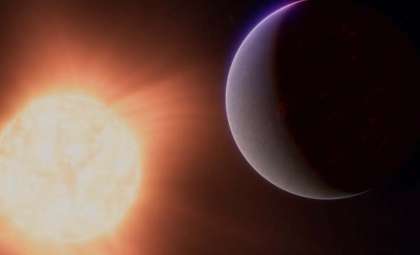
HD 189733b is classified as a “hot Jupiter,” a gas giant akin to Jupiter but subject to intense heat due to its close orbit around its star. Situated roughly 64 light-years away in the Vulpecula constellation, the planet completes its orbit at a mere 3 million miles from its star in just over two Earth days.
Conditions on HD 189733b are extreme, with temperatures around 1,700 degrees Fahrenheit (927 degrees Celsius) and winds reaching speeds up to 5,000 miles per hour (8,046 kilometers per hour). The planet is tidally locked, with one hemisphere perpetually exposed to starlight and intense heat, while the other endures the darkness and cold of space.
The JWST’s detailed observations uncovered not only hydrogen sulfide but also water vapor, carbon dioxide, and carbon monoxide in the atmosphere. These discoveries hint that such molecules may be widespread among other gas giant exoplanets. Fu explained, “Hydrogen sulfide is a principal sulfur reservoir in planetary atmospheres. The Webb telescope's enhanced precision and infrared capabilities have allowed us to identify hydrogen sulfide on exoplanets for the first time, unlocking new avenues to explore sulfur chemistry in distant atmospheres.”
Implications for Understanding Planetary Formation
Spotting hydrogen sulfide on HD 189733b is a crucial step forward in exoplanet research. Sulfur is essential for constructing more complex compounds, offering valuable hints about planetary formation and development. Tracking sulfur and other atmospheric elements on exoplanets helps scientists unveil their histories and evolutionary paths.
Fu stressed the importance of sulfur in the makeup of planetary atmospheres, commenting, “Just like carbon, nitrogen, oxygen, and phosphate, sulfur is fundamental for synthesizing complex molecules, so studying it more thoroughly is key to understanding planet formation and composition.”
Data from JWST not only enriches knowledge of HD 189733b but also lays groundwork for examining sulfur in other exoplanet atmospheres. Researchers intend to utilize the telescope to detect sulfur on more exoplanets and analyze how its abundance changes with star distance. Fu highlighted the broader impact, saying, “By investigating atmospheric compositions, we aim to comprehend how these planets arrived at their current locations.”
This breakthrough highlights the transformative impact of the JWST on exoplanet science, opening the door to more detailed analyses of alien worlds. Each new discovery advances our quest to decode the mysteries of planetary origins and the variety of planetary systems spread throughout our galaxy.
- Categories:
- Astronomy ,
- News ,
- Space ,
- Physics







0 comments
Sign in to Comment