

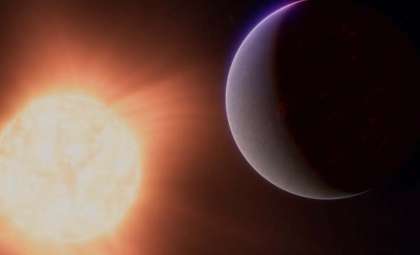
The James Webb Space Telescope (JWST) has unveiled sulfur dioxide (SO) within the atmosphere of the distant exoplanet GJ 3470b, challenging prevailing theories about planetary atmospheres and their development.
Situated roughly 96 light-years away, GJ 3470b is classified as a “hot Neptune,” orbiting a cool red dwarf star every 3.3 days. This groundbreaking detection opens new avenues for investigating atmospheric compositions on exoplanets and offers fresh insights into how such planets form.
The identification of sulfur dioxide—a molecule rare in smaller, cooler planets—introduces a novel aspect to the study of planetary atmospheres, encouraging scientists to update existing models of chemical processes and planet formation.

Sulfur Dioxide Detection in GJ 3470b’s Atmosphere
The discovery of sulfur dioxide in GJ 3470b’s atmosphere caught astronomers off guard. This compound is typically associated with much larger and hotter exoplanets, such as hot Jupiters, making its presence here highly unusual.

Thomas Beatty, a researcher at the University of Wisconsin, Madison, who led the investigation, highlighted the discovery’s importance: “We didn’t expect to detect sulfur dioxide on planets this small; this finding gives us a new perspective on how such planets form.”
This revelation offers a fresh understanding of the atmospheric composition and evolutionary history of smaller exoplanets, indicating that their chemical environments and formation mechanisms are more intricate than previously believed.
Utilizing JWST’s advanced transmission spectroscopy, astronomers observed the starlight filtering through the planet’s atmosphere, which revealed the unique absorption features corresponding to sulfur dioxide.
Distinctive Orbital Features
GJ 3470b is notable for its unusual orbit, which lies at an extreme inclination angle of 89 degrees relative to its star’s rotational axis—essentially passing over the star’s poles instead of orbiting along the equatorial plane as is common.
This rare orbital tilt hints at a chaotic past that might involve gravitational influences from neighboring planets or even a close stellar encounter. Such dynamics are uncommon and deepen the mystery surrounding GJ 3470b’s origins.
Planets generally form within the stable, flat plane of a star’s protoplanetary disk; thus, this steep orbit suggests intense gravitational interactions shaped the planet’s trajectory.
These interactions could involve close planetary flybys or a passing star’s perturbations, both of which could dramatically shift the orbital alignment and provide crucial information for refining models of planetary system evolution.
Atmospheric Makeup and Formation Insights
The atmosphere of GJ 3470b is primarily hydrogen and helium, which is peculiar compared to gas giants in our solar system. Earlier observations from the Hubble Space Telescope revealed a heavier presence of these light elements than expected.
The JWST’s identification of sulfur dioxide along with other molecules such as carbon dioxide, methane, and water vapor sheds light on the planet's developmental history. Researchers propose that GJ 3470b may have initially formed closer to its star as a rocky core before acquiring a substantial hydrogen-helium envelope.
This idea departs from the conventional understanding that gas giants form farther from their stars before migrating inward and is supported by the planet’s close orbit—only 5.3 million kilometers from its star, much nearer than Mercury’s distance from the Sun.
The atmospheric composition, rich in hydrogen, helium, and unexpectedly elevated sulfur dioxide, points to complex chemical reactions influencing the planet’s evolution.
Significance of Sulfur Dioxide’s Presence
The sulfur dioxide detected could be the result of ultraviolet radiation from the host star breaking down hydrogen sulfide molecules, freeing sulfur atoms to bond with oxygen and form SO.
The concentration of sulfur dioxide—around one million times greater than theorized—indicates active and intricate chemical pathways. This finding enhances comprehension of planetary atmospheres and helps distinguish between competing formation hypotheses.
Such elevated levels suggest photochemical reactions are more vigorous than predicted, likely fueled by the planet’s proximity to its star, providing sufficient energy. Moreover, the atmosphere’s high metallicity—approximately 100 times greater than that observed on WASP-39b—facilitates sulfur dioxide synthesis at lower temperatures.
- Categories:
- Astronomy ,
- News ,
- Space










0 comments
Sign in to Comment