
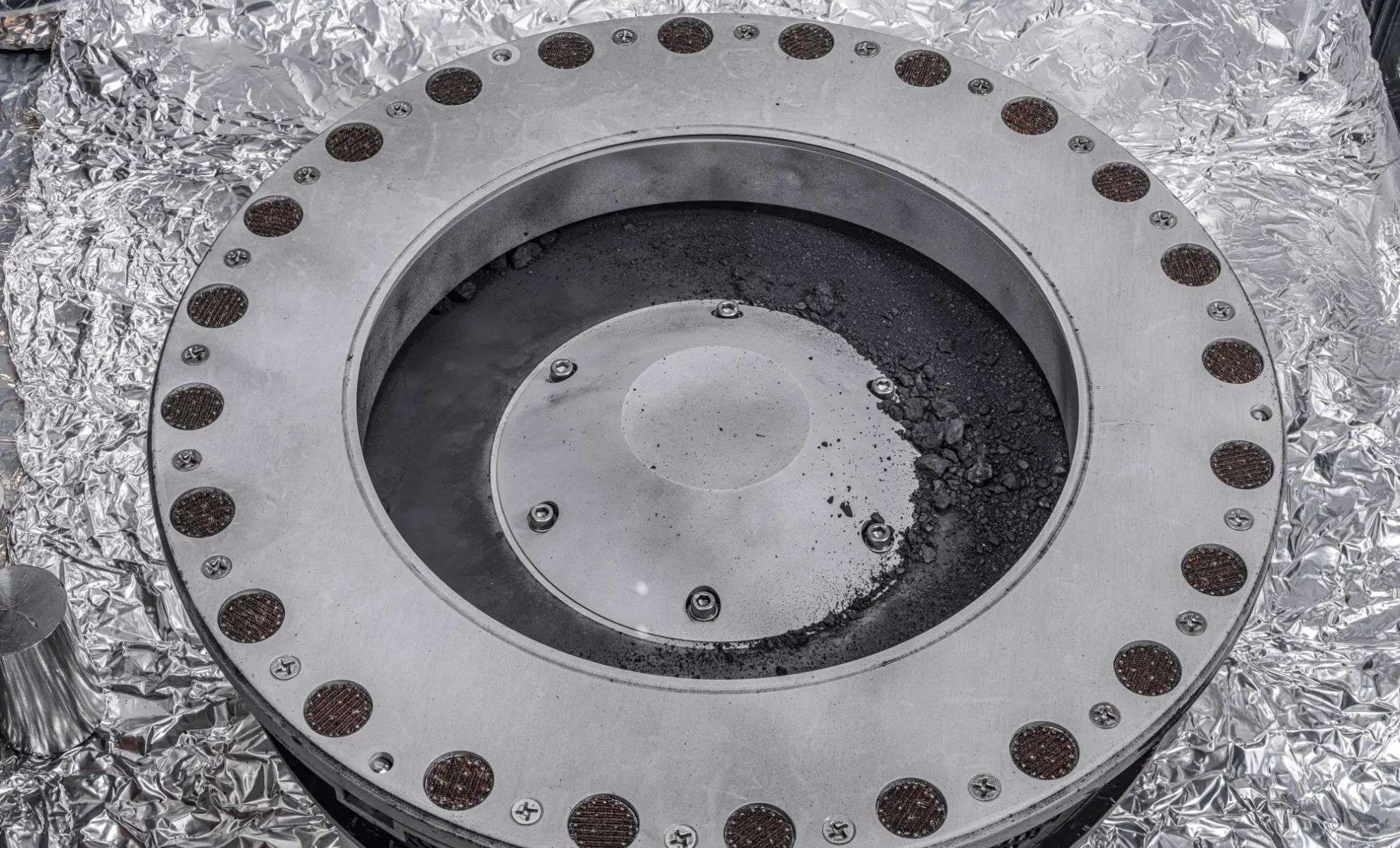
NASA’s OSIRIS-REx mission has achieved a remarkable breakthrough by detecting organic molecules and intricate carbon-based compounds in material retrieved from the ancient asteroid Bennu. This 4.5-billion-year-old celestial body, a remnant from our solar system’s infancy, holds vital clues potentially linked to the emergence of life on Earth.
This finding lends strong support to the long-standing hypothesis that asteroids and comets may have transported life’s essential components to Earth billions of years ago. Samples collected in 2020 and brought back in September 2023 reveal a diverse array of carbon, nitrogen, and water-containing minerals. These substances closely resemble those found in primitive meteorites that have impacted our planet, reinforcing the idea that life’s precursors might have originated in space before settling into hospitable environments.
The NASA research team’s detailed examination of Bennu’s samples indicates that its parent body—a once-existing planetesimal—experienced chemical processes similar to those believed to have taken place in Earth’s primordial oceans. While this does not prove that extraterrestrial life existed there, it significantly broadens our understanding of where biological molecules may have formed in the cosmos.

Advancing Our Grasp of Life’s Formation
For years, scientists have proposed that fundamental life-building ingredients—like amino acids, water-rich minerals, and organic chemicals—could have been synthesized in space and delivered to Earth via asteroids and comets. The OSIRIS-REx sample from Bennu now provides some of the most compelling evidence favoring this hypothesis.
“The data from Bennu demonstrate that the raw ingredients of life were interacting in complex and fascinating ways on the asteroid’s original parent body,” explained Tim McCoy, the study’s co-lead and meteorite curator at the Smithsonian’s National Museum of Natural History. “This marks a significant step forward along the path toward life.”
The sample showcases a unique array of organic molecules, indicating that prebiotic chemistry—chemical reactions that may have led to life—was underway on the ancient body from which Bennu originated. While these findings stop short of confirming life on Bennu, they offer strong evidence that the conditions necessary for biological chemistry were present.
Yet many questions remain unanswered. “We recognize that the essential components for life’s emergence exist here, but how far these processes advanced is still unknown,” McCoy added. Future research will focus on uncovering whether these molecules could have developed into self-replicating systems, the foundation of living organisms.
Highlights from the Bennu Sample Analysis
NASA’s preliminary investigation of the asteroid’s material has uncovered crucial revelations about early solar system chemistry.
Of particular note is the discovery of water-infused minerals, implying Bennu’s ancestor once harbored liquid water—crucial for fostering life. Although no actual organisms were found, the intricate chemistry observed reinforces the possibility that this environment supported early biochemical evolution.
Significance of This Discovery
Bennu’s sample represents the most uncontaminated extraterrestrial specimen ever retrieved, enabling researchers to study it free from the Earth-based alterations typical of meteorites entering our atmosphere. This pristine status preserves its original chemical signature dating back billions of years.
Studying Bennu’s composition offers a direct glimpse into early solar system conditions, shedding light on how life’s building blocks might have been widespread and possibly transported to developing planets. The carbon-rich organics and water-related minerals strongly suggest these ingredients were common across the early solar system.
Beyond Earth, these insights hint that comparable organic chemistry could be ongoing on other worlds with liquid water, such as Mars, Europa, and Enceladus. If asteroids like Bennu delivered critical materials to Earth, they might have contributed similarly elsewhere, raising prospects for life in diverse cosmic locales.
The Road Ahead for Asteroid Research
The OSIRIS-REx mission’s success paves the way for more asteroid sample-return projects, which enable scientists to analyze space rock chemistry directly, eliminating uncertainties caused by atmospheric entry.
NASA plans to explore Asteroid Apophis next, which will pass remarkably close to Earth in 2029—nearer than many of our satellites. The OSIRIS-APEX mission will perform detailed studies of Apophis’s makeup, offering another exceptional chance to deepen our understanding of asteroid chemistry.
Meanwhile, Bennu’s samples will continue to be scrutinized for years through advanced techniques designed to decode their secrets. This research will enhance our knowledge of how life may have originated, potentially not just on Earth but across the cosmos, by studying these intriguing space rocks.
Have We Edge Closer to Deciphering Life’s Origin Story?
NASA’s epochal asteroid samples from Bennu stand as more than a scientific breakthrough—they represent a pivotal moment in our quest to comprehend humanity’s cosmic origins. The detection of complex organics, water-bearing minerals, and amino acid analogues implies that life’s key ingredients were present well before Earth itself formed.
Though this does not prove extraterrestrial life, it offers persuasive evidence that early solar system chemistry was ripe with the components essential for life’s development. As studies advance, scientists aim to tackle profound questions:
- Did asteroids spark life’s beginnings on Earth?
- Could similar chemical processes exist on exoplanets or icy moons?
- Are we alone in the grand universe?
The OSIRIS-REx mission has granted an invaluable window into our solar system’s distant past, potentially unlocking the secrets behind the emergence of life.
- Categories:
- News











0 comments
Sign in to Comment