
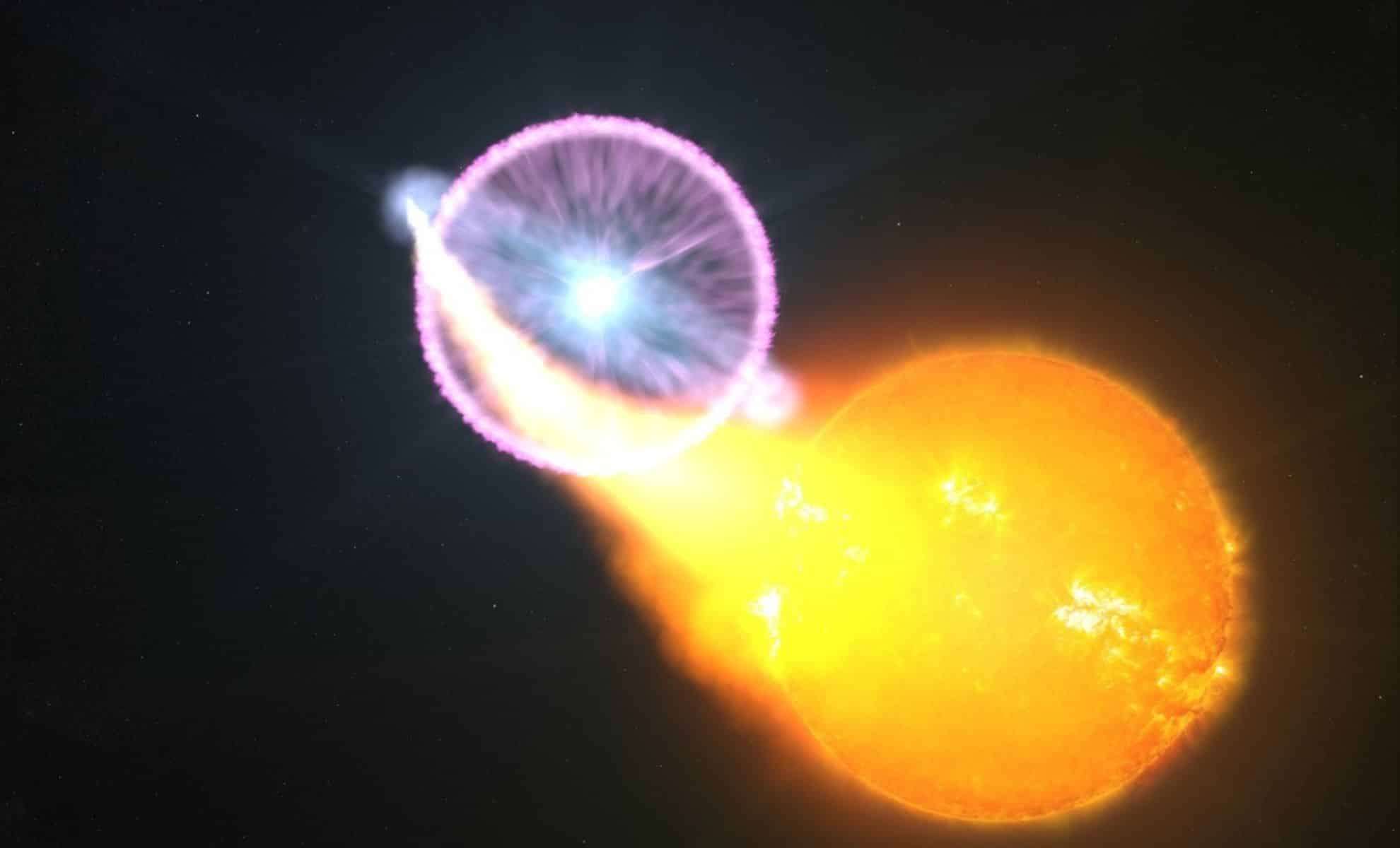
A dazzling new star is predicted to brighten the night sky soon, emerging from a cosmic blast that began around 3,000 years ago.
This star, designated as T. Coronae Borealis (T CrB), belongs to a recurrent nova system, where its next eruption could rival the brightness of the North Star for a short duration. Such appearances are exceptional events for both astronomers and skywatchers alike, with previous outbursts documented in 1866 and 1946, along with records dating back to the Middle Ages.
What Sparks T CrB’s Explosive Outbursts?
T CrB is a binary star pair, consisting of a white dwarf and a red giant gravitationally bound. The white dwarf slowly siphons hydrogen gas from its giant companion, which accumulates on its surface until a thermonuclear blast ignites – a process known as a nova. These flares can make the white dwarf shine extraordinarily bright, resembling a newly appearing star in the sky.

Edward Sion, an astrophysicist at Villanova University, likens the phenomenon to “an almost perfect cosmic storm.” As hydrogen builds, the white dwarf’s temperature exceeds 180,000 degrees Fahrenheit. When conditions trigger the explosion, the flare can be seen across vast distances. NASA characterizes this energy released as over 10 times the Sun’s annual output.
T CrB’s dramatic outbursts are cyclical, occurring roughly every 80 years. Historical accounts date back to 1217 when a German cleric first described a “dim star that suddenly shone brightly.” Sion points out that T CrB’s pattern of eruptions makes it a predictable recurrent nova system.
When and Where to Spot This Upcoming Nova
The exact moment of T CrB’s next explosion remains uncertain, but astronomers anticipate it could ignite within this month or later in the winter season. The nova will appear near the constellation Corona Borealis, just east of the prominent star Arcturus. Its visible glow is expected to last only about a week, offering a narrow viewing window.
NASA researcher Rebekah Hounsell describes the event as “a once-in-a-lifetime sight that will inspire many new astronomers.” With brightness similar to the North Star, the nova should be visible to the naked eye from numerous locations, even those impacted by some light pollution. However, after this brief flare, the star won’t erupt again until the early 22nd century.
Viewing success will depend on weather conditions and local light interference, but clear skies may reveal a spectacular show. Though affordable optical aids like binoculars can enhance details, the nova’s luminosity should be sufficient for unaided observation.
A Harmless but Rare Phenomenon
Despite its glowing intensity, this nova poses no risk to Earth. Located approximately 3,000 light-years away, T CrB’s explosion light has traveled millennia to reach us, originating around the era of King David. Edward Sion emphasizes how, from a cosmic perspective, this eruption counts as “breaking news.”
While this astronomical spectacle excites scientists, the considerable distance ensures no danger to our planet. Instead, it offers a unique chance to observe the underlying dynamics of a nova event in real time, providing vital insights into how such stellar explosions unfold.
The outburst results from the white dwarf accumulating mass from the red giant companion until it reaches a tipping point. As Sion humorously remarks, “Every 80 years, the white dwarf says, ‘I’ve got enough mass now! Time to explode!’”
Could T CrB Trigger a Supernova in the Future?
Although T CrB’s nova eruptions impress, astrophysicists speculate the white dwarf might eventually trigger an even grander event—a Type Ia supernova. Unlike a nova’s brief flare, a supernova represents the catastrophic end of the white dwarf’s existence, unleashing a vast and lasting explosion.
A Type Ia supernova shines roughly 100,000 times brighter than the Sun and, despite T CrB’s distance of 3,000 light-years, would be visible from Earth as an extraordinary cosmic spectacle. Edward Sion suggests this cataclysmic finale may occur in the far future; meanwhile, the coming nova remains harmless to us.
Each nova outburst enriches our comprehension of stellar life cycles and the complex relationships within binary star systems. These dramatic events reveal how stars live, burn, and die, shedding light on the astonishing mechanisms that shape our universe.
An Exceptional Moment for Both Stargazers and Researchers
T CrB’s forthcoming eruption provides an exciting visual display for sky enthusiasts and a rare scientific observation opportunity. As NASA’s Rebekah Hounsell commented, this is “a singular chance” for the public to observe a star’s explosive activity as it happens. For the scientific community, it represents valuable data about the mechanics of binary systems and recurrent novae.
This transient nova promises to be one of the brightest celestial phenomena visible soon. Whether you are an expert astronomer or simply enjoy the night sky, T CrB’s upcoming appearance is a rare cosmic event well worth your attention in the coming weeks.
- Categories:
- Astronomy ,
- News ,
- Space ,
- Nasa








0 comments
Sign in to Comment