
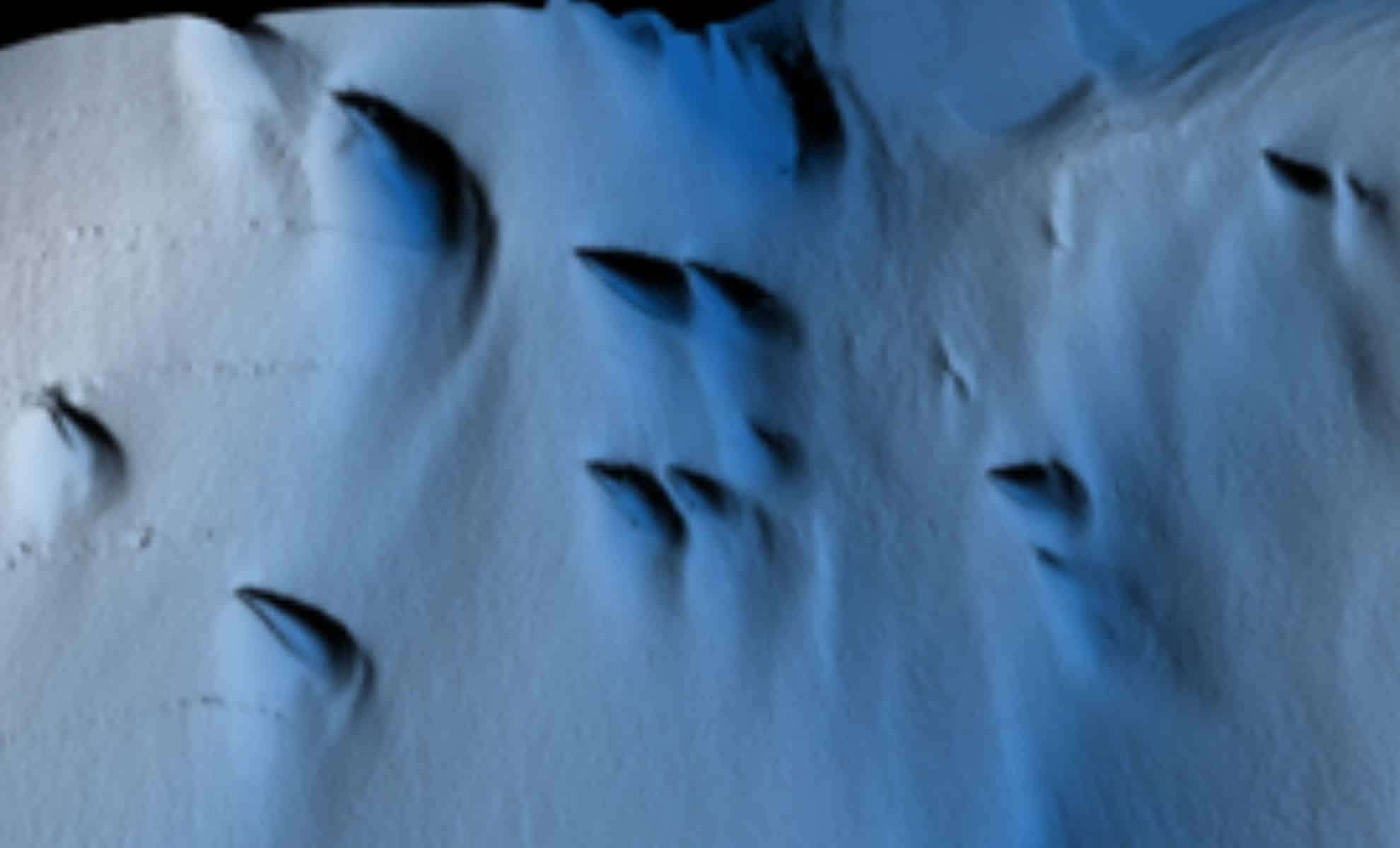
Recent fieldwork at the Dotson Ice Shelf in West Antarctica has unveiled previously unknown formations beneath the ice surface.
Using cutting-edge underwater mapping tools, researchers have gained fresh insights into how Antarctica’s ice shelves melt, shedding light on glacier erosion and their implications for rising sea levels.
Exploring the Hidden Base of the Ice Shelf
A team of scientists from the University of Gothenburg and the University of East Anglia embarked on a mission to chart the underside of the Dotson Ice Shelf. Equipped with the remotely operated vehicle (ROV) “Ran,” they completed an extensive survey covering over 600 miles (1,000 kilometers) and diving to depths of 1,150 feet (350 meters). Their goal was to produce the most detailed maps ever made of the glacier’s base.

“To fully grasp Antarctica’s ice cycle and how land ice transfers to the ocean, it is crucial to study melting from below, a process as vital as calving in transporting ice from land to sea,” explained Anna Wåhlin, an oceanography professor at the University of Gothenburg.
Revealing Unexpected Under-Ice Structures
The expedition uncovered distinctive teardrop-shaped features reaching lengths of up to 1,300 feet (400 meters) on the glacier’s underside. Rather than being smooth, the ice surface was marked by peaks and troughs. Scientists attribute these irregular patterns to uneven melting driven by water flows affected by the Earth’s rotation.
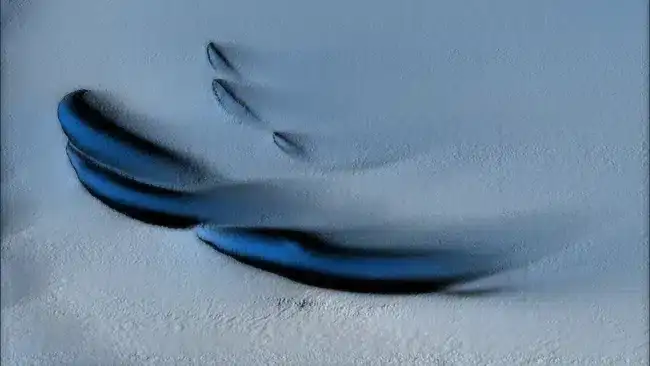
“These formations aren’t symmetrical; they curve similarly to blue mussels. This asymmetry stems from the Coriolis force, which deflects fluid motion to the left in the Southern Hemisphere,” Wåhlin added. “Within the thin layer closest to the ice, friction balances the Coriolis force, influencing water movement and melting patterns.”
Innovative Mapping Techniques Informing Climate Science
The team employed advanced multibeam sonar technology to produce high-resolution imagery of the ice’s underside, revealing how underwater currents accelerate melting at specific points. Cracks in the glacier help meltwater rise, further altering the ice structure.
“While satellite observations and ice core studies offer long-term perspectives, exploring the area beneath the ice shelf with the ROV has provided unprecedented detail—it’s like seeing the moon’s hidden side for the first time,” Wåhlin remarked.
Implications for Sea Level Rise Predictions
Understanding how ice shelves melt from below is vital to anticipating future sea level changes. While melting floating ice shelves doesn’t raise sea levels directly, it compromises the glaciers inland, speeding their flow into the ocean and contributing to sea level rise.
Professor Karen Heywood from the University of East Anglia stressed the significance of these findings: “Though ice shelves float and their melting alone doesn’t raise sea levels, this process triggers glacier acceleration upstream, which does increase sea levels.”
Overcoming Obstacles and Advancing Research
The research team's January 2024 expedition faced difficulties when the ROV was lost beneath the ice after just one dive. Despite this loss, the collected data remain invaluable, and scientists are preparing new equipment for continued exploration.
“Our mapping results indicate many prior assumptions about glacier melting underneath are incomplete. Current models fail to explain the intricate patterns observed. This method gives us a stronger foundation to uncover the mechanisms at work,” Wåhlin said.
Published in Science Advances, the study calls for improved predictive models of ice shelf melting to better assess global sea level risks. Integrating remote sensing data with oceanographic measurements will deepen scientists’ understanding of these critical Arctic transformations.
- Categories:
- News ,
- Science ,
- Climate change







0 comments
Sign in to Comment