

Emerging studies indicate that Titan, Saturn’s largest moon, could harbor complex organic processes capable of generating protocell-like formations. This exciting hypothesis, detailed in a paper from the International Journal of Astrobiology, outlines how simple molecules might interact within Titan’s frigid atmosphere and hydrocarbon lakes to create vesicle structures resembling the earliest forms of cellular organization.
Understanding Titan’s Unique Chemical Landscape
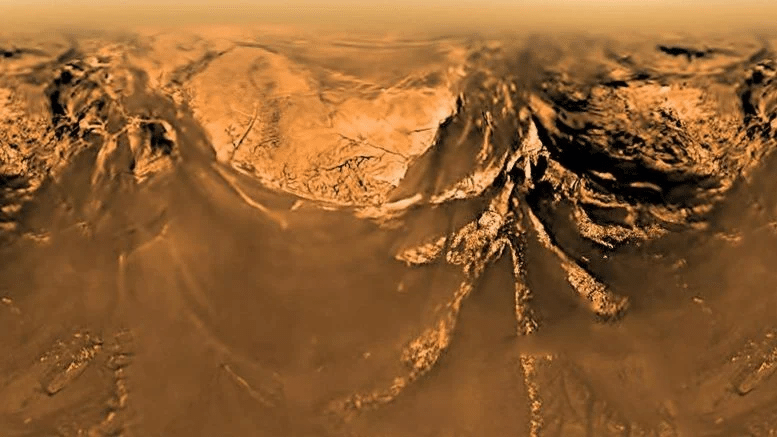
Titan, Saturn’s prominent satellite, offers a distinct environment to explore prebiotic chemistry. It features surface reservoirs of liquid methane and ethane, alongside a dense, nitrogen-rich atmosphere rich in complex organic compounds. With surface temperatures averaging near -179°C (-290°F), chemical reactions slow considerably but maintain stable interactions that would not endure under Earth-like conditions.
The interplay of cryogenic hydrocarbon seas, organic-rich terrain, and constant energy inputs from sunlight and Saturn’s magnetosphere presents an intriguing natural setting for molecules to self-organize. Titan effectively acts as an extraterrestrial laboratory for early chemical processes potentially leading to life forms that may differ fundamentally from terrestrial biology.

Formation of Protocell Analogues on Titan
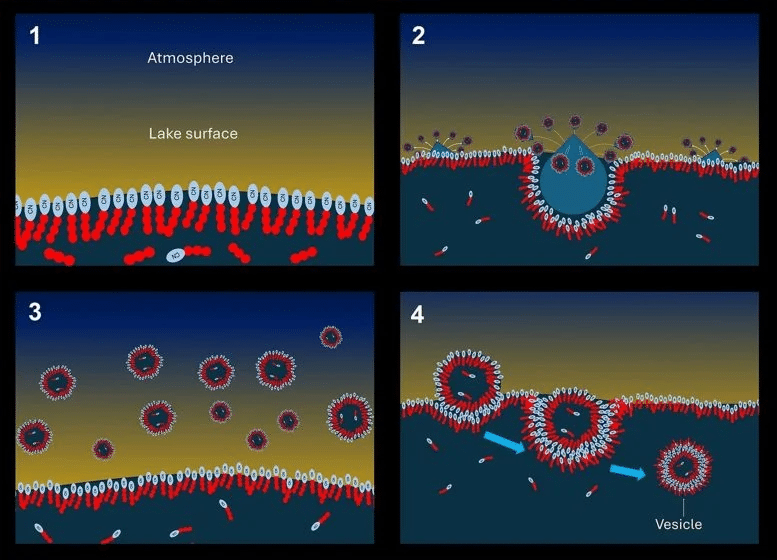
Researchers suggest that Titan’s environment could foster the spontaneous generation of vesicles—tiny spherical structures capable of encapsulating chemical reactions. These vesicles mirror protocells, which are believed to be vital precursors to modern living cells, by maintaining separate, controlled internal conditions.
“Detecting vesicle-like structures on Titan would signal an increase in molecular order and complexity—key prerequisites for life’s origins,” states Conor Nixon from NASA’s Goddard Space Flight Center in Maryland. “Such discoveries could revolutionize our approach to investigating Titan and inform future strategies for detecting life there.”
If verified, these vesicles might represent initial steps toward molecular self-organization under Titan’s harsh conditions, suggesting a life-forming pathway independent from water-based chemistry.
Broader Impact on the Quest for Alien Life
This research expands the realm of possible habitats beyond traditional water-dependent environments. Titan challenges the conventional view by showing that methane and ethane may act as viable solvents facilitating complex organic chemistry.
Upcoming explorations like NASA’s Dragonfly mission could provide direct evidence by sampling Titan’s surface and atmosphere, searching for vesicles and traces of intricate organic molecules. Confirming protocell-like structures there would redefine habitable zone criteria and revolutionize astrobiological exploration techniques.
Scientific Hurdles and Opportunities Ahead
Despite promising theories, researchers recognize significant obstacles. Titan’s extreme cold slows chemical processes and its hydrocarbon chemistry deviates markedly from water-based systems. Validating vesicle presence demands advanced in situ tools capable of differentiating these structures from basic molecular clusters.
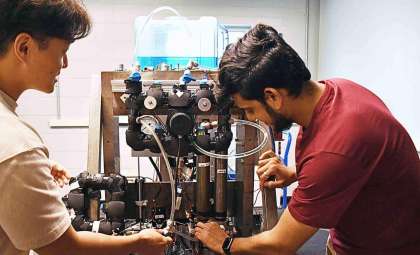
Nevertheless, Earth-based lab experiments simulating Titan’s environment have successfully produced complex vesicle-like assemblies in cryogenic hydrocarbon mixtures. These results, coupled with data from ongoing observations, herald a new chapter in astrobiology that embraces chemical diversity beyond Earth’s norms.
- Categories:
- News




0 comments
Sign in to Comment